
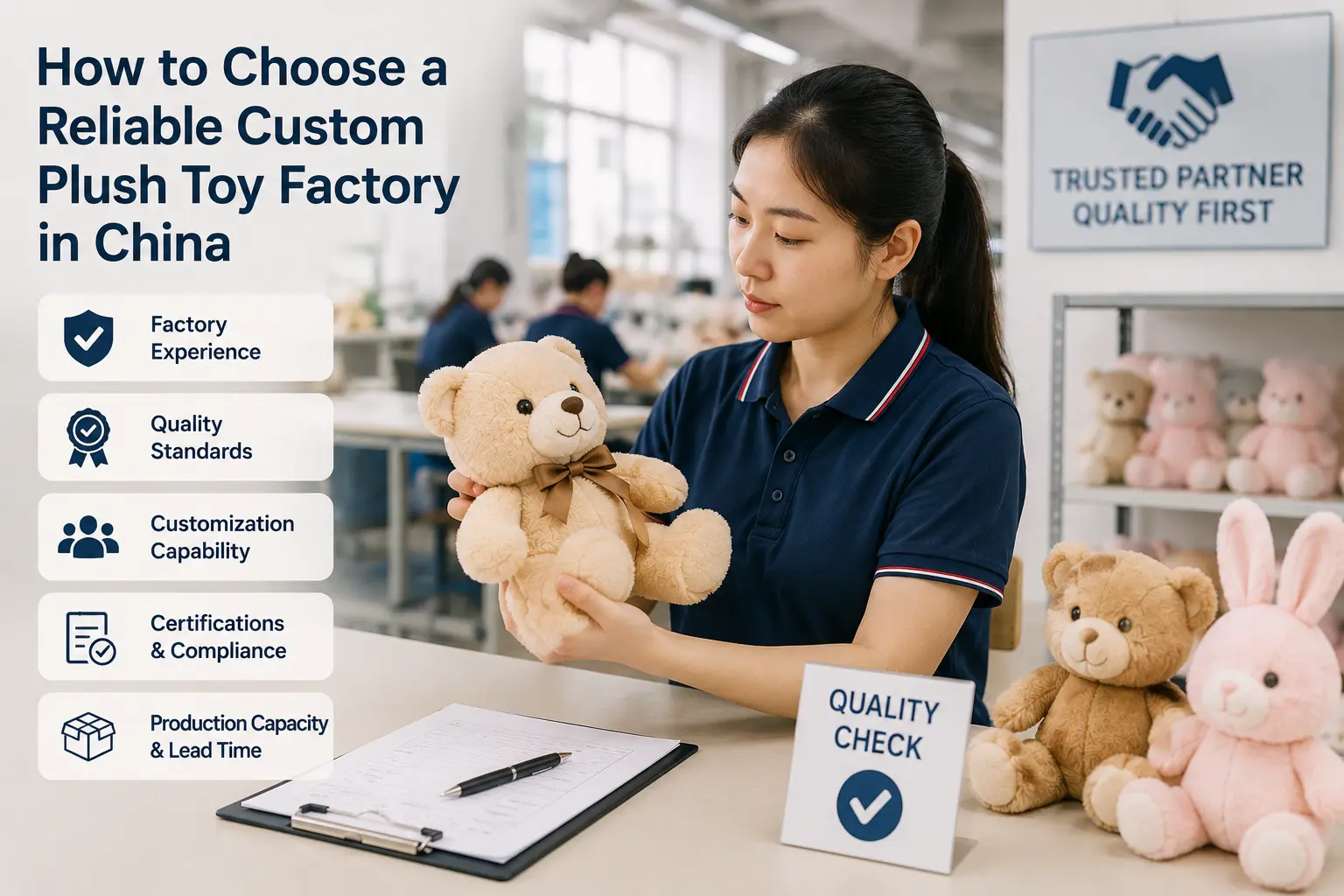
To choose a reliable plush toy factory in China, start by confirming it’s a direct manufacturer, not a trading agent. Check current ASTM F963 or EN71 reports and a social-compliance audit. Require a paid pre-production sample. Then check capacity and references. The Guangdong cluster, and Dongguan in particular, holds the most experienced plush factories.
China still makes most of the world’s plush toys. The reasons aren’t a mystery. Decades of skill. A supply chain packed into a few square miles. Capacity no other region quite matches yet. The catch is that “made in China” covers a huge spread. World-class facilities sit at one end. Workshops that vanish the week after they cash your deposit sit at the other. I’ve spent about ten years sourcing on the ground there. One lesson stands out. Whether an order goes well or goes sideways is almost always decided before any money moves. So here’s the playbook I actually use.
Where Plush Is Made: China’s Factory Clusters
Manufacturing in China is regional. Knowing the map saves you a lot of guesswork on skill and price. Plush work clusters in a few places. Each one has its own personality. Some lean premium and export-savvy. Others are built for sheer volume.
| Region | Reputation | おすすめ |
| Dongguan (Guangdong) | Premium, export-experienced | Licensed & complex plush |
| Yangzhou (Jiangsu) | ‘Toy capital’, huge capacity | Bulk stuffed animals |
| Shenzhen area | Tech-integrated, fast | Plush with electronics/sound |
| Other inland | Lower cost, variable QC | Price-sensitive simple items |
A Dongguan plush toy factory with real export history usually gets Western compliance faster. It handles the back-and-forth better too. For a first international order, that fluency is often worth the small premium.
Direct Manufacturer or Trading Agent? Verify First
This is the check almost everyone skips. It’s also the most important. Plenty of “manufacturers” are really trading companies. They take your order, add a cut, and farm the work to a factory you’ll never see. Then they drop out of the quality conversation the moment something breaks. We dig into the money side in our plush toy supplier vs. manufacturer comparison. The field tests are simple enough to run in an afternoon.
- Ask for a live walk-through. A real factory just does it. An agent finds reasons to stall.
- Read the business license. The scope should say manufacturing. The address should match the video.
- Check whose name is on the reports. Test reports should be in the factory’s own name, not passed through from someone else.
The Compliance & Audit Checklist
Reliability shows up on paper. It isn’t something a salesperson promises on a call. Before you commit, gather the documents below and actually verify them. When a factory says “we can pass any test,” treat it as a warning, not a comfort. You want the originals in hand.
- Product safety reports. Current ASTM F963 and EN71 certificates for the same materials you’re ordering.
- Social-compliance audit. Sedex, BSCI, or ISO 9001. It shows the place is run systematically.
- QC methodology. A defined AQL inspection standard. Our 品質管理 page shows what that looks like.
- Factory references. Two current B2B clients you can genuinely call.
Red Flags That Should End the Conversation
Some warning signs are worth walking away over on the spot. I’ve learned each one the expensive way, so you don’t have to.
- A price far below every other quote. It usually hides cut corners, or it’s a bait number that climbs later.
- A refusal to provide a paid sample or to be seen on video.
- Missing compliance documents, or reports that don’t match the product.
- Vagueness about capacity, ownership, or references.
- Pressure to skip the sample and go straight to bulk. Save the week, lose the run.
The Vetting Scorecard: Rate Every Factory the Same Way
Gut feeling is a lousy sourcing strategy. Score each candidate against the same criteria and the right partner tends to reveal itself on paper. Here’s the scorecard I keep open. Adjust the weights to fit your priorities. Just hold the line on comparing like for like.
| 基準 | What ‘Strong’ Looks Like | Weight | Deal-Breaker If… |
| Direct manufacturer | Owns lines, offers video walk-through | High | Blocks factory access |
| Safety compliance | Current ASTM F963 / EN71 reports | High | No original documents |
| Social audit | Sedex / BSCI / ISO 9001 on file | 中 | No audit history |
| Sampling policy | Paid, credited pre-production sample | High | Pushes straight to bulk |
| 容量 | Clear monthly output & line count | 中 | Vague or evasive |
| 参考文献 | Two contactable B2B clients | 中 | Cannot name one |
| コミュニケーション | Fast, detailed, documented | 中 | Slow or inconsistent |
One deal-breaker ends it. It doesn’t matter how strong the rest of the row looks. A factory that nails price and speed but hides its compliance file isn’t a bargain. It’s a liability in disguise. Check any testing claim against our ぬいぐるみの安全基準ガイド before you believe it.
Protecting Your First Payment
Passing the vetting is step one. Structuring the deal so your money is safe is step two. Reputable manufacturers won’t blink at any of this. Pushback here is its own red flag.
- Pay in stages. A deposit to start, commonly 30 percent, and the balance before or against shipping. Never the full amount upfront.
- Sample before bulk. Tie the balance to an approved ゴールデン・サンプル and a passing inspection.
- Use a traceable transfer. Pay the registered company account on the license, not a personal one.
- Get it in writing. A proforma invoice with specs, quantity, price, Incoterms, and dates, through a clear 注文手続き.
Communication & Terms: The Quiet Reliability Test
How a factory answers you before you’ve paid a cent is the best preview you’ll get. Fast, straight answers now usually mean the same when a batch slips later. Silence now means silence then. Pin down the basics early.
- MOQ and pricing tiers. Confirm they fit your plan. Our 少量発注ガイド helps if you’re testing a SKU.
- Production model. Settle OEM vs. ODM and who owns the IP, in writing.
- Lead times. Get committed dates against realistic production timelines.
- Incoterms and deposit. Lock them on a proper invoice, not a chat message.
For the full partner-selection framework, circle back to our hub on choosing a オーダーメイドぬいぐるみメーカー. And get a sense of who we are on the 当社について ページ。.
Running a Remote Factory Audit That Actually Works
Most buyers can’t fly to Guangdong for every order. Honestly, they don’t need to. A remote audit captures most of what a visit would, as long as you drive it. The mistake is treating the video call like a formality where you just nod along. Treat it like an inspection you’re running, and steer.
- Ask for one continuous shot. Move through cutting, sewing, stuffing, and QC live, not a glossy reel.
- Watch the background. Line count, worker activity, and material stock tell you more than the pitch.
- Read the documents on camera. Have them hold up the license and reports so you can read names and dates.
- Follow with a physical sample. A paid 試作サンプル confirms the on-screen quality survives the trip.
- Call one reference yourself. Contact a named client directly instead of reading a testimonial.
A factory that’s proud of how it runs will happily do all five. One that dodges is answering your question by refusing to answer it. Pair this with the scorecard above. Then cross-check the wider オーダーメイドぬいぐるみメーカー framework before you send a deposit.
よくある質問
How do I know if a Chinese plush factory is legitimate?
Verify a manufacturing business license. Insist on a live video walk-through. Collect current ASTM or EN71 reports and a social-compliance audit. Then talk to two existing B2B clients. A legitimate factory welcomes all four. A shaky one negotiates its way out of them.
Which city in China is best for custom plush toys?
Dongguan in Guangdong and Yangzhou in Jiangsu are the two leading hubs. Dongguan leans premium and licensed. Yangzhou is built for high-volume stuffed animals. Both bring deep experience and mature supply chains.
Should I visit the factory before ordering?
An in-person visit is ideal. It isn’t always practical. A thorough live video audit, verified documents, and a paid sample get you most of the same assurance without the flight.
The Bottom Line
Picking a plush factory in China is due diligence, not a leap of faith. The reliable partner is nearly always the one that welcomes scrutiny. The live walk-through. The original reports. The paid sample. The references you can actually reach. Score every candidate the same way. Treat a single deal-breaker as final. Protect the first payment with staged terms tied to an approved sample. Do the vetting properly once and you earn a partner you’ll reorder from for years. Skip it to save a week, and you may pay for that week with an entire ruined run.
- Verify direct manufacturer status first — agents hide the real factory behind a markup.
- Trust documents over promises — insist on current ASTM or EN71 reports.
- Never pay 100% upfront — stage payments against an approved sample and inspection.
著者について
ジャック is a plush toy sourcing and manufacturing specialist with over a decade of hands-on experience vetting and managing factories across China’s Guangdong and Jiangsu clusters. He has audited production lines and rescued troubled orders for international brands, and writes to help B2B buyers avoid costly mistakes and source smarter. Start a vetted project through the plushtoys-factory.com ordering process.