
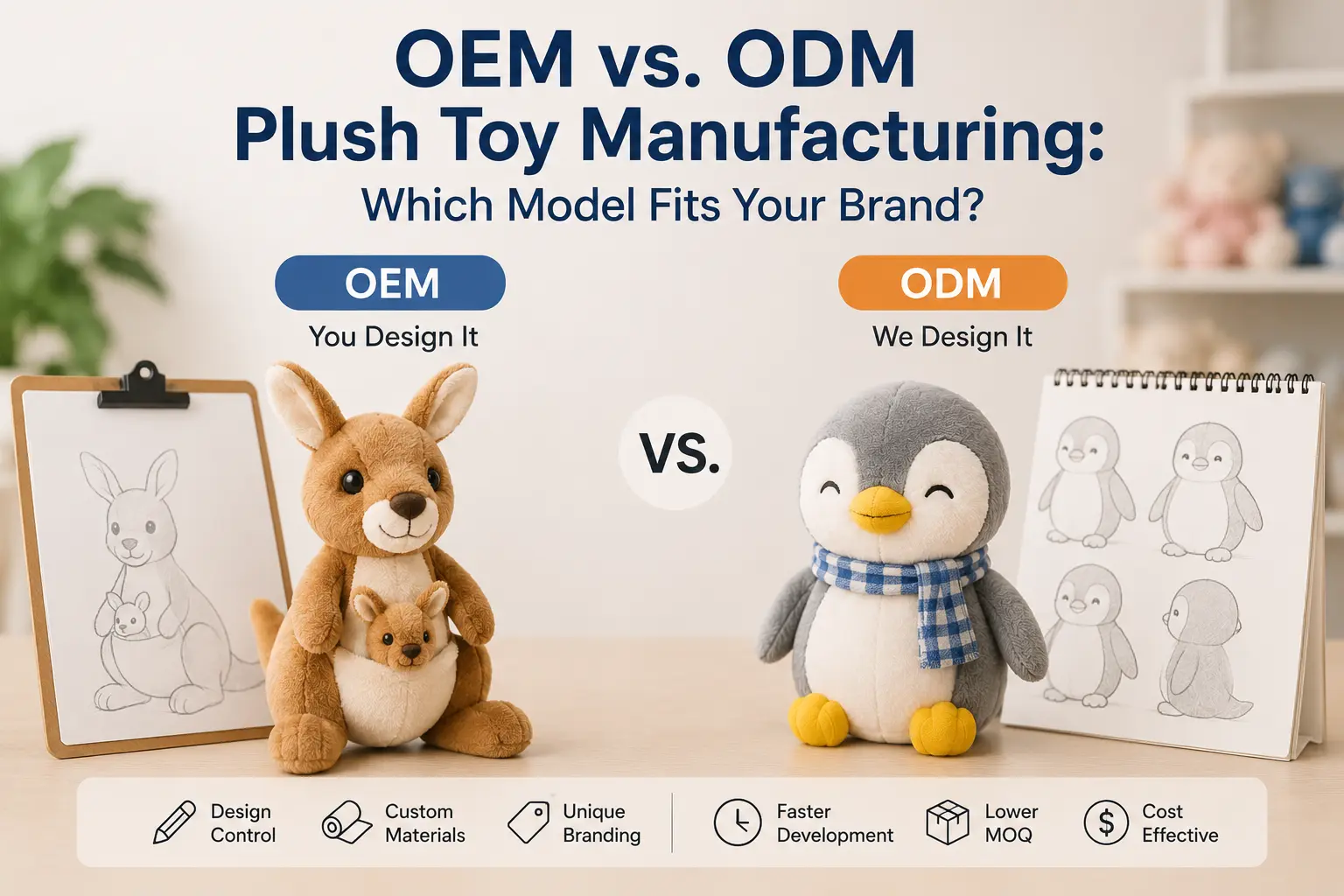
In plush manufacturing, OEM (Original Equipment Manufacturer) means the factory builds a product from your own designs and tech pack — you own the concept and IP. ODM (Original Design Manufacturer) means the factory designs the product for you, often from an existing template, and may retain some design rights. OEM offers full control and IP ownership; ODM offers speed and lower development cost.
These two acronyms get thrown around interchangeably in sourcing conversations, and the confusion costs brands real money — sometimes their entire product identity. I have watched a company discover, mid-reorder, that the “custom” design they built a brand around was an ODM template the factory was free to sell to a competitor. Knowing which model you are actually buying is fundamental. Let us make the distinction concrete.
OEM Plush Manufacturing: You Own the Design
Under an OEM arrangement, you arrive with finished artwork, a character sheet, and ideally a tech pack. The OEM plush toy manufacturer is a pure production partner: it engineers your files into a sewable pattern and manufactures to your spec. Crucially, the design and its intellectual property remain yours — the factory has no right to reproduce or resell it.
This is the model for brands with a distinct identity: licensors, established retailers, and startups with a strong original character. It demands more from you upfront — you must supply production-ready designs — but it guarantees exclusivity and protects your brand equity.
ODM Plush Manufacturing: The Factory Designs for You
Under ODM, the factory’s own design team develops the product, sometimes from a brief and sometimes by modifying an existing in-house template. You get to market faster and skip most development cost, which is attractive for generic gifting, promotional items, or seasonal filler where uniqueness matters less.
The trade-off is control. Because the factory created (or already owned) the base design, it may retain rights to that template and reuse it for other clients. Always clarify in writing whether an ODM design becomes exclusive to you — and expect to pay a premium if you want that exclusivity.
| 因子 | OEM | ODM |
| Who designs | You / your artist | 工場 |
| 知的財産権の帰属 | Yours, fully | Often shared or factory-held |
| Exclusivity | Guaranteed | Only if negotiated |
| Development cost | Higher (you fund design) | Lower / bundled |
| Speed to market | Slower | Faster |
| こんな方に最適 | Brands, licensors, originals | Promo, gifting, seasonal |
| Control over details | Complete | Limited to options offered |
The Hybrid Reality: Most Projects Are a Blend
In practice, the cleanest line between OEM and ODM blurs on real orders. A common and healthy arrangement is OEM design with ODM engineering support: you own the character, but the factory’s technical team advises on pattern feasibility, fabric choice, and safety construction. That collaboration is where a factory’s decade of production experience earns its keep — turning a beautiful illustration into something that actually stuffs and sews well.
If you are unsure which side you fall on, our broader guide to choosing a オーダーメイドぬいぐるみメーカー helps you scope the relationship before you commit.
Protecting Your IP in Either Model
Whichever model you choose, protect your artwork before a single file leaves your inbox. Standard safeguards include:
- A signed NDA before sharing character art or tech packs — non-negotiable for OEM work.
- Written IP clauses stating that all designs, patterns, and samples belong to you.
- Exclusivity terms for any ODM template you want reserved to your brand.
- Trademark registration for your character and brand name in your selling markets.
We build these protections into every OEM engagement — you can review how we handle confidentiality and documentation on our 当社について page and formalize terms during the 注文手続き.
Cost, Speed & Ownership: The Numbers Behind the Choice
Beyond the definitions, buyers want to know how the two models actually behave across a project’s lifecycle. This side-by-side maps the practical realities — from your first order through reorders — so you can weigh exclusivity against speed and spend.
| Lifecycle Stage | OEM Reality | ODM Reality |
| Upfront investment | Higher — you fund artwork & pattern | Lower — template already exists |
| Time to first sample | Longer — built from scratch | Shorter — adapts a base design |
| Reorder flexibility | Full — you own the tooling | Depends on factory’s template rights |
| Brand differentiation | Strong — unique to you | Weak — others may use the base |
| Long-term IP value | Builds an owned asset | Limited or none |
| Best margin over time | Higher for scaling brands | Fine for one-off promo runs |
The pattern is clear: ODM wins on speed and day-one cost, OEM wins on ownership and long-term value. A brand that plans to reorder and build equity almost always comes out ahead with OEM, even though it pays more to start. Weigh this against your MOQ and budget before committing.
Real-World Scenarios: Which Model Wins
Abstract trade-offs get clearer with concrete cases. Here is how the decision typically breaks down for the buyers I work with.
- A cartoon studio licensing a mascot: OEM, always — the character is the entire value and must stay exclusive and owned.
- A corporate client needing 1,000 branded gift plush for a conference: ODM — a proven teddy template with the logo embroidered is fast, cheap, and perfectly adequate.
- A startup with a rough sketch and no design team: a hybrid — OEM ownership with the factory’s ODM engineering help to make the sketch producible.
- A retailer refreshing a seasonal range yearly: ODM for filler SKUs, OEM for the signature hero product that defines the collection.
How to Decide: A Quick Framework
Choose OEM if your product’s uniqueness is the point — you have (or will invest in) original artwork and you need to own it outright. Choose ODM if speed and cost matter more than exclusivity, and a proven template gets you 90% of the way there. When your design is ready, the next step is the 試作サンプル, where either model becomes a physical prototype you sign off before bulk production begins.
Questions to Ask a Factory Before You Sign
The model you choose only holds up if the contract reflects it. Whether you land on OEM, ODM, or a hybrid, put these questions to the factory in writing and keep the answers on file. Ambiguity here is where IP disputes are born.
- Who owns the pattern and tooling? For OEM, the answer must be you — the pattern is the physical embodiment of your design.
- Is this base design exclusive to me? Critical for any ODM template; get exclusivity or a non-compete window in writing.
- Can the factory resell or reuse the design? Silence here defaults in the factory’s favor — close the door explicitly.
- What happens to my molds and samples if I leave? They should be released or stored for you, not repurposed for the next client.
- Will you sign an NDA before receiving artwork? A refusal tells you everything about how your IP will be treated.
A factory that answers these plainly and commits them to paper is one you can build a brand on. Fold the terms into your 注文手続き so ownership is never left to assumption, and use the wider オーダーメイドぬいぐるみメーカー guide to benchmark the rest of the relationship.
よくある質問
Is OEM or ODM cheaper for plush toys?
ODM usually has a lower upfront cost because you are not funding original design and development. OEM costs more to develop but protects exclusivity and long-term brand value — often the better investment for a brand that plans to reorder.
Can I switch a factory’s ODM design to be exclusive?
Sometimes, yes — but you must negotiate exclusivity in writing and typically pay a premium or minimum-volume commitment. Never assume an ODM design is exclusive by default.
Do I need a tech pack for OEM manufacturing?
Strongly recommended. A tech pack removes ambiguity and speeds sampling. Learn what one contains in our guide to reading a plush toy spec sheet.
The Bottom Line
OEM versus ODM is really a question about what you are building. If your plush is a brand asset meant to grow, own it outright with OEM and protect it with airtight IP terms. If it is a fast, functional item where a proven template does the job, ODM gets you there cheaper and quicker. Most successful programs blend the two — your design, the factory’s engineering. Decide deliberately, put ownership in writing, and you will never discover mid-reorder that your signature character belongs to someone else.
- OEM = your design, your IP, full control — best for brands that scale.
- ODM = factory design, faster and cheaper — best for promo and gifting.
- Always document IP, exclusivity, and tooling ownership before sharing artwork.
著者について
Chew is a plush toy sourcing and manufacturing specialist with over a decade of hands-on experience managing OEM and ODM production across Chinese factories. He has structured manufacturing agreements for licensors and independent brands alike, and writes to help B2B buyers protect their designs and source smarter. Reach the team via the plushtoys-factory.com ordering process.