
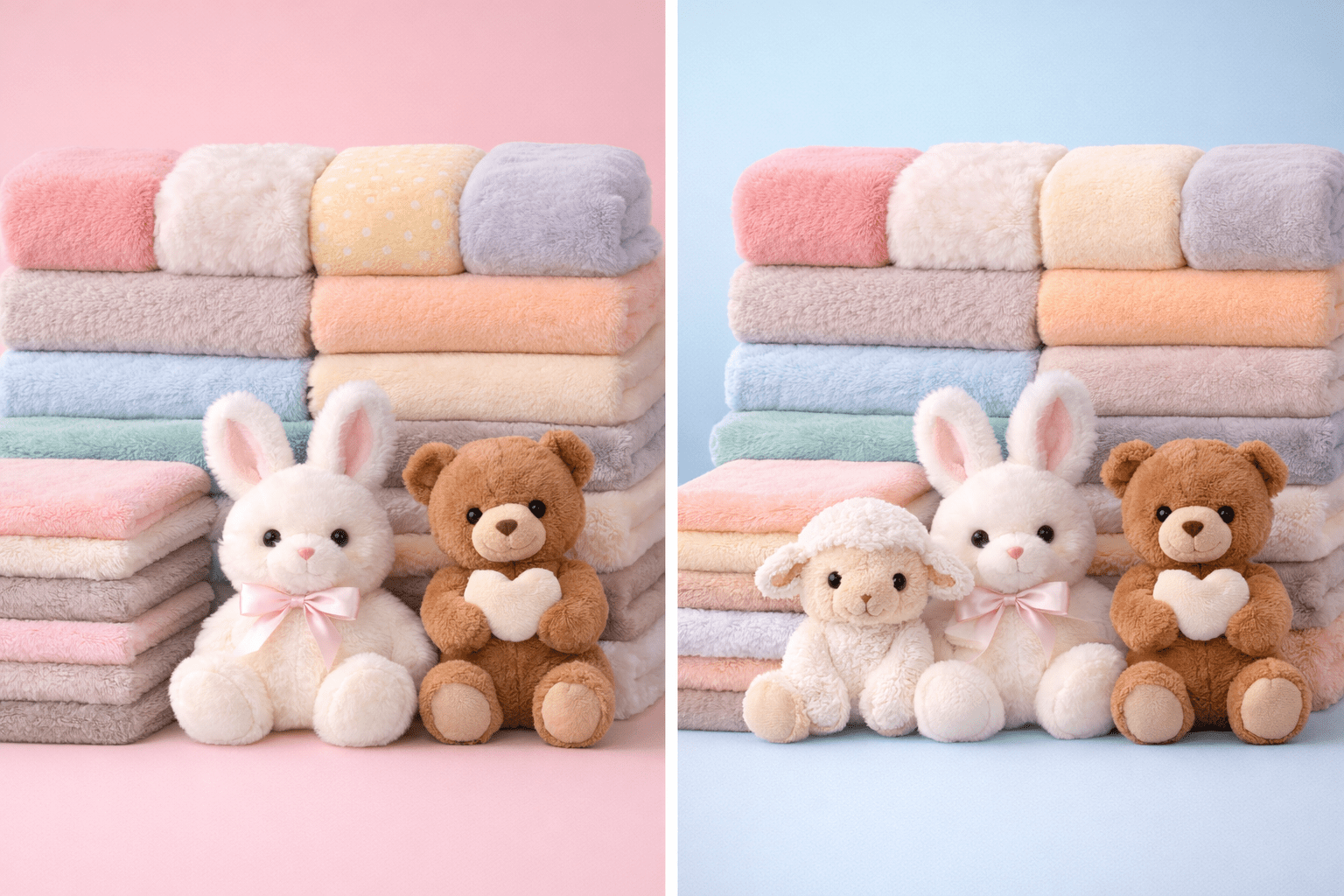
Why Fabric Selection Is a Strategic Manufacturing Decision
In plush toy manufacturing, fabric is not just a design choice. It is a structural, financial, and compliance-driven decision that directly impacts durability, unit cost, rejection rates, customer satisfaction, and long-term brand reputation.
For brand owners, OEM buyers, and sourcing managers in Canada and the United States, understanding how plush toy fabric affects both durability and cost is critical. Fabric decisions influence not only how a plush toy feels but also how it performs under real-world use, how it passes safety testing, how it survives shipping, and how it holds up over months or years of handling.
From a factory-floor perspective, fabric choice impacts cutting efficiency, stitch performance, embroidery stability, seam strength, and even stuffing retention. Selecting the wrong fabric can result in higher defect rates, failed compliance tests, increased rework, and costly production delays.
This article explains, in practical manufacturing terms, how different types of fabric for soft toys affect durability, production cost, and long-term performance, using real-world factory logic and sourcing decision frameworks.
The Role of Plush Toy Fabric in Product Performance
Fabric as a Structural Component, Not Just a Surface Layer
In modern plush manufacturing, fabric is a load-bearing component. It must:
- Hold stitch tension under repeated stress
- Resist seam splitting
- Maintain pile integrity after washing or handling
- Support embroidery and appliqué
- Meet flammability and chemical safety standards
- Withstand shipping compression and recovery
From a production standpoint, fabric choice directly influences:
- Stitch density requirements
- Seam allowance specifications
- Needle selection
- Thread type
- Cutting accuracy
- Yield per fabric roll
These technical variables affect both durability and cost.
Common Plush Toy Fabrics and Their Durability Profiles
Coral Fleece
Coral fleece is widely used due to its softness and cost efficiency.
Durability characteristics:
- Moderate abrasion resistance
- Good colorfastness
- Lower tear strength compared to woven fabrics
- Susceptible to pile flattening under compression
Cost impact:
- Lower raw material cost
- High cutting yield
- Faster sewing speeds
Best use cases:
- Promotional plush
- Entry-level retail plush
- High-volume bulk plush toys
Minky Fabric
Minky is a premium plush toy fabric known for ultra-soft texture.
Durability characteristics:
- Excellent hand feel
- Moderate seam strength
- Requires careful tension control
- Sensitive to needle marks
Cost impact:
- Higher fabric cost per yard
- Higher rejection risk if mishandled
- Slower sewing speeds
Best use cases:
- Baby-safe plush
- Premium retail plush
- Licensed character toys
Faux Fur
Faux fur offers strong visual appeal but presents production challenges.
Durability characteristics:
- High abrasion resistance
- Strong backing fabrics
- Can shed if cut improperly
- Requires specialized cutting methods
Cost impact:
- Higher fabric cost
- Lower yield due to pile direction
- Increased labor for pile management
Best use cases:
- Animal plush
- Collectible plush
- Premium brand characters
PV Velvet and Nylex
These fabrics are often used for smooth-surface plush and sports mascots.
Durability characteristics:
- Strong backing
- High seam strength
- Good embroidery stability
- Low pile distortion
Cost impact:
- Mid-range fabric pricing
- Good production efficiency
- Lower defect rates
Best use cases:
- Mascot plush
- Promotional characters
- High-handling environments
Felt and Non-Woven Fabrics
Used mainly for appliqué, facial features, and accessories.
Durability characteristics:
- Low tensile strength
- Limited abrasion resistance
- Can fuzz or pill
Cost impact:
- Very low cost
- High failure risk if used structurally
Best use cases:
- Decorative components only
- Not recommended for load-bearing panels
How Fabric Choice Impacts Stitching and Seam Integrity
Stitch Density and Fabric Backing Strength
Different fabrics require different stitch densities. For example:
- Minky requires higher stitch density to prevent seam slippage
- Faux fur requires reinforced seams due to backing stiffness
- Coral fleece can tolerate moderate stitch density
If stitch density is incorrect:
- Seams may split under stress
- Pile may shed at seam edges
- Pull test failures increase
- Product returns rise
Factories often conduct internal seam strength testing before locking fabric choices for mass production.
Fabric Selection and Embroidery Performance
Embroidery Stability by Fabric Type
Embroidery behaves differently depending on pile height and backing stability.
High pile fabrics:
- Require topping stabilizers
- Increase embroidery time
- Increase risk of puckering
Low pile fabrics:
- Produce sharper embroidery
- Lower stabilization cost
- Faster embroidery cycles
From a cost perspective, embroidery time is a major driver. A plush toy with heavy embroidery on minky or faux fur can add significant machine minutes per unit.
Stuffing Interaction With Fabric
Fabric Stretch and Stuffing Ratios
Fabric elasticity affects stuffing behavior.
High-stretch fabrics:
- Can hide overstuffing initially
- May lose shape over time
- Increase deformation risk
Low-stretch fabrics:
- Show stuffing inconsistencies immediately
- Require precise stuffing control
- Maintain shape longer
Incorrect stuffing ratios combined with poor fabric choice result in:
- Misshapen toys
- Collapsing heads
- Uneven limbs
- Failed drop and compression tests

Safety Compliance and Fabric Selection
EN71, ASTM F963, and CPSIA Implications
All plush toy fabrics must pass:
- Flammability testing
- Chemical content testing
- Heavy metal restrictions
- Phthalate compliance
Some dyed fabrics fail due to:
- Improper dye chemistry
- Inconsistent dye lots
- Uncertified suppliers
Using uncertified fabric for soft toys can cause:
- Shipment holds
- Retesting costs
- Customs delays
- Brand liability
Experienced OEM buyers insist on:
- Fabric test reports
- Material traceability
- Batch-level documentation
Cost vs Durability Trade-Offs
Where Buyers Often Miscalculate
Buyers often focus on fabric price per yard, but real cost drivers include:
- Sewing time per unit
- Rejection and rework rates
- Embroidery stability
- Testing failure risk
- Warranty and return rates
A cheaper fabric that increases rejection by even 3 to 5 percent often becomes more expensive overall than a higher-quality fabric.
Handmade vs Machine-Assisted Fabric Handling
Hand-cut fabrics may be acceptable for small batch runs, but machine-assisted cutting improves:
- Panel accuracy
- Yield optimization
- Seam alignment
- Repeatability
For mass production, inconsistent fabric handling increases waste and defect rates.
Small Batch vs Mass Production Fabric Decisions
Small batch runs allow flexibility in fabric selection. Mass production requires:
- Dye lot consistency
- Roll-to-roll matching
- Long-term supplier contracts
Choosing specialty fabrics for mass production can increase:
- Lead time
- MOQ
- Inventory risk
Lead Times, MOQ, and Fabric Availability
Certain plush toy fabrics require:
- Custom dyeing
- Minimum yardage
- Longer production cycles
This affects:
- Sampling timelines
- Production scheduling
- Cash flow planning
Sourcing managers must balance design goals with operational reality.
Decision-Making Logic Used by Experienced Buyers
Professional buyers evaluate:
- Fabric performance history
- Supplier reliability
- Testing pass rates
- Embroidery compatibility
- Long-term availability
- Cost stability
They understand that fabric decisions affect the entire production ecosystem for Plush Toys including custom plush toy manufacturing, OEM plush toys, and bulk plush toy production.
Fabric Is a Strategic Cost and Quality Lever
Fabric selection is one of the most critical decisions in plush toy manufacturing. It affects not only how a toy looks and feels but also how it performs under stress, how it passes safety audits, and how it impacts total production cost.
For brands and sourcing teams, understanding the relationship between plush toy fabric, durability, and cost leads to better long-term outcomes, fewer defects, and stronger product performance.
Choosing the right fabric for soft toys is not about selecting the cheapest option. It is about selecting the fabric that delivers consistent quality, regulatory compliance, production efficiency, and long-term brand protection.