
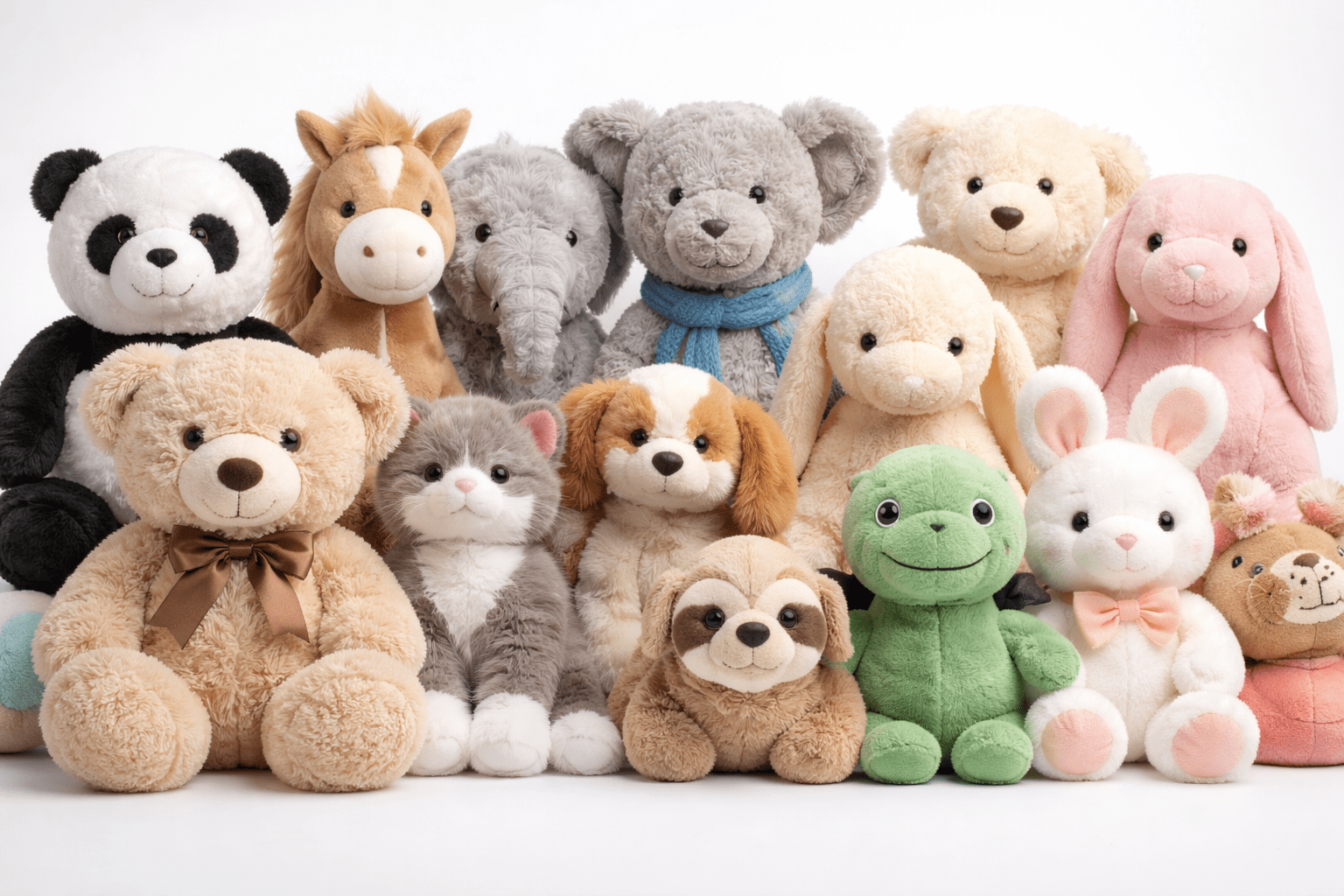
How Plush Toys Evolved From Simple Comfort Items to Strategic Branded Products
The plush toy industry did not evolve because of trends alone. It evolved because manufacturing capabilities, material science, branding strategies, and global sourcing pressures changed. What began as simple stuffed bears designed for emotional comfort has become a complex manufacturing category that includes collectibles, licensed characters, promotional mascots, limited editions, and engineered plush products designed for safety, durability, and mass distribution.
For manufacturers, OEM buyers, and sourcing managers, understanding this evolution is not academic. It directly affects fabric selection, production methods, cost structures, compliance requirements, MOQ strategies, and long-term supplier relationships. The difference between a classic plush bear and a modern collectible plush is not only aesthetic. It is structural, technical, and operational.
This article explains how plush toys evolved from early teddy bears to modern collectible and branded plush products, from the perspective of real factory operations, sourcing realities, and production decision-making.
The Origins of Classic Plush Toys and Early Manufacturing Constraints
Early Plush Toy Design Philosophy
The earliest plush toys were designed with simplicity and emotional function in mind. The goal was comfort, softness, and basic durability. Manufacturing technology was limited, so designs were intentionally simple.
Classic plush bears typically shared these traits:
- Basic cotton or mohair outer fabric
- Simple jointless body construction
- Hand-cut fabric panels
- Minimal embroidery or facial detailing
- Natural fiber stuffing such as cotton or kapok
- Loose tolerance control
Factories relied heavily on manual labor. Pattern pieces were large, seam counts were low, and design complexity was limited by hand stitching speed and fabric consistency.
Material Limitations in Early Plush Production
Early plush manufacturing faced material limitations that directly shaped product design.
Mohair and early pile fabrics were inconsistent in pile height and density. This made precise cutting difficult. Natural fiber stuffing had inconsistent loft and compression behavior. Over time, toys would lose shape and firmness.
From a factory perspective, this meant:
- High variation between units
- Difficult quality standardization
- Higher rejection rates
- Limited scalability
Classic plush bears were produced in smaller volumes with higher unit-to-unit variation. This model does not scale efficiently for modern OEM production.
Industrialization of Plush Toy Manufacturing
Introduction of Synthetic Fabrics
The introduction of polyester-based plush fabrics changed everything. Synthetic fibers allowed consistent pile height, predictable shrinkage, and better color stability.
Common modern fabrics that replaced early materials include:
- Coral fleece
- Minky fabric
- Hi-pile polyester plush
- Nylex
- Faux fur
- PV velvet
These fabrics allowed factories to:
- Standardize cutting
- Control seam alignment
- Maintain consistent softness
- Improve dye lot repeatability
From a production standpoint, this made large-scale manufacturing possible with tighter QC tolerances.
Evolution of Stuffing Materials
Natural stuffing was replaced by polyester fiberfill. This allowed:
- Controlled loft
- Consistent rebound
- Predictable weight per unit
- Reduced moisture retention
- Better hygiene and safety control
Modern factories precisely measure stuffing weight per panel section. For example, head cavity stuffing ratios are often different from torso and limb sections to maintain shape retention.
Incorrect stuffing ratios lead to:
- Deformed silhouettes
- Collapsing heads
- Uneven firmness
- Higher return rates
- Failed durability testing
This shift made plush toys more engineered products rather than soft handmade items.
From Simple Toys to Branded and Licensed Products
The Rise of Character and Brand Licensing
The evolution into collectibles began when plush toys became vehicles for licensed characters, mascots, and brand identities.
This introduced new production complexities:
- Precise color matching to brand guidelines
- Facial feature accuracy
- Embroidery detail requirements
- Fabric texture matching to character designs
- Consistent proportions across production runs
Factories had to move from generic patterns to proprietary pattern libraries for each SKU.
This is where modern Plush Toys manufacturing becomes highly technical. Pattern control, sample approval cycles, and reference sample locking become mandatory.
Pattern Development and Prototyping for Modern Collectibles
From Hand Sketch to Production Pattern
Modern plush toy development starts with detailed design inputs:
- 2D artwork
- 3D references
- Brand style guides
- Pantone color standards
Pattern engineers translate artwork into multi-panel soft structure patterns. Each curve and seam placement affects how the character reads in three dimensions.
A poorly engineered pattern leads to:
- Distorted facial expressions
- Asymmetrical limbs
- Inconsistent body proportions
- High rejection during buyer approvals
Factories now use iterative prototyping cycles. Sample rooms may produce three to five revisions before final approval.
This is where experienced sourcing teams add value. They understand how artwork translates into fabric behavior.
Cutting, Stitching, and Assembly in Modern Production
Automated and Semi-Automated Cutting
Modern factories use CNC fabric cutters or laser marking systems for consistency. This ensures:
- Repeatable panel shapes
- Reduced fabric waste
- Improved seam matching
- Faster throughput
Manual cutting is still used for small batch or specialty fabrics, but mass production relies on mechanized cutting to meet lead time and quality targets.
Stitch Density and Structural Integrity
Stitch density is one of the most overlooked technical variables in plush manufacturing.
Low stitch density causes:
- Seam splitting under tension
- Fiber shedding at seam lines
- Failed pull tests
- Reduced product lifespan
High stitch density increases labor time and can stiffen seams.
Experienced factories balance stitch per inch based on:
- Fabric pile type
- Backing material strength
- Toy size and stress points
- Target age group and safety standard
This is not guesswork. It is based on years of internal testing and audit feedback.
Embroidery, Appliqué, and Facial Detail Evolution
Transition From Simple Faces to High-Detail Features
Classic plush bears used simple stitched eyes and noses. Modern collectibles require:
- Multi-layer embroidery
- Appliqué facial panels
- Heat-cut felt features
- Digital embroidery mapping
This adds complexity and failure points.
Common embroidery problems include:
- Thread breakage
- Color bleeding
- Misalignment on curved surfaces
- Puckering due to fabric tension
Factories must adjust hoop tension, backing stabilizers, and stitch sequencing for plush fabrics.
Finishing and Final Assembly
Turning, Stuffing, and Closure Techniques
After stitching, toys are turned, stuffed, and closed using ladder stitches or machine closure depending on design.
Closure integrity is critical for safety compliance. Improper closures can fail seam pull tests.
Experienced QC teams test:
- Closure seam strength
- Stuffing migration
- Opening seam recovery
This is where many low-cost factories fail audits.
Quality Control and Safety Compliance Evolution
The Impact of Global Safety Regulations
Modern plush toys must meet strict safety standards:
- EN71 for Europe
- ASTM F963 for United States
- CPSIA for U.S. consumer products
- Phthalate and heavy metal testing
- Small parts testing
- Flammability testing
Classic plush toys were not subjected to this level of scrutiny.
Today, every material and accessory must be traceable and certified.
Ignoring safety standards leads to:
- Shipment holds
- Customs rejection
- Product recalls
- Brand liability exposure
- Long-term supplier disqualification
This is why modern Plush Toys manufacturing is compliance-driven, not just cost-driven.
Evolution Into Collectibles and Limited Editions
Design for Collectability
Modern plush collectibles differ structurally:
- Unique fabrics
- Limited run embroidery patterns
- Serialized tags
- Higher fabric GSM
- More detailed pattern segmentation
This increases unit cost but creates perceived value.
Factories must manage:
- Small batch production efficiency
- Higher changeover frequency
- Lower yield per cutting lay
- Higher sampling overhead
Sourcing managers must decide if collectible margins justify these operational costs.
Cost vs Quality in Modern Plush Manufacturing
Where Cost Is Actually Controlled
Buyers often focus on fabric price, but experienced manufacturers know cost drivers include:
- Pattern complexity
- Embroidery stitch count
- Labor minutes per unit
- Rejection and rework rates
- Compliance testing frequency
Lower fabric cost means nothing if rejection rates increase.
Handmade vs Machine-Assisted Production
Handmade plush allows artisan finishes but lacks scalability. Machine-assisted production ensures consistency but requires upfront tooling and setup costs.
Factories choose based on:
- Order volume
- Product positioning
- Lead time requirements
- Brand expectations
Small Batch vs Mass Production
Small batch production supports testing and market validation. Mass production optimizes cost per unit.
Trade-offs include:
- Higher per-unit cost in small batches
- Higher MOQ in mass production
- Inventory risk
- Change order rigidity
Lead Times, MOQ, and Scalability
Modern plush factories plan production around:
- Fabric dye lot scheduling
- Embroidery program setup
- Line balancing
- Testing lab turnaround time
MOQ exists because of these operational realities, not just profit margins.
How Experienced Sourcing Managers Make Decisions
Professional buyers evaluate:
- Factory technical capability
- Compliance history
- Sampling accuracy
- Communication quality
- Rework responsiveness
- Capacity planning
They understand that plush manufacturing is a system, not just a sewing operation.
How Plush Toys Became Strategic OEM Products
Today, Plush Toys are not simple toys. They are:
- Brand assets
- Marketing tools
- Licensed merchandise
- Corporate gifts
- Collectibles
- Fundraising products
OEM plush toy manufacturing now supports bulk plush toy production, custom plush toy manufacturing, and private label programs with structured RFQ and sampling workflows.
FAQs
How did plush toys change from simple bears to modern collectibles?
The change happened because of advances in synthetic fabrics, embroidery technology, safety standards, and branding requirements. Factories had to adopt engineered production methods to meet licensing, compliance, and large-scale consistency needs.
Why are modern plush toys more expensive to produce?
Modern plush toys require detailed pattern development, multi-layer embroidery, safety testing, and traceable materials. Each of these adds cost and labor time compared to early plush manufacturing.
How do safety standards affect plush toy design?
Safety standards determine stitch density, accessory attachment methods, fabric selection, and stuffing enclosure techniques. Designs must be engineered to pass seam strength, small parts, and flammability testing.
What role does prototyping play in collectible plush production?
Prototyping ensures artwork translates correctly into three-dimensional plush form. Multiple iterations are often needed to match brand expectations and reduce mass production risk.
Why do MOQ requirements exist in plush manufacturing?
MOQ reflects fabric dye lots, embroidery setup, cutting efficiency, and compliance testing costs. Producing below MOQ increases per-unit cost and operational inefficiency.
How does embroidery complexity affect production?
Higher embroidery stitch counts increase machine time, thread usage, and defect risk. This directly impacts unit cost, lead time, and QC workload.
What makes a plush toy suitable for collectible markets?
Collectible plush toys use higher quality fabrics, more complex patterns, detailed embroidery, and limited production runs. This increases manufacturing complexity but supports higher perceived value.