
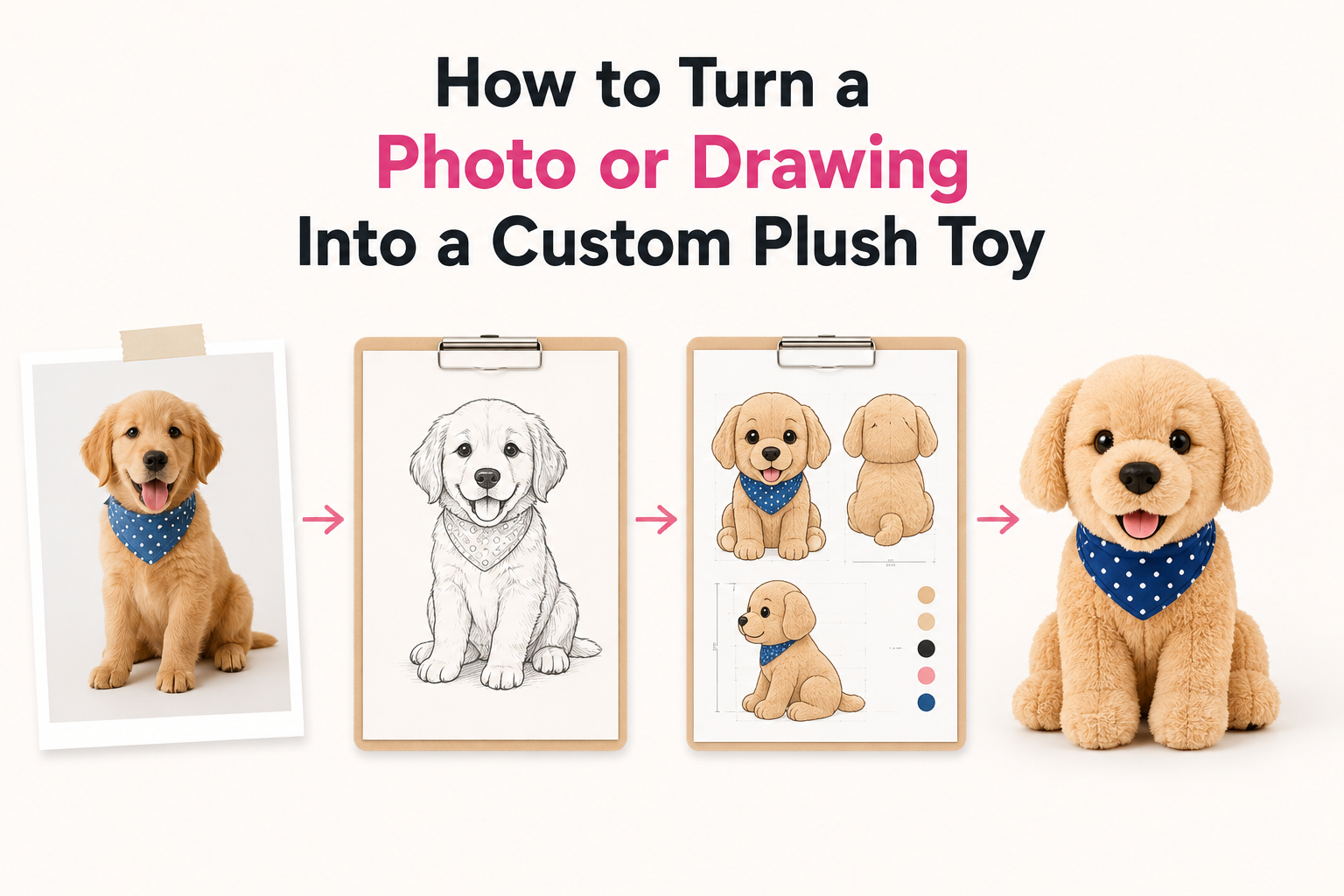
A custom plush from a photo is made by translating your reference image into a flat sewing pattern, sculpting the shapes in soft fabric, and refining a physical sample until it reads as the character or subject in your picture. A single clear photo is enough to start, but the quality of the final plush depends far more on how much visual information you provide – angles, colors, and details – than on the photo itself.
That gap between “I have a picture” and “I have a plush that looks like it” is where most first-time buyers get surprised. This guide walks through exactly what happens between the two, what your reference material needs to include, where likeness holds up and where it doesn’t, and what to budget in cost and time.
What “photo to plush” actually means
There is no machine that scans a photo and prints a stuffed animal. Turning an image into plush is a pattern-making and sampling process carried out by people. Your photo becomes a set of instructions, and a sample maker interprets those instructions in fabric.
The workflow is essentially the same whether your input is a photograph, a child’s drawing, a logo, or a digital character sheet:
- Interpretation. A designer studies your reference and identifies the core shapes – head, body, limbs, ears, snout – and the features that make the subject recognizable.
- 2D pattern drafting. Those shapes are drawn as flat panels, the way a garment pattern is drafted. A rounded plush head might be six or eight separate fabric panels sewn together.
- Digital mockup or proof. Many factories send a drawing or 3D render so you can approve proportions and colors before anything is cut.
- Physical sample. The panels are cut, sewn, stuffed, and finished into a real prototype.
- Revision rounds. You compare the sample to your photo, request changes, and the maker adjusts the pattern.
The reason this matters: a photo captures one angle in one lighting condition. A plush exists in three dimensions and gets viewed from every side. The sample maker has to invent everything your photo doesn’t show – the back of the head, the underside, the far ear – and the more they have to guess, the more the first sample can drift from what you pictured.
What reference material a factory actually needs
You can order from a single photo, and factories do it all the time. But the difference between a usable first sample and three rounds of corrections almost always comes down to the reference you supply up front.
The strongest reference package includes:
- Multiple angles. Front, side, back, and a three-quarter view remove guesswork about depth and shape. For a pet or a person’s face, a straight-on front shot plus a clear profile is the minimum.
- A full-body view if the plush is full-body. A face-only photo can’t tell a pattern maker how the body is proportioned.
- Close-ups of signature details. Fur markings, a specific eye shape, a logo placement, a costume element. These are the features people check first to decide whether the plush “looks like it.”
- Color notes. Photos lie about color depending on lighting and screen. If a color is important, name it – a Pantone reference, a paint chip, or “match this swatch” beats “it’s kind of teal.”
- Size and pose intent. Standing or sitting? Arms out or by the sides? A 20 cm keepsake or a 60 cm display piece? Pose and size change the entire pattern.
For a drawing or an original character, a turnaround or reference sheet (the same character drawn from several sides) is the single most valuable thing you can provide. If you only have one drawing, expect the maker to make interpretive choices about the hidden sides, and expect to correct them.
Photograph vs. drawing: how the input changes the job
The source image type shifts what’s easy and what’s hard.
| Input | Easier part | Harder part | Best practice |
| Photograph of a pet or person | Realistic colors and textures are visible | Faces carry huge recognition weight; small errors read as “wrong” | Supply front + profile + a detail shot of markings |
| Child’s drawing | Simple, forgiving shapes; charm tolerates imperfection | Flat art has no depth cues; proportions are ambiguous | Keep the drawing’s quirks on purpose — that’s the appeal |
| Original character / fursona | Reference sheets define all sides clearly | Style consistency and specific color codes | Provide a turnaround sheet and exact color values |
| Logo or mascot | Clean, defined shapes | Fine text and thin lines don’t survive at plush scale | Simplify small details before sampling |
A recurring reality across all of these: fine detail shrinks poorly. Text, thin outlines, and tiny patterns that look crisp on screen become muddy on a small plush. A good maker will flag this and suggest simplifying or enlarging the element, or moving it to an embroidered patch.
How faces and details get onto the plush
The subject’s features can be applied several ways, and the method affects both cost and the final look.
- Embroidery stitches features directly into the fabric. It’s durable, has a premium tactile quality, and suits eyes, small logos, and text – but every color and stitch adds to setup. It’s the standard for a clean, long-lasting face.
- Printing (dye sublimation) transfers a full-color image onto the fabric before cutting. It handles complex, photographic, or gradient detail that embroidery can’t, and it’s efficient for busy artwork – but it can look flatter and less “plush.”
- Appliqué layers cut fabric shapes onto the body for bold, simple color blocks like a belly patch or big cartoon eyes.
- Sculpting and seams create the actual 3D likeness – a snout, cheeks, a rounded muzzle – through the pattern itself, not surface decoration.
Most custom plush combine these: sculpted shapes for the form, embroidery for the face, and occasionally a printed element for something too intricate to stitch. If you’re weighing the trade-offs for a specific design, our breakdown of plush toy embroidery vs. print vs. appliqué covers when each technique earns its place.
How close will it actually look?
Set expectations here and you’ll be happy with the result; ignore this and you’ll be frustrated.
A custom plush is a stylized interpretation, not a miniature clone. Plush is a soft, rounded, low-detail medium. It captures silhouette, proportion, color, and signature features extremely well. It does not capture photo-realistic faces, fine fur texture, or exact expressions the way a sculpture or a photo would.
What plush reproduces reliably:
- Overall shape and proportion
- Color and major markings
- Recognizable features – a distinctive ear, a spot pattern, a mascot’s core look
What plush handles poorly:
- Photorealistic facial likeness of a specific person
- Very fine or very small details
- Subtle expression differences
For pets, characters, and mascots, this is usually a non-issue – the recognizable traits translate beautifully. For a literal portrait of a human face, temper expectations and lean on the most identifiable features rather than expecting a mirror image.
From approval to production: samples and revisions
The sample stage is where your photo becomes real, and it’s worth doing patiently.
- Pre-production sample. The first physical prototype, made specifically from your reference. Review it in person if you can – screens hide seam quality, stuffing firmness, and true color.
- Revision rounds. Expect at least one round of adjustments; two to three is normal for a detailed subject. Give specific, prioritized feedback (“ears sit too high; belly patch color too dark”) rather than “make it cuter.”
- Golden sample. The approved sample becomes the quality benchmark that bulk production is checked against.
Rushing sample approval is the most common cause of a disappointing bulk order, because every unit is built to match whatever you signed off on. For a full view of turnaround times and how many rounds to plan for, see how pre-production plush samples are made.
What it costs and how long it takes
Photo-to-plush pricing follows the same logic as any custom plush, driven by complexity rather than the fact that a photo was involved.
Cost drivers:
- Size – more fabric and stuffing per unit.
- Detail and color count – every embroidery color and extra component adds setup and labor.
- Number of sample rounds – sampling is usually a separate, upfront fee.
- Order quantity – per-unit cost drops sharply as volume rises, which is why minimum order quantities exist.
You’ll typically pay a one-time sampling/tooling fee to develop your specific design, then a per-unit price for the production run. A more complex subject raises both. For how these fees, minimums, and unit pricing fit together, our guide on how to order custom plush — cost, MOQ, samples, and lead times lays out the full budget picture.
Timeline, in broad strokes: design and digital proof takes a few days to a couple of weeks depending on revisions; a physical sample adds one to a few weeks; bulk production is separate again. Plan the whole cycle in weeks, not days, and build in buffer for at least one sample revision.
Ordering a small quantity – or just one
A frequent question: can I get a single plush from my photo? Yes some makers offer one-off keepsakes, and that market exists for pet replicas and personal gifts. But be aware of the economics: with a one-off, the entire design and setup cost sits on one unit, so a single custom plush is expensive per piece.
If you’re a brand or reseller, the per-unit cost only becomes sensible at volume. That’s the whole point of a minimum order quantity. If your run is small, our overview of low-MOQ custom plush explains where reasonable minimums start and why the first hundred units carry most of the fixed cost.
Safety still applies – even for a keepsake
A plush made from a personal photo is still a soft toy, and if it will be given to a child, sold, or handled by kids, it has to meet the same safety rules as any other plush. That means age-appropriate construction, secure attachment of eyes and small parts, non-toxic materials, and the relevant market testing.
This is easy to overlook when the plush feels like a personal, one-off gift, but it matters the moment a child is involved. Our summary of plush toy safety standards covers what applies in the US and EU and how compliance is verified.
Frequently asked questions
Can you make a plush from just one photo?
Yes, but one photo forces the maker to guess at every angle it doesn’t show, which usually means more sample revisions. Front, side, and back references produce a closer first sample.
Will the plush look exactly like my pet or character?
It will capture the recognizable shape, colors, and signature features. Plush is a stylized, soft medium, so expect a faithful interpretation rather than a photo-realistic copy.
What resolution or file do I need to send?
Clear and well-lit matters more than megapixels. Provide the sharpest images you have, multiple angles, and close-ups of any important detail. For characters, a reference sheet beats a single hero image.
Can text or a small logo be included?
Yes, but fine text and thin lines shrink poorly on plush. Small details are often better embroidered on a patch, enlarged, or simplified so they stay legible.
How do drawings differ from photos as a source? Drawings are more forgiving of shape and proportion and their charm survives small imperfections, but flat art gives no depth information, so the maker interprets the hidden sides. A multi-angle drawing removes that ambiguity.
Turning your image into a plush that people recognize
The single biggest lever you control is your reference material. A clear front-and-profile set, close-ups of the details that make your subject yours, and honest color notes will do more for the final result than any other decision. Pair that with realistic expectations about what a soft medium can capture, patience through one or two sample rounds, and attention to safety if children will handle it – and a photo or drawing becomes a plush that reads instantly as the real thing.