
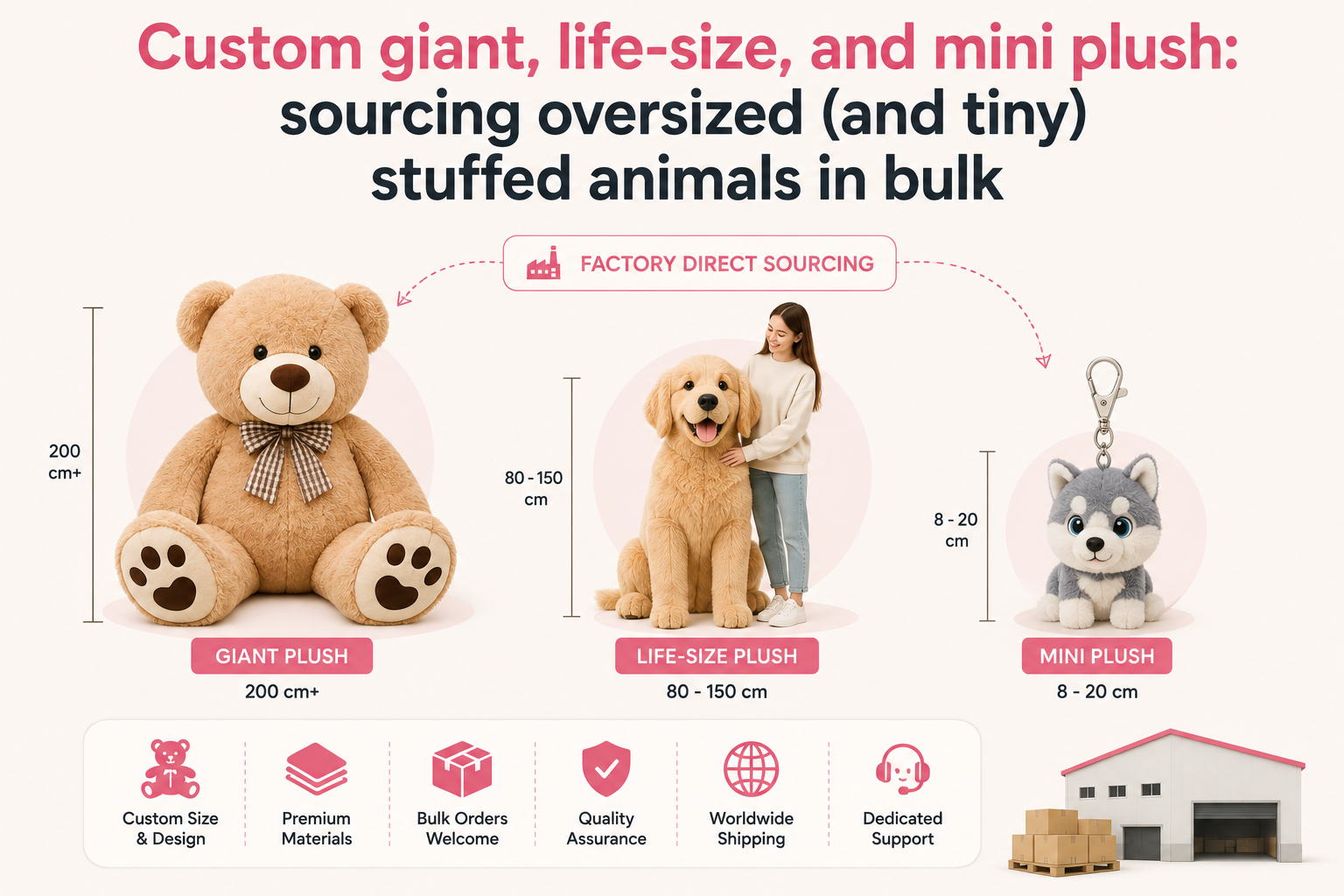
Custom giant stuffed animals are oversized plush, often waist-height or taller, made to a brand’s own design and produced in bulk. They are engineered differently from a standard plush because size changes almost everything that matters in manufacturing: how much stuffing a unit needs, whether it can hold its own shape, how the seams are built, and, more than anything, how much it costs to ship. The same is true in reverse for minis. Very small plush have their own constraints. Getting the size right, at either extreme, is where these projects succeed or blow the budget.
If you are sourcing a giant plush as a retail hero product, a display piece, or a photo-op unit, the design is only half the job. The other half is understanding why a plush twice the height costs far more than twice the price, and planning around it. Here is what actually changes with scale.
Why size changes the whole product, not just the dimensions
A common assumption is that a giant plush is just a normal plush enlarged. It is not, because volume does not grow the way height does.
When you double a plush’s height, its volume roughly increases eightfold. That single fact drives most of the surprises:
- Stuffing. A giant plush needs a lot more fill, and stuffing is a real share of the cost and the shipped weight. This is not a rounding difference. It is the main reason giants cost what they do.
- Structure. A small plush holds its shape on its own. A large one can sag, flop, or collapse under its own weight if it is only loosely stuffed with fiberfill. Bigger builds often need firmer packing, internal support, or a foam core in some areas to sit or stand properly.
- Seams. The bigger the plush, the more stress on every seam from the weight of the fill and from being picked up, hugged, or leaned on. Giant plush need reinforced, stronger seams, or they split.
So the pattern, the fill strategy, and the construction all get re-thought for scale. A maker who only quotes you a bigger version of a small pattern without addressing structure and seams is setting you up for a floppy or failing product.
Foam versus fiberfill, and holding a shape
How a giant plush is filled decides whether it looks the way you pictured or slumps into a shapeless heap.
Standard plush uses polyester fiberfill, which is soft, light, and huggable. For a small toy that is perfect. For a large one, pure fiberfill can be too soft to hold a defined shape, and a giant animal meant to sit upright or stand needs more.
The usual answers:
- Firmer, denser fiberfill packing in the areas that must hold form.
- A foam core or foam sections for structure, especially in a base, torso, or anything designed to stand.
- A mix, with foam where shape matters and soft fill where huggability matters.
The right choice depends on whether the plush is meant to be soft and cuddly, rigid and sculptural, or somewhere between. If you want to understand the fill options before you brief a maker, our guide to plush toy stuffing materials covers what each one does.
The cost that catches people out: freight
Here is the number most first-time buyers miss. For a giant plush, shipping can rival or exceed the cost of making the plush itself.
The reason is that freight is priced largely on volume, not just weight. Ocean and air freight bill by cubic meter (CBM), and a giant stuffed animal is almost all air and fluff. It is light for its size but takes up an enormous amount of space, so it eats shipping volume fast. A container fills up with far fewer giant plush than you would expect, and the per-unit freight cost climbs accordingly.
Two practical consequences:
- Always quote a giant plush project landed, meaning the product cost plus freight to your door, not just the factory price. The factory price alone will mislead you.
- Some giant plush are shipped compressed or vacuum-packed and re-lofted on arrival to save volume, though this depends on the design and the fill. Ask whether that is possible for yours.
Budgeting a giant plush without freight is the single most common way these projects go over. Treat shipping as a first-class line item from the start.
Minis have the opposite problem
At the small end, custom mini plush run into different limits, and they are worth knowing if tiny is your goal.
The main issue is detail. Features that read clearly on a normal plush get lost at mini scale. Fine markings, small faces, and intricate patterns become muddy because there is simply not enough surface to render them. Minis usually need simplified designs, with details enlarged relative to the body or dropped entirely.
The other issue is small-parts safety. Tiny plush and any small attached components are a choking hazard, so mini plush intended for or accessible to young children face stricter scrutiny on parts and construction. That constraint often decides whether a mini can be sold as a children’s toy at all, or only as an adult collectible or keychain.
Minimum quantities and “no minimum” giants
Buyers searching for custom giant plush often also search for “custom plush no minimum,” hoping to order one. It is worth being straight about economics.
You can sometimes get a single giant plush, but it is expensive per unit, because the entire cost of developing the pattern and sampling a large, structurally demanding design sits on one piece. Giants are harder to sample than small plush, so that development cost is significant.
For a brand producing a run, the per-unit cost drops with quantity in the usual way. You pay a one-time development and sampling fee, then a per-unit price that falls as you order more. Because giants are material-heavy and freight-heavy, the quantity at which the numbers feel comfortable can differ from small plush. For how sampling fees, minimums, and unit pricing fit together, see the guide to ordering custom plush, and for where minimums generally begin, our low-MOQ custom plush overview.
Where giant plush earn their keep
Giant plush are expensive to make and ship, so they pay off in specific roles rather than as everyday stock.
They work as a retail hero product, the eye-catching centerpiece that draws people to a display or a stall even if most sales are of smaller items. They work as photo-op and event units, placed in stores, lobbies, or at activations where people take pictures and share them. And they work as premium personalized gifts, where “giant personalized custom plush” is the whole appeal and the size justifies the price.
What they rarely are is a high-volume everyday seller, because the price point and the freight limit how many move. Plan a giant as a statement piece with a clear job, not as a plush you expect to sell by the thousand.
Getting the sample and the size chart right
With giant plush, the sample stage carries extra weight because size problems are expensive to discover in bulk.
When you review the prototype, check the things scale affects. Does it hold its shape the way the design intends, or does it sag? Are the seams strong enough for the weight and handling? Is the actual finished size what you specified, measured, not eyeballed? A clear size chart with real measurements, agreed before production, prevents the classic dispute where “giant” meant different things to you and the factory. Approve the sample only when the structure and the true dimensions are right, because the whole run is built to match it. For what the prototype stage involves, see how pre-production plush samples are made.
And whatever the size, a plush sold to the public or handled by children still has to meet the relevant safety rules, which for minis especially means small-parts requirements. Our summary of plush toy safety standards covers what applies in the US and EU.
Frequently asked questions
Why do giant stuffed animals cost so much more than regular plush?
Because volume grows far faster than height. A taller plush needs much more stuffing, stronger seams, and often internal structure, and it takes up a lot of shipping space. Freight alone can rival the cost of making it.
How big can a custom giant plush be made?
Very large, up to human height and beyond, but the bigger it gets, the more structure and reinforcement it needs to hold its shape, and the more freight costs. Size is limited more by cost and shipping than by manufacturing.
Can I order just one giant custom plush?
Sometimes, but it is expensive per unit because the full development and sampling cost sits on one piece, and giants are harder to sample than small plush. Per-unit cost only drops meaningfully at higher quantities.
Do giant plush use foam instead of stuffing?
Often a mix. Soft fiberfill gives the cuddly feel, while denser packing or a foam core provides structure in areas that must hold shape or stand. The balance depends on whether the plush is meant to be soft or sculptural.
What makes mini plush harder to design?
There is little surface to render detail, so fine features get lost and usually need to be simplified or enlarged. Small size also raises small-parts choking concerns, which can limit whether a mini can be sold as a young child’s toy.
Sizing the plush to the job
Whether you are going big or small, size is the design decision that drives everything else. A giant plush needs its structure, seams, and fill planned for scale, and its budget quoted landed, with freight treated as a major cost rather than an afterthought. A mini needs its design simplified and its small-parts safety handled. Match the size to a clear job, a hero display, a photo-op piece, a premium gift, a collectible keychain, agree the real measurements before production, and the finished plush will be the standout you intended instead of an expensive surprise.