
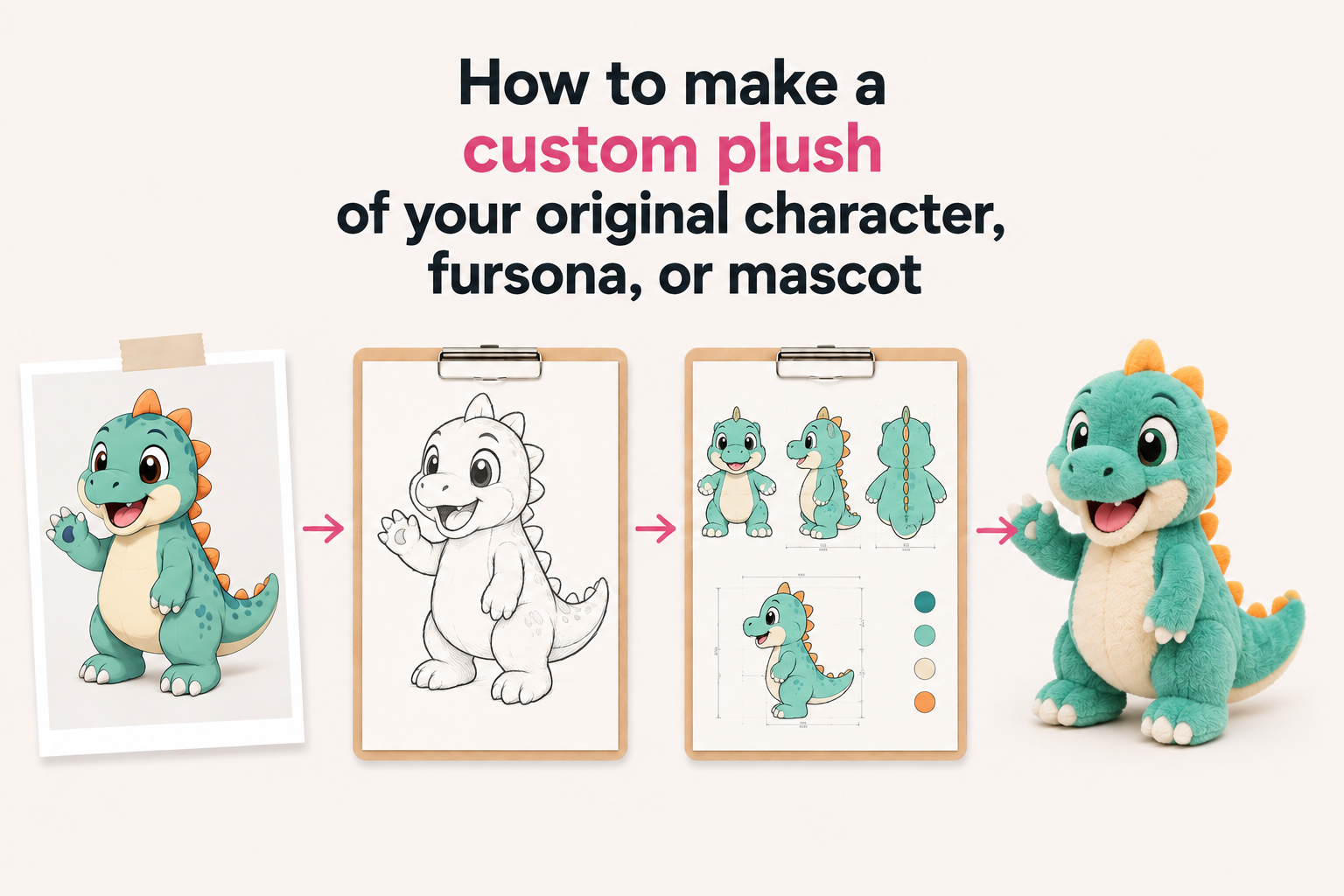
A custom OC plush is a soft toy made from your own character art instead of an existing licensed design. You supply the reference, a maker drafts a fabric pattern from it, and a sample is sewn until the plush reads as your character. The same process covers a fursona, a webcomic cast, a VTuber avatar, a game mascot, or a brand mascot. What changes is how much reference you have and how tight the likeness needs to be.
Creators come to this from two directions. Some want a single plush of a character they love. Most who are serious want a batch to sell to their audience, fund through crowdfunding, or hand out as merch. The path is similar, but the decisions about quantity, cost, and rights are where people get tripped up, so this covers all of it.
What a maker needs from you
Your art is the brief. The cleaner and more complete it is, the closer the first sample lands and the fewer rounds you pay for.
The single most valuable thing you can provide is a reference sheet, also called a turnaround: your character drawn from several angles with clear color callouts. If you have one, send it. It answers the questions a pattern maker would otherwise have to guess: what the back looks like, how the markings wrap around, what the exact colors are.
If you only have one hero illustration, you can still order, but understand what you are asking. A single front-facing drawing tells the maker nothing about the sides, the back, or the depth. They will invent those, and you will correct them at the sample stage. So supply whatever you have:
- A front view and, ideally, a back and side.
- Flat color codes or a palette, not just “purple.” Screens shift color, and character colors are usually specific to the creator.
- Close-ups or notes on signature details: a specific eye shape, a horn, a tail marking, a logo on the chest.
- A note on what must be exact versus what can be simplified.
That last point matters more than people expect, which brings up the hardest part of translating character art to plush.
Where character art fights the medium
Character designs are drawn in 2D with no thought for how they would be sewn. Plush is a soft, rounded, low-detail medium. Some things that look great on screen do not survive the translation, and a good maker will tell you so before sampling rather than after.
The usual friction points:
- Fine details and thin lines. Intricate markings, small text, and delicate patterns turn muddy at plush scale. They often need to be enlarged, simplified, or moved to an embroidered patch.
- Sharp or floating shapes. Spikes, thin limbs, and gravity-defying hair have to become sewable, stuffable forms.
- Gradient or complex coloring. Embroidery handles flat color blocks well. For busy, photographic, or gradient art, printing onto the fabric (dye sublimation) reproduces detail that stitching cannot, though it looks flatter. Many plush combine both.
None of this means your character cannot be made. It means the design gets adapted into plush form, and the version that survives the medium is what you approve. Expect the maker to suggest changes. That is a sign they know what they are doing.
Getting the likeness right through prototyping
The prototype stage is where your character stops being a drawing and becomes an object. It is worth doing patiently, because everything in your bulk run gets built to match whatever sample you sign off on.
The flow:
- The maker produces a first physical prototype from your reference.
- You review it. If you can see it in person, do, because photos hide seam quality, stuffing firmness, and true color.
- You give specific, prioritized feedback. “The muzzle is too long, the belly marking sits too high, this blue is too dark” works. “Make it look more like the art” does not.
- The maker revises and sends another sample.
Plan for at least one revision round, and often two or three for a detailed character. The approved version becomes the benchmark that production is checked against. For a fuller picture of timing and how many rounds to expect, see how pre-production plush samples are made.
How many can you make, and what does it cost
This is where hobby and business diverge.
You can order a single OC plush. One-off makers exist for exactly that. But the math is brutal per unit, because the entire cost of developing the pattern and sampling your character sits on that one piece. A one-off is a keepsake, not a sensible way to buy at any scale.
The moment you want more than a handful, the per-unit cost drops, which is the whole reason minimum order quantities exist. You pay a one-time fee to develop the design and sample it, then a per-unit price for the run, and that per-unit price falls as the quantity rises. If your audience is small and you are testing demand, our overview of low-MOQ custom plush shows where reasonable minimums begin and why the first hundred units carry most of the fixed cost. For how sampling fees, minimums, and unit pricing stack up, the guide to ordering custom plush walks through the full budget.
Cost is driven by the plush itself: size, number of embroidery colors, how many separate components, and how many sample rounds your design needs. A busy character with many colors and add-on parts costs more to set up and more per unit than a simple two-color one.
Funding a plush run through crowdfunding
A lot of OC and fursona plush get made through crowdfunding, because it solves the quantity problem. Instead of guessing how many you can sell and paying for them upfront, you collect orders first and produce to demand.
If you go this route, a few things keep you out of trouble:
- Get your sample approved before you launch, or at least before you promise a delivery date. Backers are funding a real object, and a finished prototype is what lets you price and photograph it honestly.
- Build your funding goal around the real quantity break you are aiming for, including sampling, production, and shipping, not just the per-unit price.
- Give yourself a timeline buffer. Sampling, production, and freight all take weeks, and a campaign that promises delivery too soon usually slips.
The creators who deliver smoothly are the ones who treated the prototype and the numbers as homework done before the campaign, not after.
Who owns the character, and protecting it
If the design is yours, the plush of it is yours to sell. That is the appeal of an OC over a licensed character: no royalties, no permission needed, full control.
Two things are still worth handling deliberately.
First, your rights in your own design. Your character is your intellectual property, and a reputable manufacturer makes your custom pattern and tooling exclusive to you rather than reselling your design to someone else. If that matters to you, put it in writing and ask about a non-disclosure agreement before you share your reference sheet. Our guide on plush toy IP protection, NDAs, and design rights covers how this works when you manufacture through an OEM factory.
Second, other people’s rights. This is the line creators cross without noticing. Your original character is fine. A plush of a copyrighted or trademarked character you do not own, whether that is an anime character, a game character, or a mascot from a brand, is not yours to manufacture or sell without a license, no matter how the search term is phrased. Making it for personal use is one thing. Producing a batch to sell is where you invite a takedown or worse. If you are building a business, keep it to designs you own or are licensed to use.
Safety, if anyone under 14 will hold it
An OC plush is still a soft toy. If it will be sold to the public or handled by children, it has to meet the same rules as any other plush: securely attached eyes and small parts, non-toxic materials, and the testing your market requires. This is easy to skip when you think of your product as niche merch for adult fans, but the standards apply to the product, not the fandom. If minors are anywhere in your audience, our summary of plush toy safety standards covers what applies in the US and EU.
Frequently asked questions
Can I get a plush made from just one drawing?
Yes, but one drawing forces the maker to guess the sides and back, which usually means more sample corrections. A reference sheet with multiple angles and color codes gets you a much closer first prototype.
Will the plush match my art exactly?
It will capture the shape, colors, and signature features so your character is clearly recognizable. Some fine details get simplified to work as plush, and the version you approve at the sample stage is what gets produced.
Do I need a reference sheet, or is an illustration enough?
An illustration is enough to start, but a reference sheet is far better because it defines every side and the exact colors. Without one, expect the maker to interpret the hidden angles and expect to correct them.
Can I make a plush of an anime or game character I like?
For personal use, that is your call. Producing a batch to sell a character you do not own is copyright or trademark infringement and can get your run pulled. A business should stick to original characters or licensed ones.
How do creators usually pay for a plush run?
Many use crowdfunding, collecting orders before producing so they can hit a quantity that makes the per-unit cost work. Approving a sample before launching keeps the campaign honest on price and timing.
From character sheet to a plush your audience wants
The work that decides your result happens before production: a complete reference sheet, clear color codes, and a realistic view of which details will survive as plush. Add patient sample rounds, a quantity that makes the economics work, and clean ownership of the design, and your character becomes a plush that fans recognize on sight. Keep it to designs you actually own, mind the safety rules if kids are in the mix, and the rest is just execution.