
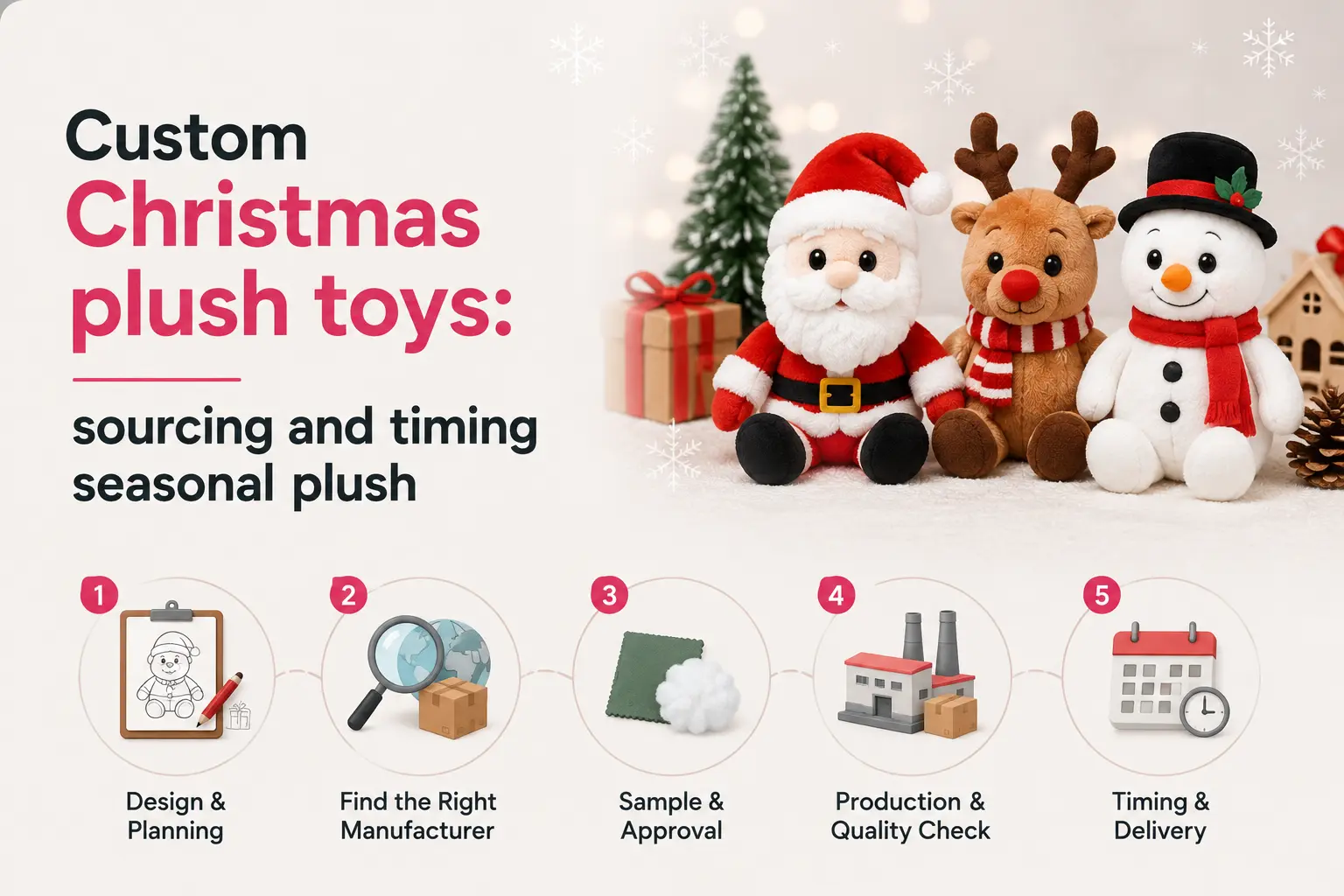
Custom Christmas plush toys are holiday-themed soft toys made to a brand’s own design, such as Santa, reindeer, snowmen, or a brand character in seasonal dress, produced for a narrow selling window. The thing that makes seasonal plush different from any other plush order is not the design. It is the calendar. A Christmas plush that arrives in January is worthless, and factory capacity, sampling, production, and shipping all take time that runs out fast in peak season. This is a guide to getting seasonal plush right, which is mostly a guide to timing.
Brands that treat a holiday order like an ordinary one, and start in autumn, miss the window or pay premiums to rush. Brands that plan backward from the selling date get their product on shelves and sold through. The design work is the same as any custom plush. The scheduling is where seasonal projects are won or lost.
Why seasonal plush is a timing problem first
Every custom plush takes time to sample, produce, and ship. For a year-round product, a delay is an inconvenience. For a Christmas product, a delay can mean the entire order misses its only selling window.
The pressure comes from two directions at once. First, the total lead time is longer than people expect: design and sampling, then bulk production, then freight, added together, run into months, not weeks. Second, everyone else is ordering at the same time, so the factories and the freight lanes you depend on are at their busiest exactly when you need them. That combination is why a seasonal order started too late either slips or gets expensive.
Plan backward from the selling date
The right way to schedule seasonal plush is to fix the date the product must be on sale, then work backward through every stage with a buffer at each step.
Count backward through:
- In-store or in-warehouse date. When the product must be ready to sell, which for Christmas retail is often well before December.
- Freight time. Ocean shipping from an overseas factory takes weeks, and customs clearance adds more. Air is faster and far costlier.
- Bulk production. The factory needs time to make the run, and that time stretches during peak season when order books are full.
- Sampling and approval. At least one or two prototype rounds, each with back-and-forth, before production can start.
- Design and quoting. The earliest stage, and the one people compress when they start late.
Adding these with realistic buffers usually lands the start date months ahead of the selling season. For seasonal plush, that means the middle of the year is not early, it is on time. Our guide to ordering custom plush covers how long each stage typically runs, and how pre-production samples are made shows why the approval stage cannot be rushed.
Peak-season capacity and freight
The two stages most affected by seasonality are the two you control least: factory capacity and shipping.
Factories fill their production calendars ahead of the holidays, and a slot that was open in spring may be gone by late summer. Booking your production window early is not just about your own timeline; it is about reserving capacity before it is taken. Leaving it late can mean a longer queue, a rushed run, or a factory that cannot take the order at all.
Freight tightens the same way. The pre-holiday months are the busiest shipping period of the year, with higher rates and less space. A delay that pushes your shipment into that crunch can raise costs and add transit time exactly when you have none to spare. Quote your seasonal plush landed, including freight, and lock shipping plans early rather than assuming space will be there.
Designing seasonal SKUs worth repeating
Seasonal plush rewards designs that can work across more than one year, because a design tied to a single moment has to sell out or become dead stock.
A few principles help:
- Favor evergreen holiday motifs. A classic Santa, reindeer, or snowman can be reordered and sold across multiple seasons, while a design pegged to a specific year’s trend cannot.
- Keep a coherent themed set. A small family of matching seasonal plush, or plush paired with items like embroidered stockings, sells as a collection and as gifts.
- Consider extendability. A design that also works as a general winter or gift item has a longer life than one that only reads as December 25.
The goal is to avoid designs whose value evaporates the moment the holiday passes, unless you are confident of selling through completely.
Managing dead-stock risk
Dated seasonal stock carries a risk that year-round plush does not: whatever you do not sell in the window sits for a year, ties up cash, and may never move.
Ways to keep that risk in check:
- Order conservatively the first year. Prove the demand before committing to a large seasonal run, especially for a new design. Our low-MOQ custom plush overview shows where sensible minimums start for a first, cautious order.
- Prefer reorderable designs. Evergreen motifs you can sell again next year turn leftover stock from a loss into next season’s opening inventory.
- Match quantity to a realistic sell-through, not an optimistic one. Seasonal windows are short and unforgiving, and over-ordering a dated product is expensive.
Seasonal plush can be very profitable within its window. The discipline is not letting the excitement of a holiday launch push you into a quantity the window cannot absorb.
Safety still applies to holiday plush
A Christmas plush is still a toy. If it is sold to the public or handled by children, it must meet the same safety rules as any other plush, regardless of the season or the novelty framing. Seasonal designs sometimes add risky elements, small bells, beads, hard accessories, or glitter, and each of those has to be assessed and, for young children, usually designed out or securely built in. Our summary of plush toy safety standards covers what applies in the US and EU, and the holiday rush is no reason to skip it.
Frequently asked questions
When should I start ordering custom Christmas plush?
Plan backward from your on-sale date through freight, production, sampling, and design, with a buffer at each stage. In practice that usually means starting around the middle of the year, because the combined lead time runs into months and peak-season capacity fills early.
Why is seasonal plush harder to source than year-round plush?
The selling window is short and fixed, so any delay can cause the order to miss it entirely. At the same time, factory capacity and freight are at their busiest before the holidays, which is exactly when you need them.
How can I avoid getting stuck with unsold holiday plush?
Order conservatively in a design’s first year, favor evergreen motifs you can sell again next season, and match quantity to a realistic sell-through. Dated stock that does not move in the window sits for a year, so restraint protects your cash.
Should Christmas plush use trendy or classic designs?
Classic motifs like Santa, reindeer, and snowmen can be reordered and sold across multiple years, which lowers dead-stock risk. Trend-specific designs can sell well but must sell through, since they lose value once the moment passes.
Do holiday plush toys need safety testing?
Yes. A seasonal plush is still a toy and must meet the same safety rules if sold or handled by children. Seasonal extras like bells, beads, or hard accessories need assessing and, for young kids, designing out or securing.
Getting seasonal plush to shelves on time
Seasonal plush is a scheduling exercise wearing a festive costume. Fix your on-sale date, count backward through freight, production, and sampling with real buffers, and book factory capacity and shipping before the peak-season crunch takes them. Design for reorder where you can, order to a realistic sell-through, and keep the safety standards the holiday rush tempts brands to skip. Handle the calendar well and a Christmas plush lands when it can actually sell, which for a dated product is the whole game.