
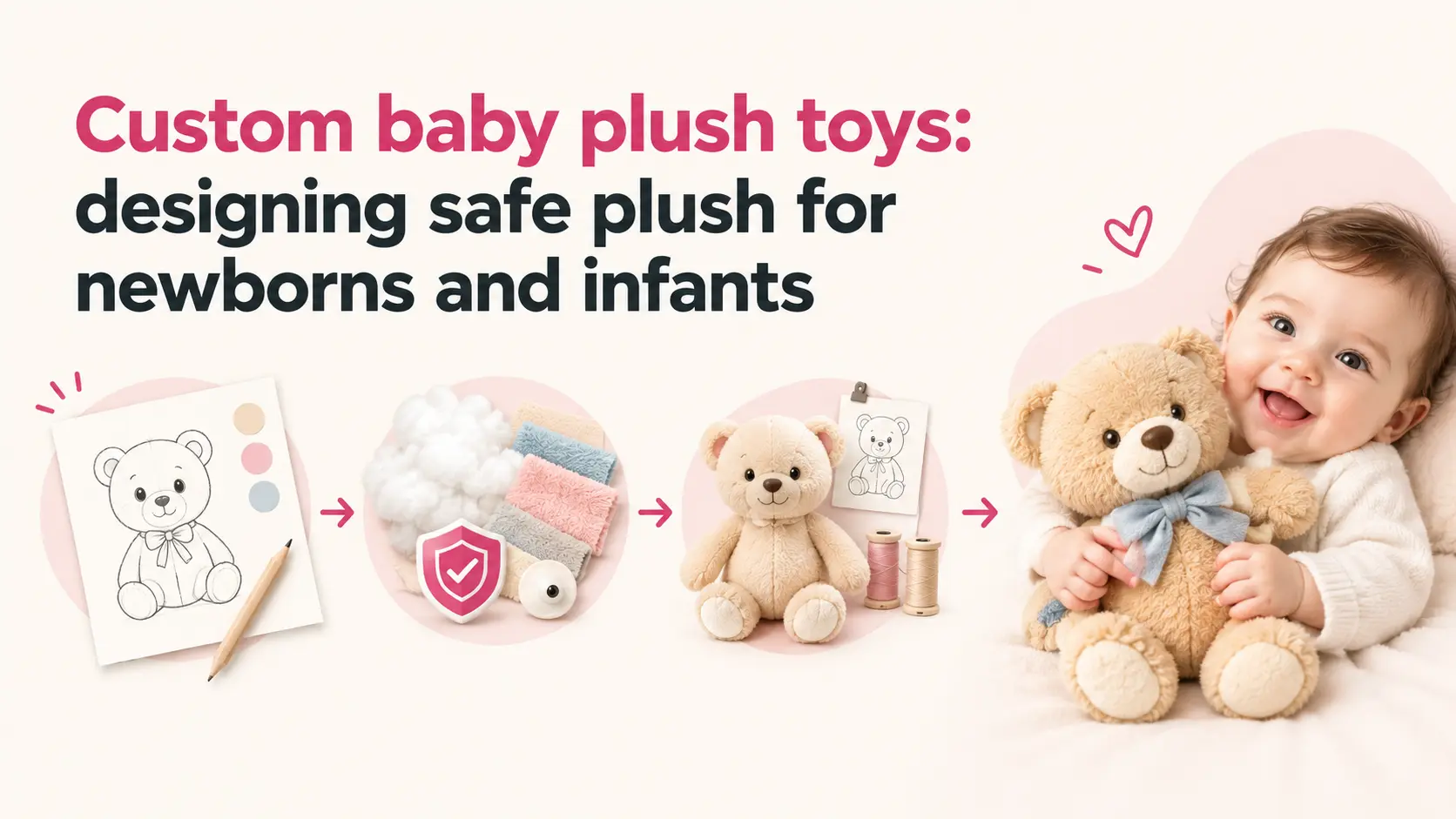
A custom baby plush toy is a soft toy made to a brand’s own design for infants, built to a higher safety standard than plush for older children or adults. The core difference is that a baby mouths, grips, and sleeps near the toy, and cannot recognize or avoid a hazard, so everything that could come loose, be swallowed, or irritate skin has to be designed out. For a brand entering the baby market, the appealing design is the easy part. The safety-driven construction is what makes the product sellable and, more importantly, safe.
Baby plush is one of the least forgiving products to get wrong, because the buyer is a parent choosing on trust and the user is the most vulnerable one there is. This covers how these toys are designed and sourced, and the specific decisions that make a plush safe for the youngest children.
Why baby plush is a different product
Plush for a five-year-old and plush for a newborn look similar and are built to different rules. The reason is developmental. Infants explore with their mouths, have no sense of danger, and spend long stretches in close contact with the toy, sometimes while sleeping. That changes what “safe” means.
The practical result is that baby plush strips out the features that make older-kid and collectible plush interesting: the plastic eyes, the small accessories, the long fibers, the intricate parts. What is left is deliberately simple, and that simplicity is the design, not a limitation.
The safety decisions that define baby plush
A handful of construction choices separate a genuine baby-safe plush from an ordinary one relabeled for infants.
- Embroidered features, never plastic parts. Plastic safety eyes and noses can be chewed or pulled off and swallowed. Baby plush uses embroidered eyes, noses, and details stitched directly into the fabric so nothing can detach.
- No small or removable parts. Buttons, beads, bows, pom-poms, and small accessories are hazards. Anything decorative must be sewn in as fabric or embroidery, not attached as a separate piece.
- Secure, reinforced stitching. Seams must be strong with no loose threads, since a baby can pull threads or work a weak seam open to reach the fill.
- Short-pile, low-shed fabric. Long fibers can be pulled out and inhaled or swallowed. Short, dense, low-shed fabric is safer for infants.
- Washability. Baby toys get dirty and need frequent cleaning, so machine-washable construction and colorfast, non-bleeding dyes matter.
- Non-toxic, hypoallergenic materials throughout. Fabric, fill, and dyes must be safe against skin and safe if mouthed.
Each of these is a design decision made before production, not a fix applied after. A plush designed with plastic eyes cannot simply have them removed later without redrawing the face.
Testing and standards for the youngest children
Toys for children under three, and especially for infants, face the strictest safety testing, because the small-parts and choking rules are tightest at this age.
In broad terms, plush sold for babies must meet the toy safety requirements of the market it is sold in: CPSIA and ASTM F963 in the United States, EN71 in the European Union, and equivalents elsewhere. The under-three category adds specific small-parts requirements, and toys must be age-graded correctly so they are labeled and sold for the right age. Some claims, like flame resistance or specific filling standards, carry their own tests.
The important qualifier is that exact requirements vary by market, by the child’s age band, and by the toy’s features, so confirm what applies to your specific product and destination before production rather than assuming. Our summary of plush toy safety standards covers the US and EU frameworks and is the right place to start, and skipping proper testing on an infant product is the one shortcut no brand should take.
Designing baby plush that still stands out
Working within these constraints does not mean every baby plush looks the same. It means the appeal comes from different places.
Since fine detail and add-on parts are out, baby plush leans on:
- Soft, rounded, huggable shapes that feel good against skin
- Gentle color palettes, often muted or pastel, that parents favor
- Texture built into the fabric rather than attached, like a soft ribbed ear or a crinkle panel sewn safely inside
- Sensory features designed to be safe, such as a soft rattle sealed inside the body or a securely embedded crinkle layer
Comfort objects and lovies, small flat plush a baby bonds with, are a strong format here precisely because they are simple. And matching a baby plush with a coordinated blanket, made to the same safety standard, creates a gift set that parents and gift-givers reach for. If you plan to extend into blankets, keep them to the same infant-safe construction covered in our custom plush blankets guide.
Cost, minimums, and sampling
Custom baby plush price like other custom plush: a one-time development and sample fee, then a per-unit price that falls with quantity. The added cost sits in the testing and the careful construction rather than in complexity, since the designs are simple.
Two points specific to baby products:
- Budget for testing. Infant safety testing is not optional and is a real line item. Build it into your costs from the start.
- Sample for safety, not just looks. When you review the prototype, check the stitching strength, confirm every feature is embroidered or sewn in with nothing removable, and verify the fabric and fill. The approved sample is what production matches. For what the sample stage involves, see how pre-production plush samples are made.
If you are testing a new baby line at low volume, our low-MOQ custom plush overview shows where minimums begin, and the guide to ordering custom plush lays out the full cost and timeline.
Frequently asked questions
What makes a plush toy safe for a newborn?
Embroidered features instead of plastic eyes, no small or removable parts, reinforced stitching with no loose threads, short low-shed fabric, washability, and non-toxic hypoallergenic materials. These are designed in from the start, not added later.
Why can’t baby plush have plastic eyes?
Plastic safety eyes and noses can be chewed or pulled off and swallowed, which is a choking hazard for infants. Baby plush uses eyes and noses embroidered directly into the fabric so nothing can detach.
What safety standards apply to custom baby plush?
Toys for infants must meet the market’s toy safety rules, such as CPSIA and ASTM F963 in the US or EN71 in the EU, with the strictest small-parts requirements applying under age three. Exact requirements vary by market and product, so confirm before production.
Can baby plush have rattles or sounds?
Yes, if built safely. A soft rattle or a crinkle layer can be sealed securely inside the body so a baby cannot reach it. Any sound element must be fully contained with no accessible hard or small parts.
Do baby plush toys need to be washable?
In practice, yes. Baby toys get dirty and need frequent cleaning, so machine-washable construction and colorfast dyes that do not bleed are important for a product parents will actually use.
Building a baby line parents trust
Baby plush earns its market on safety, and the safety is built in at the design stage: embroidered features, nothing removable, strong seams, gentle low-shed fabric, and full testing for the age. Work within those constraints and let the appeal come from soft shapes, calm colors, and safe sensory touches rather than detail and accessories. Budget for the testing, sample for safety as much as looks, and you get a baby plush a parent can hand to a newborn without a second thought, which is exactly what the product has to be.