
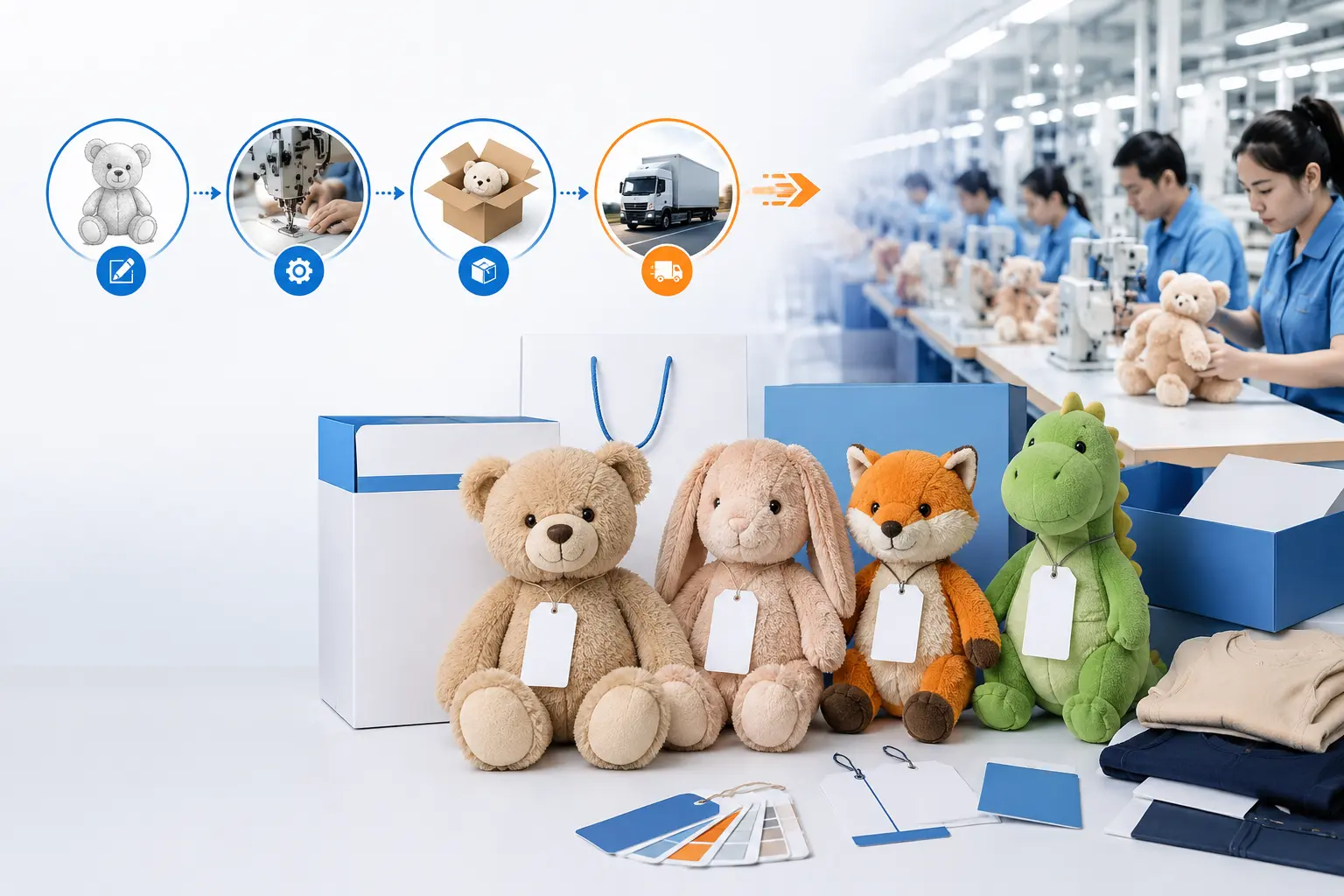
Not every brand that wants to sell plush toys wants to spend four months developing one from a blank sheet. Sometimes you have a store, an audience, and a gap on the shelf — and what you need is a good-quality soft toy with your branding on it, on the water in weeks, not seasons. That’s the exact problem white label plush toys solve.
White label is one of the most misunderstood corners of the plush world. People confuse it with cheap generic tat, or with full custom, and it’s really neither. Used well, it’s a fast, capital-light way to launch. Used badly, it’s how you end up with the same bear everyone else is selling. This guide explains what white label plush actually is, how it differs from OEM and ODM, and when it’s the right call.
Quick answer: A white label plush toy is an existing, factory-designed soft toy that a brand rebrands as its own — adding its logo, hang tags, and packaging — without developing the toy from scratch. It offers the fastest, lowest-cost route to market, trading full design control for speed and lower minimums.
White label, private label, OEM, ODM — untangling the terms
These four terms get thrown around interchangeably, and the confusion costs buyers real money. Here’s the clean version.
| Model | What you get | Design control | Speed | Best for |
|---|---|---|---|---|
| White label | Existing factory design, your branding | Branding only | Fastest | Fast launch, testing a market |
| Private label | Existing design, sometimes minor tweaks, your branding | Low | Fast | Retailers building an own-brand line |
| ODM | Factory-designed base you modify (colors, size, details) | Medium | Medium | Brands wanting a distinct look without full tooling |
| OEM | Your original design, built to your spec from scratch | Full | Slowest | Licensed characters, unique IP |
The practical spectrum runs from “put my label on your toy” (white label) all the way to “build my exact character from my art” (OEM). White label sits at the fast, low-commitment end. If you want the full breakdown of the two custom models, our OEM vs ODM plush toys explainer digs into where the line sits and which route fits which brand.
The mistake buyers make is paying OEM prices and timelines when white label would have served — or, less often, going white label when their whole value proposition was a unique character that demanded custom.
When white label is the right move
White label earns its keep in a few specific situations, and being honest about which one you’re in saves a lot of grief.
You’re testing a market. You suspect your audience wants plush but you’re not sure which style, size, or character type. White label lets you put branded product out cheaply and let sales data guide your first real custom order.
Speed is the whole point. There’s a seasonal window, a trend to catch, or a retail slot to fill, and a four-month custom development cycle would miss it entirely. White label can have branded stock moving in a fraction of that time.
Capital is tight. Custom development means tooling, sampling rounds, and higher minimums. White label typically means lower MOQs and no development spend, which keeps your first bet small.
The plush isn’t your differentiator. If your brand’s value is your community, your content, or your other products, and the plush is a merch extension, you may not need a bespoke design at all. A well-made white label toy with great branding does the job.
If, on the other hand, a unique character is your product, white label will undercut the very thing you’re selling — that’s when you step up to ODM or OEM and accept the longer road.
What you can and can’t change
This is where expectations need to be set carefully, because “white label” doesn’t mean “identical to the sample and nothing else.” There’s usually a middle band of light customization available.
| Element | Typically changeable on white label? |
|---|---|
| Logo, hang tag, care label | Yes — this is the core of it |
| Packaging and inserts | Yes |
| Fabric color (from factory options) | Often, at higher MOQ |
| Embroidered branding on the toy | Sometimes |
| Size or body shape | Rarely — that’s ODM territory |
| Face, character, sculpt | No — that’s OEM |
The moment you start wanting to change the toy rather than the branding, you’ve quietly crossed into ODM, and your cost and timeline shift accordingly. That’s not a bad thing — it just needs to be a conscious decision, not a surprise on the invoice.
Costs, minimums, and timelines
White label’s appeal is concentrated in these numbers. Because the design already exists and tooling is done, you skip the most expensive and slowest parts of custom development.
- MOQs: often lower than full custom — sometimes a few hundred pieces per design where OEM might demand a thousand-plus.
- Timeline: branded stock can move in a few weeks rather than the 3–4 months a from-scratch custom program takes.
- Cost: no development or tooling spend; you’re mainly paying for units plus branding setup (hang tags, packaging).
For a realistic sense of how white label compares to going fully custom, our custom plush toy manufacturing cost breakdown shows exactly which line items disappear when you skip bespoke development. The savings aren’t just money — the biggest win is often the months you don’t spend.
The compliance point everyone tries to skip
Here’s the trap. Because the toy already exists, buyers assume compliance is “handled” and they can just slap a label on and sell. That assumption can get you fined or your shipment seized. Even on a white label product, you — the brand whose name is on it — carry responsibility for meeting the safety standards of your market: ASTM F963 in the US, EN71 in Europe.
A good supplier will have existing test reports for the base product, but you must confirm they’re current, cover your target market, and match the exact configuration you’re buying. Our plush toy safety standards guide walks through what to ask for. Never take “it’s already certified” at face value without seeing the paperwork.
The honest trade-off
White label buys you speed, low cost, and low risk. It costs you uniqueness. That’s the entire deal, and it’s a genuinely good deal for the right brand at the right moment. My usual advice: use white label to learn — launch fast, see what your audience actually buys — and then reinvest that knowledge into a custom program once you know exactly what will sell. Plenty of successful plush brands started with a rebranded toy and a good story, and graduated to bespoke once the demand was proven.
Frequently asked questions
What’s the real difference between white label and custom plush toys?
White label means you take a plush the factory has already designed and produced, and you rebrand it as your own with your logo, hang tags, and packaging — the toy itself stays as-is. Custom, whether ODM or OEM, means the toy is designed or modified specifically for you, from tweaking an existing base to building an original character from your artwork. White label trades design control for dramatically faster launch times and lower costs, which is exactly the trade-off that makes it right for some brands and wrong for others.
Is white label plush cheaper than developing a custom toy?
Almost always, and the savings run deeper than the unit price. Because the design already exists, you skip development spend, tooling charges, and multiple sampling rounds, and minimums are often lower too. You’re mainly paying for the units themselves plus branding setup like custom hang tags and packaging. The other saving is time — cutting months off your timeline has real financial value when you’re chasing a season or a trend.
Can I change anything about a white label plush, or is it fixed?
You can reliably change everything about the branding — logo, hang tags, care labels, packaging, and inserts — and often the fabric color from the factory’s available options at a higher minimum. What you generally can’t change is the toy’s size, shape, face, or sculpt; the moment you want to alter the actual product rather than its branding, you’ve moved into ODM or OEM territory with the cost and timeline that implies. Knowing where that line sits keeps you from surprise charges.
Do I still need safety testing and compliance for a white label plush?
Yes, absolutely, and this is the most dangerous thing buyers overlook. As the brand whose name is on the product, you carry legal responsibility for meeting your market’s safety standards regardless of who designed the toy. A reputable supplier will hold test reports for the base product, but you must verify they’re current, cover your specific market, and match the exact version you’re buying. Selling on the assumption that “it’s already certified” without seeing valid paperwork can lead to fines or seized shipments.
When should I move from white label to a fully custom plush?
Move up when uniqueness starts driving your sales — when your audience is asking for a specific character, when competitors are selling the same generic base, or when you’ve gathered enough sales data to know precisely what a custom toy should be. The smart path is to use white label to launch fast and learn cheaply, then reinvest that proven demand into an OEM or ODM program. Jumping straight to full custom before you understand your market means betting big money on an invalidated guess.
About the author
Zhang Wei guides brands through the sometimes-confusing choice between white label, private label, ODM, and OEM plush manufacturing. Having worked across the full spectrum from rebranded stock to ground-up custom development, he’s blunt about the trade-offs and allergic to buyers overpaying for a level of customization they don’t need. He writes about sourcing strategy, manufacturing models, and toy safety for brands who want to launch smart rather than just launch big.
Not sure whether white label or custom fits your brand? Compare the routes in our OEM vs ODM guide or tell us your timeline and we’ll point you to the right path.