
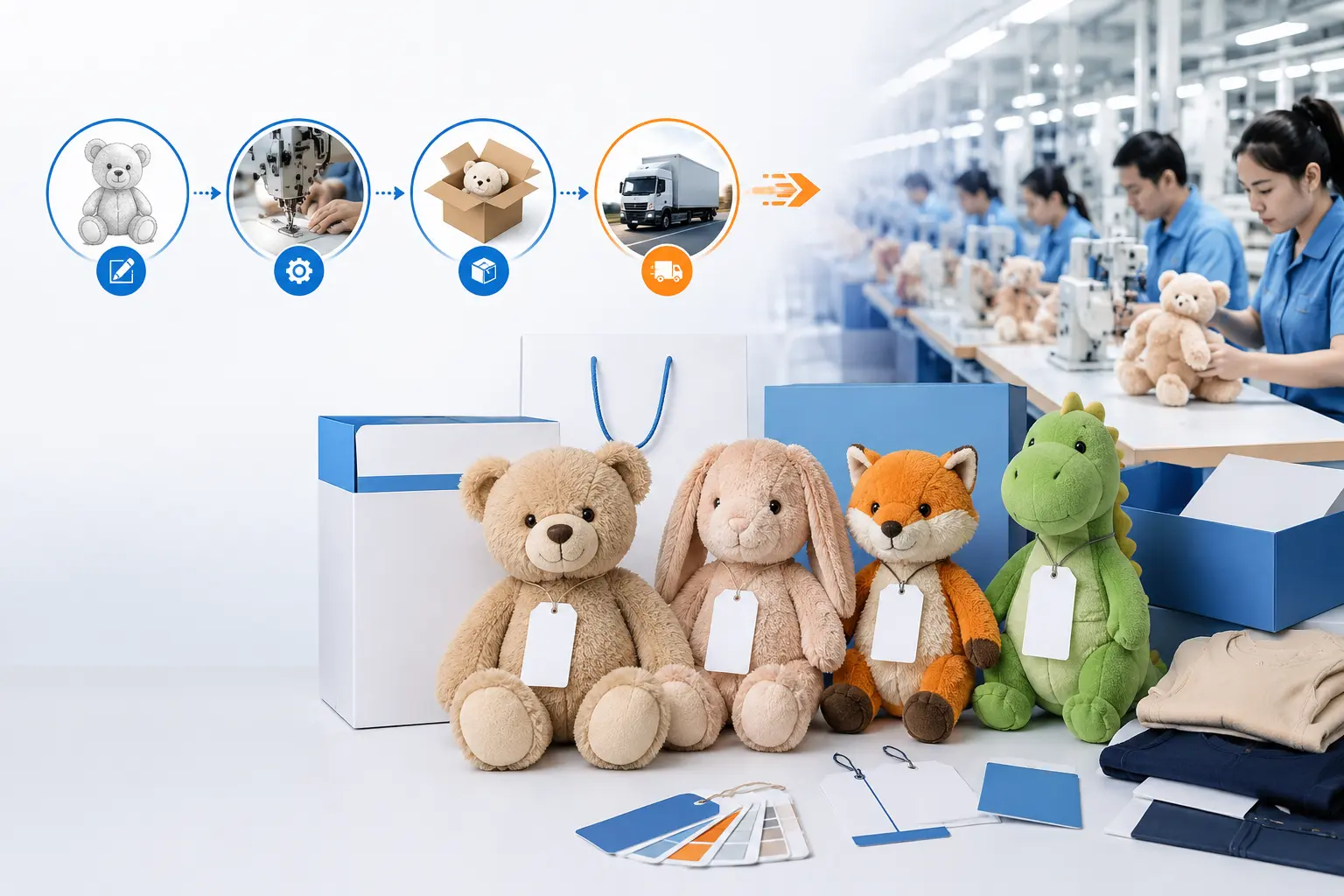
ぬいぐるみを販売したいと考えているブランドすべてが、白紙の状態から4ヶ月かけて商品を開発したいとは限りません。時には、店舗や顧客層があり、棚に空きがある場合もあり、そんな時に必要なのは、高品質なぬいぐるみで、 あなたの そこにブランドロゴが入っていて、数週間で水に浮かぶ。季節単位ではない。まさにそこが問題なんだ ホワイトラベルのぬいぐるみ 解く。.
ホワイトラベルは、ぬいぐるみの世界において最も誤解されがちな分野の一つです。人々はこれを、安っぽい汎用商品や完全なオーダーメイド商品と混同しがちですが、実際にはそのどちらでもありません。うまく活用すれば、迅速かつ低コストで商品を発売できる手段となります。しかし、使い方を誤れば、他の誰もが販売しているのと同じクマを扱ってしまう結果になってしまいます。 このガイドでは、ホワイトラベルのぬいぐるみが実際にどのようなものか、OEMやODMとどう異なるのか、そしてどのような場合にホワイトラベルが適切な選択肢となるのかを解説します。.
簡単な答え: ホワイトラベルのぬいぐるみとは、既存の工場設計によるぬいぐるみを、ブランドが独自にリブランディング(ロゴ、吊り下げタグ、パッケージを追加)したもので、一から開発を行う必要がありません。これは、デザインに対する完全なコントロール権を犠牲にする代わりに、スピードと少量の最小発注数量を実現し、市場投入までの時間を短縮し、コストを最小限に抑えることができる最も迅速かつ低コストな手法です。.
ホワイトラベル、プライベートラベル、OEM、ODM――用語の整理
これら4つの用語は、しばしば混同されて使われており、その混乱が購入者に実際の金銭的損失をもたらしています。ここでは、その違いを明確に解説します。.
| モデル | 内容 | 設計管理 | 速度 | こんな方に最適 |
|---|---|---|---|---|
| ホワイトラベル | 既存の工場設計、貴社のブランドイメージ | ブランディングのみ | 最速 | 迅速な立ち上げ、市場のテスト |
| プライベートブランド | 既存のデザイン、場合によっては微調整、貴社のブランディング | 低 | 速い | 自社ブランドラインを展開する小売業者 |
| ODM | メーカーがデザインしたベースを、お客様ご自身でカスタマイズ(色、サイズ、細部) | 中 | 中 | 金型一式を用意せずに、独自のデザインを実現したいブランド |
| OEM | お客様独自のデザインを、ご要望通りに一から製作いたします | 全文 | 最も遅い | ライセンス取得済みキャラクター、独自のIP |
実際の範囲は、「自社ブランド名をおもちゃに貼る」(ホワイトラベル)から、「私のイラストを基に、そのキャラクターを忠実に再現する」(OEM)まで多岐にわたります。ホワイトラベルは、迅速で負担の少ない選択肢です。これら2つのカスタマイズモデルの詳細な比較をご希望の場合は、当社の OEMとODMのぬいぐるみ この解説記事では、その境界線がどこにあるのか、またどのルートがどのブランドに適しているのかを詳しく掘り下げています。.
購入者が犯しがちな間違いは、ホワイトラベルで十分だったにもかかわらずOEM価格や納期を支払ってしまうこと、あるいは(それほど頻繁ではありませんが)、独自のキャラクターこそが価値提案のすべてであり、カスタム製品が不可欠であるにもかかわらず、ホワイトラベルを選択してしまうことです。.
ホワイトラベルが適切な選択肢となる場合
ホワイトラベルは、特定の状況下においてこそその価値を発揮します。自分がどの状況にあるかを正直に認識しておくことで、後々のトラブルを大幅に防ぐことができます。.
市場をテストしているのです。. 顧客はぬいぐるみを求めていると推測しているものの、どのスタイル、サイズ、キャラクタータイプが好まれるかは定かではありません。ホワイトラベルを利用すれば、自社ブランドの商品を低コストで市場に投入し、販売データをもとに最初の展開の方向性を決めることができます。 real 特注品。.
スピードこそがすべてだ。. 季節限定の販期や、捉えるべきトレンド、あるいは埋めるべき小売枠がある中で、4か月もかかるカスタム開発サイクルでは、それらを完全に逃してしまうことになります。ホワイトラベルなら、その数分の1の時間でブランド商品を市場に投入することができます。.
資金繰りが厳しい。. カスタム開発には、金型製作、試作工程、そしてより高い最小発注数量(MOQ)が伴います。一方、ホワイトラベル製品は通常、MOQが低く、開発費用もかからないため、初期投資を最小限に抑えることができます。.
ぬいぐるみだけでは差別化にはなりません。. もしブランドの価値がコミュニティやコンテンツ、あるいは他の製品にあり、ぬいぐるみがその派生商品であるならば、特注のデザインはまったく必要ないかもしれません。ブランディングがしっかりされた、質の高いホワイトラベルのおもちゃがあれば十分です。.
一方、もし一意な文字が は 自社製品の場合、ホワイトラベルはまさに自社が販売しているものを価格面で脅かすことになります。そんな時は、ODMやOEMへと踏み出し、より長い道のりを受け入れるべきです。.
What you can and can’t change
This is where expectations need to be set carefully, because “white label” doesn’t mean “identical to the sample and nothing else.” There’s usually a middle band of light customization available.
| Element | Typically changeable on white label? |
|---|---|
| Logo, hang tag, care label | Yes — this is the core of it |
| Packaging and inserts | Yes |
| Fabric color (from factory options) | Often, at higher MOQ |
| Embroidered branding on the toy | Sometimes |
| Size or body shape | Rarely — that’s ODM territory |
| Face, character, sculpt | No — that’s OEM |
The moment you start wanting to change the toy rather than the branding, you’ve quietly crossed into ODM, and your cost and timeline shift accordingly. That’s not a bad thing — it just needs to be a conscious decision, not a surprise on the invoice.
Costs, minimums, and timelines
White label’s appeal is concentrated in these numbers. Because the design already exists and tooling is done, you skip the most expensive and slowest parts of custom development.
- MOQs: often lower than full custom — sometimes a few hundred pieces per design where OEM might demand a thousand-plus.
- Timeline: branded stock can move in a few weeks rather than the 3–4 months a from-scratch custom program takes.
- Cost: no development or tooling spend; you’re mainly paying for units plus branding setup (hang tags, packaging).
For a realistic sense of how white label compares to going fully custom, our オーダーメイドぬいぐるみの製造コスト breakdown shows exactly which line items disappear when you skip bespoke development. The savings aren’t just money — the biggest win is often the months you don’t spend.
The compliance point everyone tries to skip
Here’s the trap. Because the toy already exists, buyers assume compliance is “handled” and they can just slap a label on and sell. That assumption can get you fined or your shipment seized. Even on a white label product, you — the brand whose name is on it — carry responsibility for meeting the safety standards of your market: ASTM F963 in the US, EN71 in Europe.
A good supplier will have existing test reports for the base product, but you must confirm they’re current, cover your target market, and match the exact configuration you’re buying. Our ぬいぐるみの安全基準ガイド walks through what to ask for. Never take “it’s already certified” at face value without seeing the paperwork.
The honest trade-off
White label buys you speed, low cost, and low risk. It costs you uniqueness. That’s the entire deal, and it’s a genuinely good deal for the right brand at the right moment. My usual advice: use white label to learn — launch fast, see what your audience actually buys — and then reinvest that knowledge into a custom program once you know exactly what will sell. Plenty of successful plush brands started with a rebranded toy and a good story, and graduated to bespoke once the demand was proven.
よくある質問
What’s the real difference between white label and custom plush toys?
White label means you take a plush the factory has already designed and produced, and you rebrand it as your own with your logo, hang tags, and packaging — the toy itself stays as-is. Custom, whether ODM or OEM, means the toy is designed or modified specifically for you, from tweaking an existing base to building an original character from your artwork. White label trades design control for dramatically faster launch times and lower costs, which is exactly the trade-off that makes it right for some brands and wrong for others.
Is white label plush cheaper than developing a custom toy?
Almost always, and the savings run deeper than the unit price. Because the design already exists, you skip development spend, tooling charges, and multiple sampling rounds, and minimums are often lower too. You’re mainly paying for the units themselves plus branding setup like custom hang tags and packaging. The other saving is time — cutting months off your timeline has real financial value when you’re chasing a season or a trend.
Can I change anything about a white label plush, or is it fixed?
You can reliably change everything about the branding — logo, hang tags, care labels, packaging, and inserts — and often the fabric color from the factory’s available options at a higher minimum. What you generally can’t change is the toy’s size, shape, face, or sculpt; the moment you want to alter the actual product rather than its branding, you’ve moved into ODM or OEM territory with the cost and timeline that implies. Knowing where that line sits keeps you from surprise charges.
Do I still need safety testing and compliance for a white label plush?
Yes, absolutely, and this is the most dangerous thing buyers overlook. As the brand whose name is on the product, you carry legal responsibility for meeting your market’s safety standards regardless of who designed the toy. A reputable supplier will hold test reports for the base product, but you must verify they’re current, cover your specific market, and match the exact version you’re buying. Selling on the assumption that “it’s already certified” without seeing valid paperwork can lead to fines or seized shipments.
When should I move from white label to a fully custom plush?
Move up when uniqueness starts driving your sales — when your audience is asking for a specific character, when competitors are selling the same generic base, or when you’ve gathered enough sales data to know precisely what a custom toy should be. The smart path is to use white label to launch fast and learn cheaply, then reinvest that proven demand into an OEM or ODM program. Jumping straight to full custom before you understand your market means betting big money on an invalidated guess.
著者について
張偉 guides brands through the sometimes-confusing choice between white label, private label, ODM, and OEM plush manufacturing. Having worked across the full spectrum from rebranded stock to ground-up custom development, he’s blunt about the trade-offs and allergic to buyers overpaying for a level of customization they don’t need. He writes about sourcing strategy, manufacturing models, and toy safety for brands who want to launch smart rather than just launch big.
Not sure whether white label or custom fits your brand? Compare the routes in our OEM vs ODM guide or tell us your timeline and we’ll point you to the right path.