
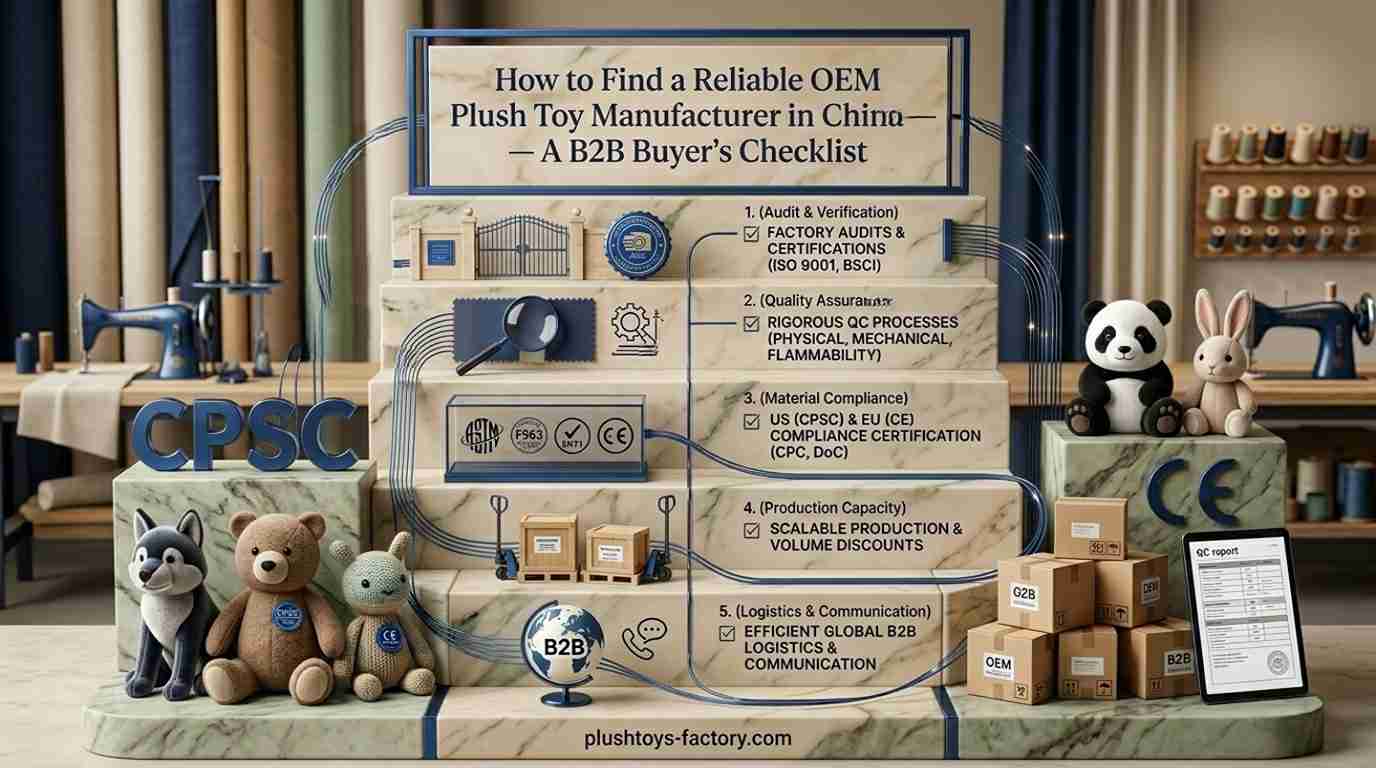
So finden Sie einen zuverlässigen OEM-Hersteller für Plüschtiere in China – Checkliste für B2B-Einkäufer
Finding an OEM plush toy manufacturer in China isn’t hard.
Finding one that delivers what they promise, on time, on spec, with proper compliance documentation, that’s the actual challenge.
We’ve been manufacturing in Dongguan for over 15 years. In that time, we’ve seen brands make the same sourcing mistakes repeatedly. Not because they’re careless. Because nobody gave them a proper checklist before they wired their first deposit.
This is that checklist.
What OEM Actually Means in Plush Toy Manufacturing
Before the checklist — a quick clarification that matters more than most buyers realize.
OEM stands for Original Equipment Manufacturer. In plush toy sourcing, it means the factory produces toys based entirely on your design specifications. Your character. Your dimensions. Your materials. Your branding.
This is different from ODM, Original Design Manufacturer, where the factory provides existing designs that you customize with your logo or colorway.
Most brands sourcing custom plush toys want OEM. They have a specific character in mind. A mascot. A licensed character. A product designed in-house.
Why does this distinction matter? Because not every factory that claims OEM capability actually has it. Some factories show OEM on their website but primarily do ODM, they’re set up for adapting existing molds and patterns, not building from scratch. Sending a new character brief to an ODM-focused factory is how you end up with something that looks approximately like your design but not quite right.
Ask directly: “Do you develop new patterns from customer design briefs, or do you primarily adapt existing designs?” The answer tells you a lot.
The Checklist: 12 Things to Verify Before Placing an OEM Order
1. Confirm They Are a Factory, Not a Trading Company
This is the first filter. Trading companies present themselves as manufacturers. Some are transparent about it. Many aren’t.
A trading company places your order with an actual factory, adding margin, reducing your control, and creating a communication layer between you and the people who actually make your toys.
How to verify: Ask for factory photos, factory registration documents, and a video call where you can see the production floor. A real factory will have no problem showing you. Ask for their manufacturing license number — in China, factories have a business registration that specifies manufacturing as their business type.
2. Check Their Experience With Your Target Market
A factory that primarily ships to European buyers may have EN71 compliance dialed in, but has never issued a US Children’s Product Certificate. A factory that ships mostly to domestic Chinese distributors may have neither.
Ask specifically: “What percentage of your orders ship to the USA? To Europe?” Ask to see examples of ASTM F963 test reports and EN71 test reports they’ve issued for previous clients.
3. Request Full Sample Development Capability
OEM manufacturing starts with a sample. Before committing to production, you need a physical prototype that matches your approved specifications.
Ask: “What is your sample development process?” A proper answer should include pattern development, initial prototype, client review and revision rounds, and final sample approval before bulk production.
If a factory is vague about sample revisions — “we’ll make it right” without specifics — that’s a flag. Get in writing how many revision rounds are included and what the timeline is.
4. Verify AQL Inspection Process
AQL stands for Acceptable Quality Level. It’s the international standard for how production batches are inspected before shipment.
AQL 2.5 means that during inspection, a defect rate of 2.5% or below is acceptable. Higher AQL numbers mean more defects are allowed.
Ask: “What AQL standard do you apply to outgoing shipments?” If they don’t know what AQL means, that tells you something. If they say AQL 4.0 or higher, that’s more defects than most retail buyers will accept.
At Ziyee Family, every batch ships after an AQL 2.5 inspection. The inspection report is available to clients.
5. Confirm Pantone Color Matching
For branded products, color accuracy matters. Your character’s specific shade of blue or your mascot’s exact orange needs to match your brand guidelines.
Ask: “Do you use Pantone color matching?” Ask how they handle color approval before production. A good answer: physical fabric swatches matched to your Pantone reference, sent to you for approval before bulk production begins.
A factory that matches colors “by eye” or only works from reference photos is a factory that will produce close colors, but probably not exact.
6. Review Their Fabric Sourcing
Fabric quality varies enormously in plush manufacturing. Short-cut pile, long-cut pile, minky, velboa, faux fur — each behaves differently in production and performs differently in testing.
Ask where their fabrics are sourced. Ask if they can provide fabric samples before production. Ask specifically whether their fabrics have been tested for EN71-3 chemical compliance or ASTM F963 chemical requirements.
A factory that sources fabric from the cheapest available mill without testing is a factory that will eventually produce a batch that fails chemical testing. That failure shows up in your market, not theirs.
7. Ask About Their Minimum Order Quantity Per Design
MOQ varies widely. Some factories won’t move below 500 pieces. Some claim no minimum but charge prohibitive per-unit rates at low volumes.
Get the actual number. And ask whether the MOQ applies per design or per order. If you want three different characters, do each need to meet the minimum individually?
For most B2B brands testing new products, an MOQ of 100-300 pieces per design is workable. Higher than that, and you’re taking significant inventory risk on an untested product.
8. Confirm Lead Times in Writing
Standard lead times for custom OEM plush toys from Chinese factories:
| Stage | Zeitleiste |
|---|---|
| Sample development | 7-14 business days |
| Bulk production | 25-35 days |
| Sea freight USA | 18-25 days |
| Air freight USA/Europe | 5-8 days |
| Total minimum | 8-14 weeks |
Total door-to-door timeline: 8-14 weeks minimum for sea freight.
Get these numbers in writing in your purchase order. “Approximately 30 days” is not a commitment. A specific calendar date is.
9. Review Their Export Documentation Process
Customs clearance requires proper documentation. Commercial invoice, packing list, bill of lading, certificate of origin, and, for toys specifically, compliance documentation.
Ask: “What export documents do you provide with each shipment?” Ask specifically about CPSC compliance documentation for US-bound shipments and CE documentation for European shipments.
A factory that’s never shipped to compliant retail markets will be vague here. A factory with real export experience will give you a specific list.
10. Check Communication Quality and Response Time
This sounds soft. It’s not.
A factory’s communication quality before your order is placed is the best predictor of their communication quality during production — when it actually matters.
Send a detailed inquiry. See how long they take to respond. Check whether the response addresses your actual questions or gives generic answers. Ask a follow-up technical question. A factory with competent sales and technical staff will answer specifically.
At Ziyee Family, we commit to 12-hour response times for all client inquiries. That commitment applies throughout the production cycle — not just during the sales process.
11. Ask for Client References
A factory with real B2B export experience has clients who can verify that experience.
Ask: “Can you provide two or three client references I can contact?” Some factories will decline for confidentiality reasons — that’s legitimate. But a factory that can’t point to any verifiable history of successful exports should be approached carefully.
Alternatively, ask if they have any case studies, testimonials with company names, or any publicly verifiable history of their work.
12. Get a Complete Quote Before Paying Anything
A complete quote for OEM plush toy manufacturing should include:
- Per-unit production cost at your specified quantity
- Sample development cost (often refundable against bulk order)
- Packaging cost if custom packaging is required
- AQL inspection cost (sometimes charged separately)
- The compliance testing cost if they arrange it
- Shipping cost estimate (or confirm you’re arranging separately)
Any quote that’s missing items from this list will generate surprises later. Surprises in manufacturing almost always mean higher costs.
Red Flags That Should Stop an Order
Some things are immediate disqualifiers.
No physical sample process. Any factory willing to go straight from brief to bulk production is a factory that doesn’t understand — or doesn’t care about — quality control.
Certificates without test reports. A CE certificate is a declaration. The test reports are the evidence. If a factory can’t produce the actual lab test reports behind their compliance claims, the claims are unverifiable.
Dramatic price drops when you push back. A factory that quotes $8 per unit, then drops to $5.50 when you hesitate, isn’t finding efficiency. They’re removing something from the process.
Unavailable for video calls. Every legitimate factory will get on a video call. If a factory avoids showing you their facility — on camera, in real time — that’s a significant flag.
No English-speaking technical contact. Sales teams often speak functional English. But if there’s no technical person available to answer specification questions in English, your design brief will get lost in translation at some point during production.
Fazit
Sourcing the right OEM plush toy manufacturer in China takes more than a Google search. It takes the right questions — asked before the deposit is wired.
If you want to understand exactly how we handle OEM production for B2B brands in the US and Europe. Our process, our timelines, our compliance documentation, we’re straightforward about all of it.
Request a factory-direct quote
Häufig gestellte Fragen
How do I verify a Chinese factory’s legitimacy?
Ask for their business registration number and verify it through China’s National Enterprise Credit Information Publicity System. Ask for their manufacturing license. Request a video call showing the production floor during working hours.
What’s the difference between a factory audit and a factory visit?
A factory visit is you (or your agent) visiting the facility in person. A factory audit is a formal third-party inspection conducted by a company like SGS, Bureau Veritas, or Intertek — resulting in a scored report against defined criteria. Audits provide standardized, verifiable documentation that factory visits alone don’t.
Should I use a sourcing agent instead of going direct?
Sourcing agents add margin and a communication layer. Going directly to a factory gives you more control and typically better pricing. The tradeoff is that vetting the factory becomes your responsibility entirely. If you lack the time or China sourcing experience to verify factories properly, a reputable sourcing agent with transparent fees can reduce risk.
What payment terms are standard for OEM plush toy orders?
Standard is 30% deposit upfront, 70% balance before shipment. Some factories offer 50/50. Never pay 100% upfront. Never wire money before seeing a signed purchase order with specifications.
How do I protect my design IP when working with a Chinese factory?
Request an NDA before sharing detailed design files. Register your design with China’s National Intellectual Property Administration if you’re producing significant volumes. Work with factories that have a history of B2B export relationships — established factories with Western clients have reputational reasons to respect IP agreements.