
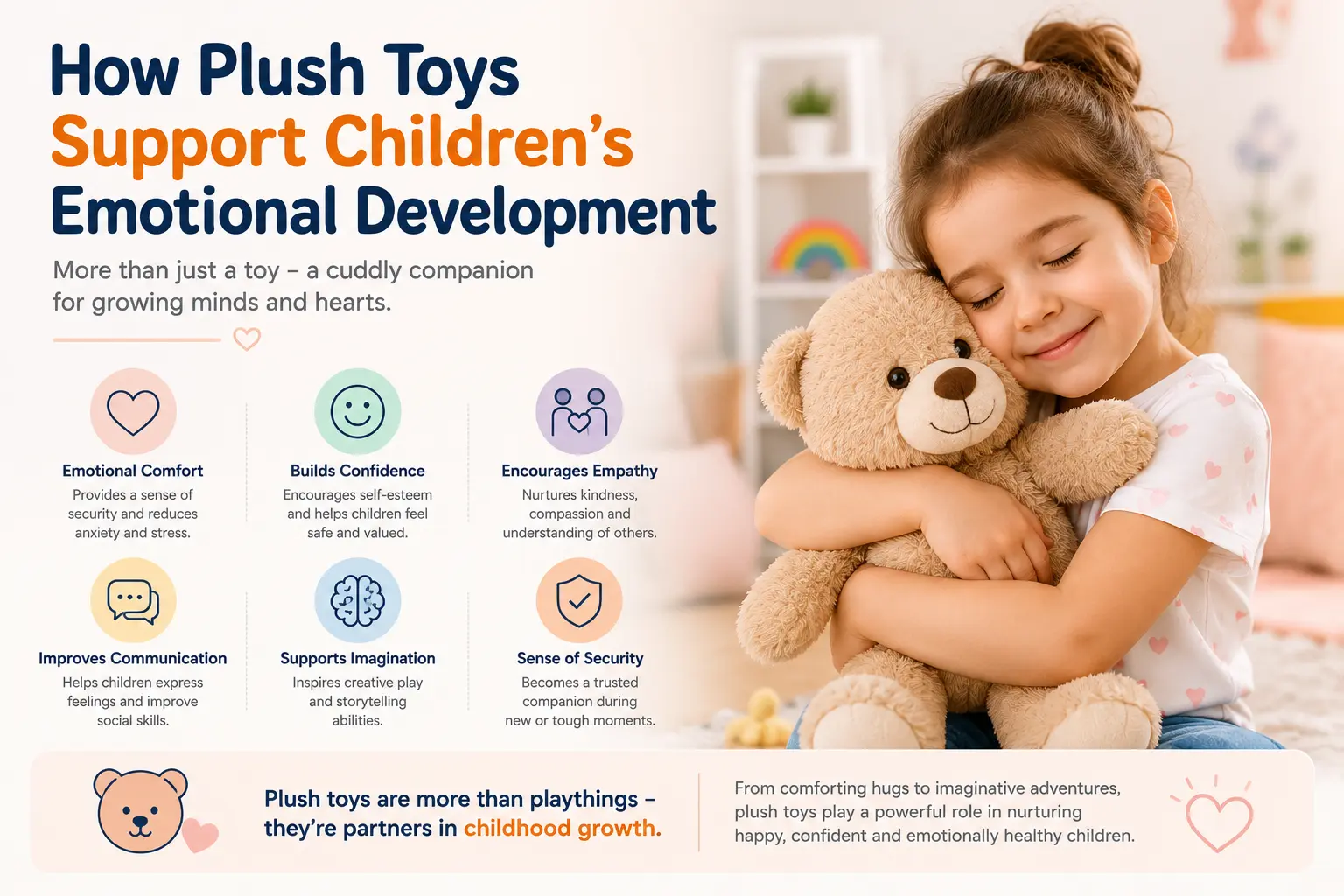
Ask any parent to pry a favourite stuffed rabbit out of a toddler’s hands at bedtime and you’ll learn something no research paper can teach you as fast: that plush toy is doing real work. It isn’t just a toy. For a young child, it can be a comfort object, a practice friend, a night-light with fur, and a first lesson in caring for something outside themselves.
I spend most of my time on the manufacturing side of brinquedos de pelúcia, but the reason this category exists at all is emotional, not commercial. So it’s worth taking the question seriously: how do plush toys actually contribute to a child’s emotional development? The short version is that they give children a safe, controllable relationship to rehearse the big feelings they’re still learning to manage. The longer version is more interesting.
Resposta rápida: Plush toys support emotional development by acting as “transitional objects” — comforting stand-ins that help children self-soothe, feel secure when apart from caregivers, practice empathy and caregiving, and safely process fear, change, and big emotions through pretend play.
The comfort object: a child’s first tool for self-soothing
Developmental psychologists have a name for the beloved stuffed animal: a transitional object. The term comes from pediatrician and psychoanalyst Donald Winnicott, who observed that many young children adopt a soft object that helps them bridge the gap between total dependence on a caregiver and growing independence.
Here’s what that means in a living room. A parent leaves the room, and for a toddler that’s genuinely stressful — object permanence is still shaky, and “gone” can feel like “gone forever.” A plush toy the child controls, carries, and trusts becomes a portable piece of security. Squeezing it, holding it to the cheek, talking to it — these are early self-soothing behaviors, and self-soothing is the foundation of emotional regulation later in life.
This is also why the hand-feel of a plush toy isn’t a trivial detail. Softness is functional here, not decorative. The tactile comfort is part of the mechanism, which is one reason thoughtful makers care so much about the fabric a plush toy is made from — a scratchy comfort object doesn’t get chosen, and the one that doesn’t get chosen can’t do its job.
Practicing empathy by caring for something small
Somewhere around age two or three, something shifts. The child stops only being comforted by the plush and starts caring for it. They tuck it in. They feed it. They scold it gently and then apologize. They insist it’s scared of the dark too.
This is empathy in its earliest rehearsal form. By projecting feelings onto the toy, a child practices imagining an inner world other than their own — the exact skill empathy is built from. A stuffed animal is a perfect practice partner because it’s completely safe: it never rejects the child, never reacts unpredictably, and never has a bad day. The child gets to run the caregiving simulation over and over with zero social risk.
Processing big feelings through pretend play
Children don’t have the vocabulary to say “I felt anxious about starting day care.” What they can do is act it out with a plush. The toy goes to day care, the toy is scared, the toy is brave, the toy comes home and everything’s fine. Through that little narrative, the child is quietly metabolizing a real experience.
This kind of symbolic play is one of the most important ways young children process fear, loss, jealousy, and change. A plush toy is the ideal cast member because it’s endlessly re-cartable — it can be the monster on Monday and the protector on Tuesday. Parents and therapists both lean on this, which is why stuffed animals show up so often in play therapy settings.
What the developmental stages roughly look like
Emotional use of plush toys evolves with age. This is a general map, not a schedule — every child is different — but it helps explain why the same toy means different things over time.
| Age range | Primary emotional role | What you’ll notice |
|---|---|---|
| 0–12 months | Sensory comfort | Soothed by softness, texture, and gentle weight |
| 1–2 years | Transitional/security object | Attaches to one specific toy; distressed if it’s lost |
| 2–4 years | Empathy and caregiving practice | Feeds, tucks in, and talks to the toy |
| 4–6 years | Symbolic and narrative play | Acts out stories, fears, and social scenarios |
| 6+ years | Companionship and identity | Keeps favourites for comfort, nostalgia, and self-expression |
The through-line is that a single well-made plush can accompany a child across all of these stages, taking on new meaning as the child grows. That longevity is part of what makes the category special — and part of why quality and durability matter so much.
Why safety is inseparable from the emotional benefit
There’s an uncomfortable truth buyers and parents both need to sit with: an emotionally important toy is one a child holds against their face, chews, sleeps with, and refuses to be parted from. That intimacy is exactly why safety can’t be an afterthought.
A comfort object has to survive constant washing without shedding, hold its stitching under daily stress, and contain absolutely nothing that could come loose. Securely embroidered eyes instead of glued-on plastic, non-toxic fill, tight seams, and compliance with standards like ASTM F963 or EN71 aren’t box-ticking — they’re what makes it safe for a toy to be loved this hard. The table below shows how emotional function and safety requirements line up.
| Emotional behavior | Why it happens | Safety implication |
|---|---|---|
| Holding to face, sleeping with it | Self-soothing, security | Breathable fabric, no loose small parts, washable |
| Chewing and mouthing | Sensory exploration (infants) | Non-toxic dyes and fill, no detachable eyes |
| Constant carrying and dragging | Attachment | Reinforced seams, colorfast fabric |
| Being thrown, squeezed, hugged hard | Emotional release | Durable stitching, resilient fill |
If you’re on the sourcing side of this, our overview of normas de segurança para brinquedos de pelúcia and the guide to stuffing materials both go deeper on how to build a plush that’s safe to be this close to a child.
What this means for parents and for brands
For parents, the practical reassurance is this: a child’s fierce attachment to one grubby stuffed animal isn’t a problem to solve. It’s healthy development in action. The best thing you can usually do is respect it — and maybe quietly source a backup of the exact same toy for the inevitable lost-at-grandma’s-house emergency.
For brands and makers, the lesson is that you’re not selling fluff. You’re making an object a child may trust more than almost anything else in their world. That’s a responsibility, and it’s also the reason the good ones last for generations.
Perguntas frequentes
Why do children get so attached to one specific plush toy? That one chosen toy becomes what psychologists call a transitional object — a portable source of security that helps a child feel safe when a caregiver isn’t there. Because the child controls it completely and it responds the same way every time, it becomes deeply reassuring in a way an ever-changing world isn’t. The attachment is a normal, healthy sign that the child is learning to self-soothe and build independence, not something to worry about or discourage.
At what age do plush toys start helping emotional development?
The comfort benefit begins in infancy through pure sensory soothing, but the deeper emotional work usually kicks in between one and two years old, when a child forms a real attachment to a specific toy. From roughly two to four they begin practicing empathy by caring for it, and from four upward they use it in storytelling and to process feelings. A single toy can serve all these stages, meaning something different to the child at each age.
Are plush toys safe for babies to sleep with?
For infants under about 12 months, paediatric safe-sleep guidance generally recommends keeping soft objects out of the crib, so a plush is better as a supervised daytime companion at that age. As children move past their first year and out of the crib, a well-made plush becomes a valuable bedtime comfort object. Whenever a child sleeps with one, it should be breathable, washable, free of loose small parts, and compliant with toy safety standards.
Can plush toys really help a child manage anxiety and change?
Yes, and it’s one of their most valuable roles. Children lack the words to explain feelings like fear or jealousy, so they act those feelings out through the toy — sending it to day care, making it brave, comforting it through a scary night. This symbolic play lets the child rehearse and metabolize real experiences in a safe, controllable way, which is exactly why stuffed animals are used so often in play therapy settings.
Does the quality of a plush toy actually affect its emotional value?
It does, more than people expect. A comfort object is held against the face, chewed, washed constantly, and dragged everywhere, so softness and durability are functional, not cosmetic. A scratchy or poorly made toy simply doesn’t get chosen as the comfort object, and one that falls apart or fails safety standards can’t be trusted for that intimate daily use. Quality is what allows a toy to be loved intensely for years.
Sobre o autor
Zhang Wei writes about plush toys from the maker’s side of the table, with a particular interest in why these products matter beyond the shelf. Having worked closely with the design and safety side of soft-toy manufacturing, he’s convinced that understanding a child’s emotional relationship to a plush is the starting point for building a good one. He covers product development, materials, and toy safety for parents and brands who want toys that are genuinely worth holding onto.
Building toys designed to be loved and safe to be this close to a child? See how we approach plush toy safety or explore our soft toy range.