
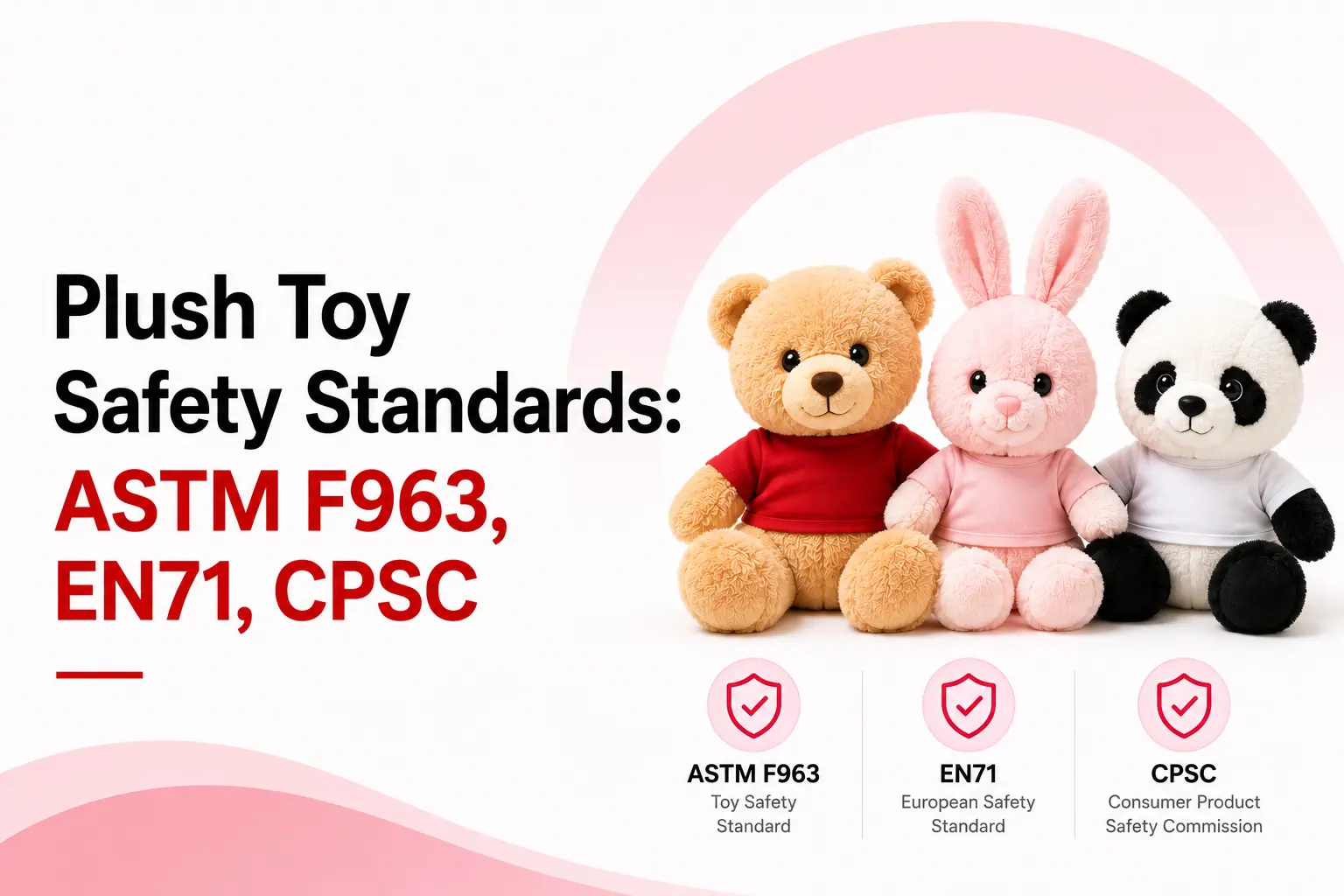
Plush toy safety standards matter because most plush toys are children’s products, and children’s products are regulated. The requirements that apply to a specific toy depend on where you sell it, who it is intended for, and what it is made of. There is no single global rulebook: a plush toy sold in the United States and the same toy sold in the European Union answer to different frameworks, and meeting one does not automatically satisfy the other. Before you place a production order, the practical goal is to know which requirements apply to seu product in seu market, and to confirm them with your manufacturer and a testing laboratory.
Standards, regulations, testing, and certification are not the same thing
A common mistake is treating “ASTM F963,” “EN71,” and “CPSC” as interchangeable certifications. They are different kinds of things:
- A standard (ASTM F963, EN 71) is a technical document describing safety requirements and test methods.
- A regulation or law (the US CPSIA, the EU Toy Safety framework) makes a standard legally binding.
- Testing is what a laboratory does to check a product against a standard.
- Certificação is the document declaring the product meets the requirements.
- Conformidade is the overall state of meeting every rule that applies to your product and market.
Keeping these apart makes the rest of the picture much clearer.
ASTM F963 and the CPSC in the United States
ASTM F963 is the mandatory toy safety standard in the United States. It became legally binding through the Consumer Product Safety Improvement Act of 2008 (CPSIA), and the current version, ASTM F963-23, has been mandatory for toys manufactured on or after April 20, 2024. It covers hazards such as mechanical and physical properties, flammability, and certain chemicals.
O Comissão de Segurança de Produtos de Consumo (CPSC) is the federal agency that enforces toy safety in the US. It does not “certify” individual toys. Instead, under the CPSIA, toys intended primarily for children 12 and under must be tested by a CPSC-accepted third-party laboratory, and the manufacturer or importer issues a Children’s Product Certificate (CPC) based on that testing. The CPSIA also brings in related requirements, including limits on lead and phthalates, tracking-label rules for children’s products, and small-parts restrictions. These apply alongside ASTM F963 rather than instead of it.
EN 71 and the European framework
EN 71 is the series of harmonised toy safety standards used in the European Union. It is multi-part: EN 71-1 covers mechanical and physical properties, EN 71-2 covers flammability, and EN 71-3 covers the migration of certain chemical elements, with further parts addressing other hazards.
In the EU, toys are placed on the market under the Toy Safety framework and carry the Marcação CE, which is the manufacturer’s declaration that the toy meets the applicable requirements. Testing to the relevant EN 71 parts supports that declaration. The CE mark is a compliance statement, not a quality award or a third-party seal.
The EU rules are changing
In December 2025 the EU adopted a new Toy Safety Regulation (EU) 2025/2509, which will replace the long-standing Toy Safety Directive. It becomes applicable from August 1, 2030, and until then toys can still be placed on the EU market under the existing Directive. The new regulation strengthens chemical restrictions and introduces measures such as a digital product passport. The EN 71 standards are being revised in parallel to support it. For any toy entering the EU today, the current Directive and EN 71 still govern, but buyers planning long product lifecycles should be aware of the transition.
How the two frameworks compare
| # | United States | European Union |
| Governing law | CPSIA | Toy Safety Directive (Regulation 2025/2509 from 2030) |
| Key standard | ASTM F963-23 | EN 71 series |
| Enforcing/compliance route | CPSC + third-party testing → CPC | CE marking + Declaration of Conformity |
| Regulator | CPSC | National market surveillance authorities |
Because the frameworks differ, a toy sold in both regions generally needs testing for both. Plan for more than one set of tests if you sell across markets.
Why age grading, materials, and components matter
Age grading determines which tests apply. A toy intended for young children faces stricter requirements, particularly around small parts and choking hazards, than one graded for older children. Age grading must match the testing and the way the product is marketed.
The materials and components in a plush toy each carry their own considerations. Fabrics and dyes, the material de enchimento, embroidery threads, printed elements, plastic eyes, and any accessories can affect chemical or mechanical testing. Sewn-in features such as eyes and noses are checked for pull strength; small components are assessed as potential choking hazards; and any magnets or batteries introduce additional, specific requirements. This is why the exact test scope depends on the design rather than a fixed checklist.
What testing involves and what to request
Toy testing typically combines mechanical and physical checks, flammability, and chemical analysis, run to the relevant standard for the destination market. When you commission testing, ask your manufacturer or laboratory for the test report showing the product, the standards tested against, and the results, plus the certification appropriate to your market (a CPC for the US, a Declaration of Conformity for the EU). Request that the age grading on the report matches your intended market listing.
Why one sample test isn’t the whole story
Passing a test on one sample confirms that sample met the standard. It does not guarantee that every unit in a production run is identical. Materials, dye lots, and components can vary between batches, which is why ongoing controle de qualidade matters alongside lab testing. A sound approach pairs initial testing with in-line and pre-shipment inspection, often against a sampling benchmark such as AQL 2.5, so what ships matches what was tested.
Working with manufacturers and testing laboratories
Testing is carried out by independent laboratories. Well-known international names include Bureau Veritas and QIMA, among others, and for the US market the lab must be accepted by the CPSC for the relevant tests. No single named laboratory is mandatory as long as the testing meets the applicable requirements, so confirm accreditation for your market rather than assuming any lab qualifies. A manufacturer experienced with your target market can help coordinate testing, but responsibility for compliance ultimately sits with the brand or importer placing the product on the market. Our guide to how a manufacturer supports safety compliance and our breakdown of safety testing cost go deeper on the practical side, and our comparison of ASTM F963 and EN 71 explains which applies where.
Common compliance mistakes to avoid
- Assuming one market’s test covers every market.
- Treating a standard, a regulation, and a certificate as the same thing.
- Mismatching age grading between the listing and the test report.
- Testing one sample and skipping ongoing inspection.
- Confirming testing only after production, when changes are expensive.
Safety is where a plush order is easiest to get wrong and most costly to fix after the fact. Building it into the brief from the start keeps a project on schedule. As a China-based OEM and ODM manufacturer, Plush Toys Factory produces to the standard relevant to a buyer’s market and can help coordinate third-party testing as part of the processo de pedido. For product-specific requirements, confirm the applicable rules with an accredited laboratory for your market.
Perguntas frequentes
1. Why do plush toy safety standards matter?
Plush toy safety standards matter because most plush toys are children’s products, and children’s products are regulated. The requirements that apply to a specific toy depend on where you sell it, who it is intended for, and what it is made of. There is no single global rulebook, so a plush toy sold in the United States and the same toy sold in the European Union answer to different frameworks, and meeting one does not automatically satisfy the other. The practical goal is to know which requirements apply to your product in your market before you order.
2. What is the difference between a standard, a regulation, testing, and certification?
These are different kinds of things that are often confused. A standard, such as ASTM F963 or EN 71, is a technical document describing safety requirements and test methods. A regulation or law, such as the US CPSIA or the EU Toy Safety framework, makes a standard legally binding. Testing is what a laboratory does to check a product against a standard, certification is the document declaring the product meets the requirements, and compliance is the overall state of meeting every rule that applies to your product and market.
3. What is ASTM F963?
ASTM F963 is the mandatory toy safety standard in the United States. It became legally binding through the Consumer Product Safety Improvement Act of 2008, and the current version, ASTM F963-23, has been mandatory for toys manufactured on or after April 20, 2024. It covers hazards such as mechanical and physical properties, flammability, and certain chemicals. Meeting it is a legal requirement for toys sold in the US market, not an optional quality step.
4. What is the CPSC and does it certify toys?
The Consumer Product Safety Commission, or CPSC, is the federal agency that enforces toy safety in the United States. It does not certify individual toys. Instead, under the CPSIA, toys intended primarily for children 12 and under must be tested by a CPSC accepted third party laboratory, and the manufacturer or importer issues a Children’s Product Certificate based on that testing. The CPSIA also brings in related requirements, including limits on lead and phthalates, tracking label rules, and small parts restrictions.
5. What is EN 71?
EN 71 is the series of harmonised toy safety standards used in the European Union. It is multi part, with EN 71-1 covering mechanical and physical properties, EN 71-2 covering flammability, and EN 71-3 covering the migration of certain chemical elements, plus further parts addressing other hazards. In the EU, toys are placed on the market under the Toy Safety framework and carry the CE mark, which is the manufacturer’s declaration that the toy meets the applicable requirements. Testing to the relevant EN 71 parts supports that declaration.
6. Are the EU toy safety rules changing?
Yes. In December 2025 the EU adopted a new Toy Safety Regulation (EU) 2025/2509, which will replace the long standing Toy Safety Directive. It becomes applicable from August 1, 2030, and until then toys can still be placed on the EU market under the existing Directive. The new regulation strengthens chemical restrictions and introduces measures such as a digital product passport, and the EN 71 standards are being revised in parallel. For any toy entering the EU today, the current Directive and EN 71 still govern.
7. Does one market’s safety test cover every market?
No. Because the US and EU frameworks differ, a toy sold in both regions generally needs testing for both. The US route runs through the CPSIA, ASTM F963-23, and a Children’s Product Certificate based on third party testing, while the EU route runs through the Toy Safety framework, the EN 71 series, and CE marking with a Declaration of Conformity. Meeting one does not automatically satisfy the other, so you should plan for more than one set of tests if you sell across markets.
8. Why do age grading, materials, and components matter?
Age grading determines which tests apply, since a toy intended for young children faces stricter requirements around small parts and choking hazards than one graded for older children, and the grading must match the testing and marketing. The materials and components also each carry their own considerations, as fabrics, dyes, filling, embroidery threads, printed elements, plastic eyes, and accessories can affect chemical or mechanical testing. Sewn in eyes and noses are checked for pull strength, and any magnets or batteries add specific requirements, so the test scope depends on the design.
9. Why isn’t testing one sample enough?
Passing a test on one sample confirms that sample met the standard, but it does not guarantee that every unit in a production run is identical. Materials, dye lots, and components can vary between batches, which is why ongoing quality control matters alongside lab testing. A sound approach pairs initial testing with in line and pre shipment inspection, often against a sampling benchmark such as AQL 2.5, so that what ships matches what was tested.
10. Who is responsible for plush toy safety compliance?
Testing is carried out by independent laboratories, and for the US market the lab must be accepted by the CPSC for the relevant tests. A manufacturer experienced with your target market can help coordinate testing, but responsibility for compliance ultimately sits with the brand or importer placing the product on the market. No single named laboratory is mandatory as long as the testing meets the applicable requirements, so you should confirm accreditation for your market rather than assuming any lab qualifies.
Sobre o autor
Zhang Wei is a custom plush toy manufacturing specialist at Plush Toys Factory, where he works alongside the in-house design and production team behind the Ziyee Family range. Drawing on years of hands-on experience in OEM and ODM plush production, he writes practical, straightforward guides on designing, sampling, testing, and sourcing custom soft toys, with a particular focus on safety standards and market compliance. His work helps brands, retailers, and promotional buyers turn artwork into safe, well-made plush they can put their name on with confidence.