
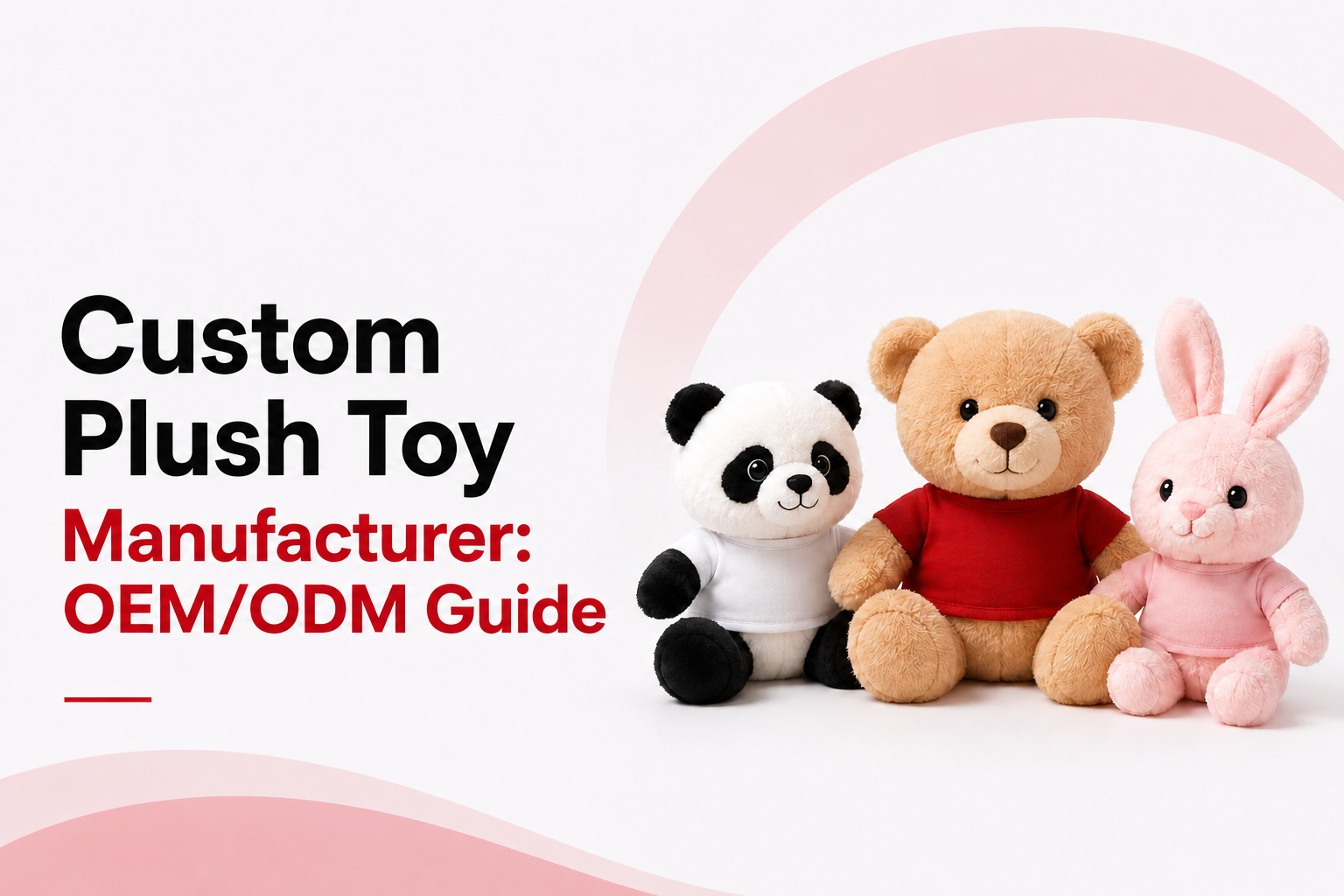
A custom plush toy manufacturer is a factory that produces soft toys to a buyer’s own design instead of selling ready-made stock. You supply the concept, artwork, or a reference sample, and the factory turns it into a finished product that is sewn, stuffed, and packaged to your specification. Most custom plush sold by brands, retailers, and promotional companies is made this way, and a large share of it is produced in China, where the supply chain for plush fabric, safety-tested filling, and skilled sewing sits close together.
This guide walks through how custom plush manufacturing works, the difference between OEM and ODM, and what to check before you commit to a factory.
What a custom plush toy manufacturer actually does
A genuine manufacturer runs production in-house: pattern-making, fabric cutting, embroidery or printing, sewing, stuffing, and final assembly. That distinction matters. A large share of the “suppliers” you find online are trading companies that outsource the real sewing to a third factory, which adds a margin and a layer between you and the people making decisions about your product. Working with a direct fábrica de brinquedos de pelúcia usually means clearer answers on technical details and tighter control over the finished toy.
The work covers far more than stitching. A capable partner helps you turn 2D artwork into a 3D pattern, choose fabrics and filling suited to the toy and its market, build and revise a physical sample before mass production, run the bulk order to an agreed quality standard, and arrange safety testing with compliant packaging.
OEM vs ODM plush manufacturing
The two terms describe who owns the design.
OEM (Original Equipment Manufacturer) means the factory makes seu design. You provide the character, artwork, tech pack, or reference sample, and the factory produces it to that brief. You own the intellectual property. This is the model for brands with their own characters, licensed properties, or original mascots.
ODM (Original Design Manufacturer) means the factory supplies an existing design or design service that you customise: adjusting colours, size, or fabric, or adding your logo. It is faster and cheaper to start, but the base design is not exclusive to you.
| # | OEM | ODM |
| Who designs it | You | The factory |
| IP ownership | Yours | Usually the factory’s or shared |
| Ideal para | Original characters, licensed IP | Faster launches, logo customisation |
| Setup cost and time | Higher | Lower |
Plenty of buyers use both models: an ODM base for a quick promotional run, and full OEM for a flagship character they want to own outright. If you are protecting an original design, settle IP ownership in writing before you share artwork.
From artwork to finished plush
Custom plush follows a fairly consistent path from idea to delivery. Knowing the stages helps you brief a factory well and spot where things tend to go wrong.
Design and specification
Everything starts with a clear brief. The more precise your artwork and specification, the closer the first sample will land. A proper tech pack, with turnaround views of the character, dimensions, Pantone colours, and construction notes, removes guesswork. If you only have a rough sketch, a good custom stuffed animal maker can help develop it, though you should expect more sampling rounds when the starting point is loose.
Materials and construction
Fabric defines how a toy looks and feels. Short-pile options such as velboa read as smooth and hold fine detail, while longer-pile minky feels softer and plusher. The choice affects cost, minimums, and how sharp the detail can be, so it is worth understanding the common plush fabrics and how minky, velboa, and super-soft fabrics compare before you write the brief. The filling is usually polyester fibre, sometimes combined with plastic pellets for weight, and it is selected for softness, shape retention, and safety compliance.
Amostragem
Before any bulk run, the factory sews a pre-production sample from your artwork. This is the cheapest insurance in the whole process. It is where you catch problems with proportion, colour, and construction before they are copied across thousands of units. One or more revision rounds is normal. Our guide to how pre-production samples are made covers typical turnaround and what to check on each round.
Production and quality control
Once you approve the sample, bulk production begins. Serious factories inspect during and after production rather than only at the very end. A common benchmark is AQL 2.5 inspection, a statistical sampling method used to accept or reject a batch, followed by a pre-shipment inspection before the container leaves. How a supplier handles controle de qualidade is one of the clearest signals of how the finished order will turn out.
Safety testing and compliance
Plush toys are often children’s products, so they are regulated, but the requirements depend on where you sell rather than on the factory alone. Toys sold in the United States generally fall under CPSIA and the ASTM F963 standard. Toys sold in the European Union fall under the Toy Safety Directive and EN 71. A responsible manufacturer builds to the relevant standard and arranges third-party lab testing, but no factory can promise a product is “compliant” for a market without testing that specific product against that market’s rules. If you sell in more than one region, budget for more than one set of tests. Our comparison of ASTM F963 and EN 71 explains which standard applies where.
MOQ, lead times, and packaging
Minimum order quantity, pricing, and timelines vary with design complexity, fabric, size, and factory. There is no universal figure, and any supplier quoting the same MOQ for every product is not really looking at your design. Instead of guessing, see our breakdowns of plush toy MOQs, manufacturing cost, and bulk lead times. Packaging, whether a simple polybag, a header card, or a retail window box, should be briefed alongside the toy, since it affects retail readiness and compliance labelling.
How to evaluate a plush toy factory
Before committing, confirm the basics:
- Direct manufacturer, not a trader. Ask to see the factory, the production lines, or a live video walkthrough.
- Relevant experience. Look for samples of similar work in your category, whether keychains, large plush, or detailed character pieces.
- Sampling capability. A good factory will revise until the sample is right rather than push you to approve early.
- Testing and compliance support. Confirm experience with your target market’s standards.
- Communication. Clear technical answers matter more than fast sales replies.
Our checklists for choosing a custom plush factory in China e vetting a supplier for a USA brand go deeper on due diligence.
Common sourcing mistakes
- Choosing on price alone, then finding quality or compliance gaps later.
- Rushing or skipping the sample stage.
- Sending vague artwork and blaming the factory for a weak first sample.
- Assuming one safety test covers every market.
- Sharing original designs before IP ownership is agreed.
Working with a plush manufacturer
Custom plush is a collaborative process. The strongest results come from a clear brief, a well-reviewed sample, and a factory that keeps design, production, and quality control under one roof. As a China-based OEM and ODM plush manufacturer, Plush Toys Factory works with brands, retailers, and promotional buyers across keychains, brinquedos de pelúcia, teddy bears, and produtos licenciados. If you already have a concept or artwork, the next step is usually a sample, which you can start through our processo de pedido.
Perguntas frequentes
1. What is a custom plush toy manufacturer?
A custom plush toy manufacturer is a factory that produces soft toys to a buyer’s own design instead of selling ready made stock. You supply the concept, artwork, or a reference sample, and the factory turns it into a finished product that is sewn, stuffed, and packaged to your specification. Most custom plush sold by brands, retailers, and promotional companies is made this way, and a large share of it is produced in China, where the supply chain for plush fabric, safety tested filling, and skilled sewing sits close together.
2. What does a custom plush toy manufacturer actually do?
A genuine manufacturer runs production in house, covering pattern making, fabric cutting, embroidery or printing, sewing, stuffing, and final assembly. Beyond stitching, a capable partner helps you turn 2D artwork into a 3D pattern, choose fabrics and filling suited to the toy and its market, build and revise a physical sample before mass production, run the bulk order to an agreed quality standard, and arrange safety testing with compliant packaging. Working with a direct factory usually means clearer answers on technical details and tighter control over the finished toy.
3. What is the difference between OEM and ODM plush manufacturing?
The two terms describe who owns the design. OEM, or Original Equipment Manufacturer, means the factory makes your design, so you provide the character, artwork, tech pack, or reference sample and you own the intellectual property. ODM, or Original Design Manufacturer, means the factory supplies an existing design or design service that you customise by adjusting colours, size, or fabric, or adding your logo. OEM suits brands with their own characters or licensed properties, while ODM is faster and cheaper to start but the base design is not exclusive to you.
4. Should I choose OEM or ODM for my plush toy?
It depends on whether you need to own the design. OEM is best for original characters, licensed IP, and flagship products you want to own outright, though it carries a higher setup cost and longer timeline. ODM is best for faster launches and logo customisation at lower cost, but the design is usually the factory’s or shared. Plenty of buyers use both, running an ODM base for a quick promotional run and full OEM for a flagship character. If you are protecting an original design, settle IP ownership in writing before you share artwork.
5. How does a custom plush toy go from artwork to finished product?
Custom plush follows a fairly consistent path. It starts with design and specification, where a precise tech pack with turnaround views, dimensions, Pantone colours, and construction notes removes guesswork. Next comes materials and construction, where the fabric and filling are chosen. Then the factory sews a pre production sample for you to review and revise, and once you approve it, bulk production begins with quality control during and after the run. Knowing these stages helps you brief a factory well and spot where things tend to go wrong.
6. What fabrics and fillings are used in custom plush toys?
Fabric defines how a toy looks and feels. Short pile options such as velboa read as smooth and hold fine detail, while longer pile minky feels softer and plusher. The choice affects cost, minimums, and how sharp the detail can be, so it is worth understanding the common plush fabrics before writing your brief. The filling is usually polyester fibre, sometimes combined with plastic pellets for weight, and it is selected for softness, shape retention, and safety compliance.
7. Why is the sampling stage important in plush manufacturing?
Before any bulk run, the factory sews a pre production sample from your artwork, and this is the cheapest insurance in the whole process. It is where you catch problems with proportion, colour, and construction before they are copied across thousands of units. One or more revision rounds is normal, and a good factory will revise until the sample is right rather than push you to approve early. Rushing or skipping this stage is one of the most common and costly sourcing mistakes.
8. What quality control should a plush toy factory use?
Serious factories inspect during and after production rather than only at the very end. A common benchmark is AQL 2.5 inspection, a statistical sampling method used to accept or reject a batch, followed by a pre shipment inspection before the container leaves. How a supplier handles quality control is one of the clearest signals of how the finished order will turn out, so it is worth confirming their inspection process before you commit to a bulk run.
9. What safety testing and compliance do plush toys need?
Plush toys are often children’s products, so they are regulated, but the requirements depend on where you sell rather than on the factory alone. Toys sold in the United States generally fall under CPSIA and the ASTM F963 standard, while toys sold in the European Union fall under the Toy Safety Directive and EN 71. A responsible manufacturer builds to the relevant standard and arranges third party lab testing, but no factory can promise compliance for a market without testing that specific product against that market’s rules. If you sell in more than one region, budget for more than one set of tests.
10. How do I evaluate a plush toy factory before ordering?
Before committing, confirm the basics. Check that it is a direct manufacturer rather than a trader by asking to see the factory, the production lines, or a live video walkthrough. Look for relevant experience with samples of similar work in your category, and confirm the factory’s sampling capability, since a good one revises until the sample is right. Also confirm testing and compliance support for your target market’s standards, and pay attention to communication, because clear technical answers matter more than fast sales replies.
Sobre o autor
Zhang Wei is a custom plush toy manufacturing specialist at Plush Toys Factory, where he works alongside the in-house design and production team behind the Ziyee Family range. Drawing on years of hands-on experience in OEM and ODM plush production, he writes practical, straightforward guides on designing, sampling, testing, and sourcing custom soft toys. His work helps brands, retailers, and promotional buyers turn artwork into safe, well-made plush they can put their name on with confidence.