
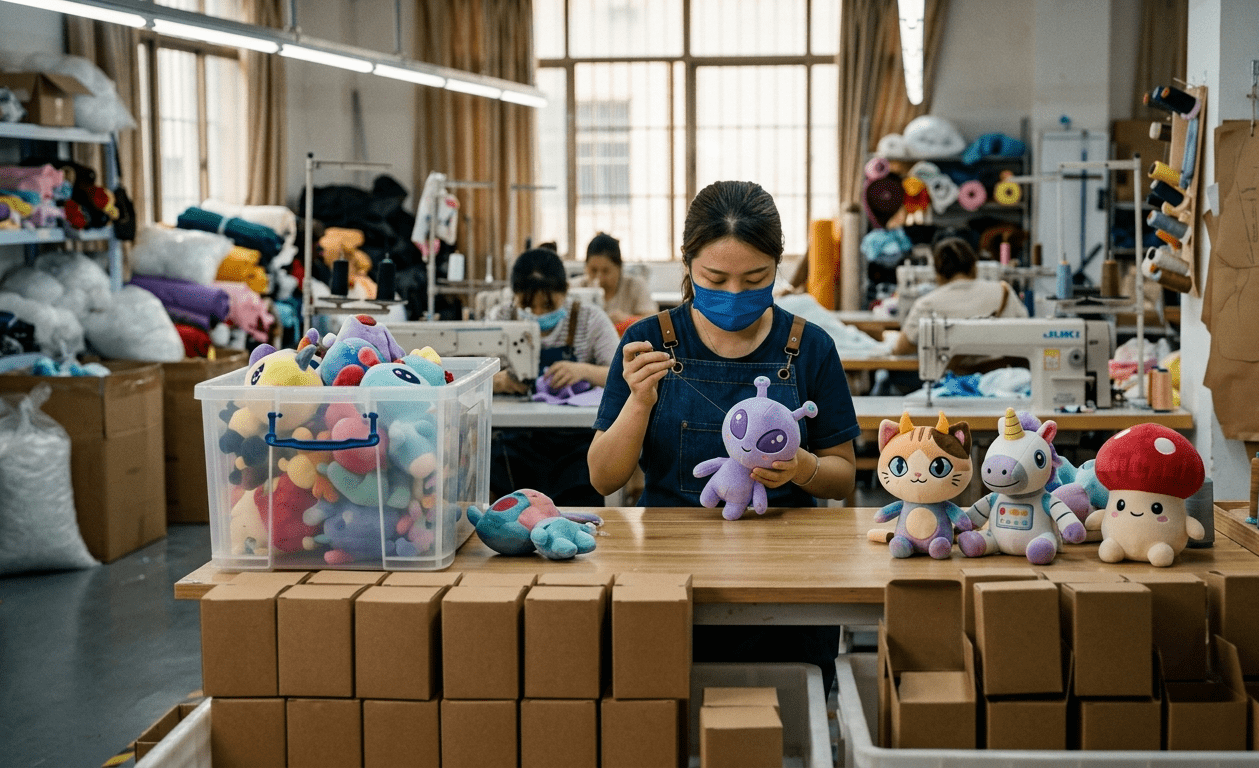
What Is a Custom Blind Box Plush Toy and Why Are USA Brands Launching Their Own Lines?
A blind box plush toy is a collectible stuffed figure sold in sealed packaging where the buyer does not know which character or variant they will receive until they open the box. The format, popularized by Pop Mart’s Labubu and Molly series, generated over $1.7 billion in revenue for Pop Mart in 2024 and drove the “kidult” collectible trend that is now reshaping how USA brands think about plush merchandise (Pop Mart Annual Report, 2024).
The global stuffed animals and plush toys market was valued at $13.68 billion in 2025, growing at 8.4% CAGR through 2033 (Grand View Research, 2025). Blind box and collectible plush is the fastest-growing segment within that market, with adult collectors aged 18 to 35 driving purchase frequency at 3x to 8x the rate of traditional toy buyers. TikTok sales for collectible plush tips formats reached tens of millions of units in 2025 alone.
For USA brands, this is a white-space opportunity. A bicho de pelúcia personalizado factory can produce a blind box character series from 100 units per variant, with full IP protection, ASTM-certified materials, and retail-ready packaging.
The 2026 Blind Box Market in the USA: Why This Is the Right Moment to Launch
Three market forces accelerated the blind box plush format from a niche import product into mainstream USA retail between 2023 and 2025.
Force 1: The Labubu Effect. Pop Mart’s Labubu dolls generated millions in TikTok unboxing views throughout 2025, with Google searches for the term hitting all-time highs in November 2025 (Google Trends, 2025). USA retail chains including Target and Hot Topic expanded their blind box floor space by 25% to 40% in Q4 2025 to meet demand.
Force 2: Adult Collectors Are the Growth Engine. Adults now represent close to 25% of all toy buyers globally (Circana, 2025). The “kidult” consumer is specifically drawn to limited editions, secret rare variants, and character series with complete collecting potential. This demographic spends more per purchase and generates more social content about their collections than any other buyer group.
Force 3: Social Commerce and the Unboxing Economy. A good unboxing video for a collectible plush generates engagement rates 4x to 10x higher than standard product review content (CreatorIQ, 2025). The surprise mechanism is inherently filmable. For brands, that organic content creation by customers is a scalable marketing asset that does not require advertising budget.
USA brands that move first in custom blind box plush hold a significant advantage. Repeat purchase rates in established blind box series average 60% to 75% of initial buyers (Pop Mart data, 2024).
How to Design a Collectible Blind Box Plush Series
Series architecture defines how many characters form the base set, how many secret or rare variants exist, and what makes each character distinct. Successful series share three qualities: a unifying design language (all characters feel like they belong together), individual personality differences (each character is memorable on its own), and a “completion reward” (owning the complete set produces a satisfying visual collection).
A practical starting structure for a first-time launch: 6 to 8 base characters, 1 to 2 secret or rare variants, and a consistent size of 10 to 15 cm. This structure keeps initial production investment manageable while giving collectors enough variety to generate purchasing excitement.
Character design for plush manufacturing must account for producibility at scale. The most effective blind box plush characters share these traits: simple, high-contrast silhouettes; faces with large eyes and minimal detail that translate well from digital art to physical embroidery; rounded body forms that are efficient to cut, sew, and stuff; and a limited color palette per character (4 to 6 colors maximum).
Variant structure is the collectibility mechanism. Rare variants can be color variants (easy to produce at low incremental cost), characters with different outfit accessories (slightly higher cost), or entirely different characters that share design language (highest development cost but strongest collector appeal).
Manufacturing Process for Blind Box Plush Series
- Phase 1: Series Design Finalization (2 to 4 weeks) — All character designs in the series must be finalized before sampling begins. Changing a character’s design after sampling starts resets the timeline for that character.
- Phase 2: Multi-Character Sampling (10 to 15 working days) — Each character in the series requires its own pre-production sample. Sampling fees apply per character, typically $80 to $150 each.
- Phase 3: Sample Review and Approval — Each character sample is reviewed for color accuracy, proportion, embroidery quality, and cross-character visual consistency.
- Phase 4: Mass Production (20 to 30 working days for 6 to 8 characters at 300 to 500 units each).
- Phase 5: Assortment Mixing and Packaging — The factory mixes characters into sealed blind box units according to your specified distribution ratio (e.g., 10% rare, 90% split evenly across base characters). This mixing and sealing step adds 2 to 3 working days.
Packaging Design for Maximum Unboxing Impact
Packaging for blind box plush toys is a brand investment, not just a shipping protection measure. It is the first thing the buyer sees and the surface that appears in every unboxing video.
- Window-less sealed design — The defining feature of a blind box is that the buyer cannot see which character they received. Any packaging with a window defeats the mechanic.
- Character artwork on exterior panels — The outside of the box should display all characters in the series so buyers can see what they might get.
- A rarity indicator system — visible on the outside (but not revealing which character is inside) creates anticipation.
- Unboxing experience design — Inside packaging layers (tissue paper, character card, branded inner wrap) add to the physical unboxing experience and give TikTok creators more content elements to film.
For brands exploring how existing collectible character lines handle packaging and variant display, A Família Bread keychain series is a useful reference point for character differentiation within a unified series aesthetic.
Blind Box Series Format Comparison
| Format | Characters | MOQ Per Variant | Unit Cost | Ideal para |
| Mini Keychain Series | 6-8 | 100-300 unidades | $3.00 – $5.50 | Market test, low investment |
| Standard Box Series (10-15 cm) | 6-12 | 300-500 unidades | $5.00 – $10.00 | Core collectible retail |
| Premium Figure Series (15-20 cm) | 4-8 | 500 a 1.000 unidades | $10.00 – $18.00 | Adult collector market |
| Limited Edition Drop | 1-3 | 200-500 pcs | $12.00 – $20.00 | Seasonal, exclusive |
| Bag Charm Blind Box | 6-12 | 100-200 pcs | $2.80 – $5.00 | Fashion/accessory channel |
FAQ: Custom Blind Box Plush Toy Manufacturer
Quanto custa lançar uma série personalizada de pelúcias em caixas-surpresa?
Uma série de mini chaveiros de 6 caracteres, com 300 unidades por caractere (1.800 unidades no total), custa normalmente entre $5.000 e $12.000 em custo de produção (FOB), além de $500 a $1.200 em taxas de amostragem, somando-se o design e a impressão da embalagem, que custam de $800 a $3.000. O investimento total para o lançamento de uma série de teste de mercado varia de $7.000 a $16.000 antes do envio. A mesma série, vendida no varejo a $15 a $20 por unidade, gera $27.000 a $36.000 quando todo o estoque é vendido.
Qual é o pedido mínimo para uma série de pelúcias em caixas surpresa?
A maioria dos fabricantes qualificados aceita quantidades mínimas de pedido (MOQ) de 100 a 300 unidades por personagem para formatos de mini chaveiros e de 300 a 500 unidades por personagem para itens colecionáveis padrão de 10 a 15 cm. Uma série de 6 personagens, com 300 unidades cada, representa um pedido de produção total de 1.800 unidades, o que é uma quantidade prática para o lançamento de uma série inédita.
Como posso proteger meus desenhos de personagens para que não sejam copiados?
A proteção do design começa com a assinatura de um Acordo de Confidencialidade antes de compartilhar qualquer arte com um fabricante. No caso de personagens originais de importância comercial, o registro dos direitos autorais no Escritório de Direitos Autorais dos EUA oferece proteção legal. Uma fábrica de brinquedos de pelúcia de boa reputação assinará um Acordo de Confidencialidade como prática padrão antes de receber quaisquer arquivos de design.
O que faz com que uma série de pelúcias em caixas surpresa se torne viral?
Quatro fatores determinam o sucesso viral: uma estética forte e distinta, com um apelo emocional claro; uma mecânica de surpresa genuína, com embalagens lacradas e raridade real para variantes especiais; uma experiência de desembalagem que seja satisfatória de filmar; e uma série grande o suficiente para gerar uma comunidade de colecionadores, mas pequena o suficiente para que completá-la pareça algo viável.
Posso produzir uma série de pelúcias em caixas surpresa com personagens que eu mesmo criei?
Sim. As fábricas operam no modo OEM, produzindo a partir das artes finais fornecidas por você. Forneça esboços dos personagens em três vistas (frente, verso e lateral), especificações de cores Pantone, mapas de detalhes de bordado e medidas alvo. Certifique-se de possuir todos os direitos de uso comercial sobre quaisquer designs desenvolvidos por artistas freelancers antes de encaminhá-los para produção.
Os bichinhos de pelúcia em caixas surpresa precisam de certificação de segurança para serem vendidos no varejo dos EUA?
Yes. Any plush toy product sold through US retail channels needs to meet ASTM F963 requirements and have supporting third-party test documentation. For products that may be handled by children under 12, a Children’s Product Certificate is mandatory. Most major retailers require ASTM compliance as a vendor condition regardless of age classification.
Which USA retailers carry blind box plush collectibles?
As of 2026, the major USA retail channels for blind box plush collectibles include: Hot Topic (youth fashion and collector market), Target (mainstream consumer), GameStop (gaming and pop culture), Five Below (price-accessible market), Urban Outfitters (adult lifestyle), and online via Amazon, Whatnot, and direct DTC.