
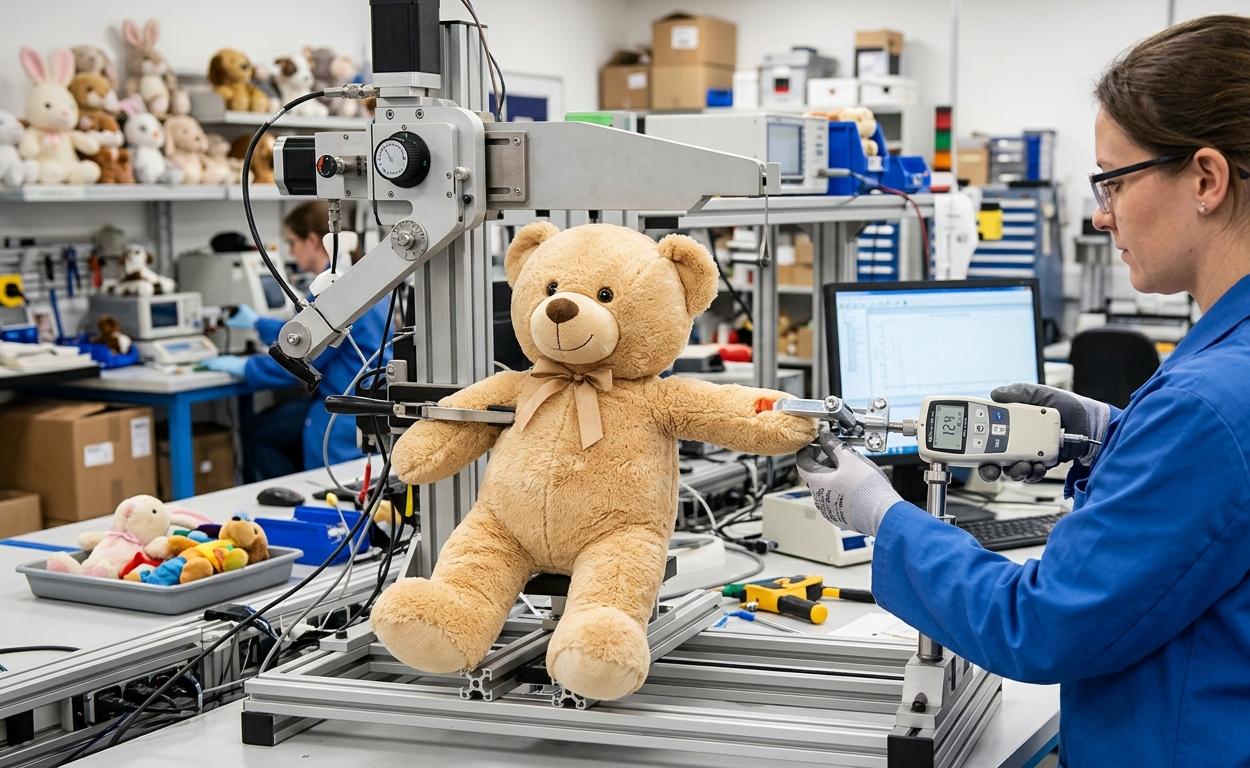
Every plush toy sold legally in the US or EU has to pass a specific set of lab tests before it ever reaches a shelf. Those tests fall into three categories — mechanical/physical, flammability, and chemical — and exactly which standard applies depends on where the toy is being sold. This guide breaks down what each test actually checks, one standard at a time, so you know what a compliant plush toy manufacturer should be testing for before you approve a production run.
United States: ASTM F963 + CPSIA
ASTM F963 has been the toy safety standard since 1986 and was made legally mandatory by the Consumer Product Safety Improvement Act (CPSIA) of 2008. It’s codified at 16 C.F.R. Part 1250, and the current mandatory version is ASTM F963-23.
Mechanical and Physical Tests
- Small parts / choking hazard test. Any component under roughly 3 cm — plastic eyes, noses, buttons, beads — is checked to confirm it can’t detach and pose a swallowing risk, typically using a small-parts test cylinder that simulates a child’s airway.
- Tension and torque testing. Attached components like eyes and noses are pulled and twisted to confirm they won’t come loose under normal use or reasonably foreseeable abuse.
- 鋭い突起や鋭い縁。. The toy is checked for accessible sharp points or edges that could cut or puncture.
- Seam strength and fiber length. Plush-specific requirements cover how strong seams need to be and limit the length of loose fibers that could pose a hazard.
- Use-and-abuse simulation. F963 requires simulated use and abuse testing — the toy is stressed the way a child realistically might handle it, not just inspected at rest.
Flammability Testing
Plush and other fabric toys must have a burn rate under 0.1 inches per second. Anything that burns faster than that threshold is classified as highly flammable and can’t legally be sold as a children’s toy.
Chemical and Toxicological Tests
- Lead content. CPSIA sets a 100ppm limit for lead in accessible substrate materials (plastic and metal components).
- Phthalates. Restricted under 16 CFR Part 1307, particularly relevant to any plasticized components like plastic eyes or accessories.
- Heavy metals and soluble elements. Tested per ASTM F963 Section 4.3.
- Stuffing and filling. Filling materials must carry non-toxic certification and meet clean-fill requirements.
ドキュメント
Every US-market plush toy needs a Children’s Product Certificate (CPC) issued by a CPSC-accepted third-party accredited lab (such as SGS, Intertek, or Bureau Veritas), referencing the specific ASTM F963 version tested against. The CPC must be retained for five years after the last unit is sold.
European Union: EN71 + CE Marking
The EU operates on a self-declaration model — the CE Mark — but that mark is only legally valid when it’s backed by a complete EN71 testing dossier, kept on file for 10 years.
EN71-1: Mechanical and Physical Properties
Tests the structural integrity of the toy using a small-parts cylinder, similar in concept to the US test but with additional rules — for example, a strict limit on cord or ribbon length (22 cm or less on toys intended for children under 3) to prevent entanglement and strangulation risk.
EN71-2: Flammability
Checks flame spread rate on the toy’s surface and specifically prohibits highly flammable materials like nitrocellulose. Plush toys must pass combustion testing with no molten droplets forming during the burn.
EN71-3: Migration of Certain Elements
This is where EN71 goes noticeably further than the US standard: it screens for the migration of up to 19 heavy metals — including cadmium, mercury, arsenic, antimony, and selenium — compared to the narrower list covered under ASTM F963. Testing has to cover every accessible part of the toy, including paint, plastic, and fabric.
Additional EN71 Parts
Parts 9 through 13 of the EN71 series address organic compound limits and specific chemical exposure thresholds, which can apply depending on the toy’s materials.
Side-by-Side: What Each Standard Actually Checks
| Test Category | US (ASTM F963 / CPSIA) | EU (EN71) |
|---|---|---|
| Small parts / choking | Small-parts cylinder test | EN71-1 small-parts cylinder |
| Sharp points/edges | Covered under F963 | Covered under EN71-1 |
| Cord/ribbon length | Not explicitly standardized | ≤22cm for under-3s (EN71-1) |
| 可燃性 | Burn rate <0.1 in/sec | No molten droplets (EN71-2) |
| Heavy metals tested | Primarily lead-focused | Up to 19 elements (EN71-3) |
| Lead limit | 100ppm (accessible substrate) | Covered under EN71-3 migration limits |
| Certification | CPC from CPSC-accepted lab | CE Declaration + EN71 dossier |
| Documentation retention | 5 years | 10 years |
Other Markets Worth Knowing
- UK: EN71 testing plus UKCA marking (post-Brexit equivalent of CE)
- Australia/New Zealand: AS/NZS 8124, broadly aligned with ISO 8124/EN71
- Canada: Canada Consumer Product Safety Act (CCPSA), with requirements similar in scope to ASTM F963
- Japan: ST Mark (Japan Toy Safety Standard) plus specific chemical regulations
Testing Timeline and Cost
Standard plush toy testing (EN71 Parts 1–3 or ASTM F963) typically takes 10–14 working days at an accredited lab; electronic or sound-enabled plush can take 14–21 days because of added testing scope. Third-party lab costs generally run $300–$800 per design, depending on how many materials and colors need to be tested and which regional standards apply.
When Retesting Is Required
A passed test isn’t permanent. New testing is typically required whenever:
- Fabric, stuffing, or a key component supplier changes
- The design changes in a way that affects a safety-related component (different eyes, different filling, altered seams)
- Production moves to a different factory
Routine production batches of an already-certified SKU generally don’t require retesting unless materials change — but annual re-testing is standard practice for ongoing production lines, on top of immediate retesting whenever specifications shift.
What Happens If a Plush Toy Fails Testing
A failed test isn’t just a delay — it can cascade into real financial and legal exposure. If a small-parts, tension, or flammability test fails, the design typically has to be reworked (stronger seams, a different attachment method, a slower-burning fabric) and resubmitted for a fresh round of testing, adding another 10–14 days and another lab fee. If a chemical test fails — lead, phthalates, or a heavy metal over the EN71-3 threshold — the issue usually traces back to a specific material or component, which means identifying and requalifying a new supplier before retesting is even possible.
The bigger risk shows up after a product has already shipped. If a non-compliant plush toy reaches the US or EU market, it can trigger a recall, remove the listing from major marketplaces, and in serious cases expose the brand owner to legal liability — even if the factory, not the brand, made the underlying material substitution. This is why customs authorities and platforms like Amazon increasingly cross-check the documentation on file against the actual product rather than accepting a certificate at face value.
How to Read a Lab Test Report
A compliance report is only useful if it’s read correctly. A few things worth checking on any test report before approving a production run:
- Standard version. Confirm the report references the currently mandatory version (ASTM F963-23, or the latest EN71-3 revision) — a report tied to an outdated version doesn’t satisfy current requirements.
- Scope. Check that all three relevant test categories were actually covered. A report that only shows EN71-3 chemical results, for example, says nothing about mechanical safety or flammability.
- Sample match. Verify the tested sample’s materials, colors, and components match what’s going into mass production. A report for a red version of a toy doesn’t automatically cover a blue version if the dye or fabric batch differs.
- Lab accreditation. For the US market, the lab must be CPSC-accepted; a report from a non-accredited lab won’t satisfy the 児童用製品証明書 requirement.
- Age grading. Confirm the toy’s stated age range on the report matches its actual packaging and marketing — small-parts thresholds and cord-length rules are stricter for toys aimed at children under 3.
よくある質問
Is ASTM F963 the same as CPSIA?
No. ASTM F963 is the technical safety standard itself; CPSIA is the federal law that made F963 legally mandatory and added extra requirements like the 100ppm lead limit and third-party testing mandate.
Does EN71-3 alone confirm a plush toy is safe for the EU?
No. EN71-3 only covers chemical migration. A compliant plush toy also needs to pass EN71-1 (mechanical/physical) and EN71-2 (flammability) — testing only one part of the standard is a common and serious compliance gap.
What burn rate makes a plush toy “flammable” under US rules?
A surface burn rate faster than 0.1 inches per second classifies the fabric as highly flammable and disqualifies it from sale as a children’s toy under ASTM F963.
Can one lab report cover both the US and EU markets?
Not directly. ASTM F963/CPSIA and EN71/CE are separate standards with different thresholds and documentation requirements, so a toy sold in both markets typically needs test reports for each, though labs can often run them in parallel to save time.