
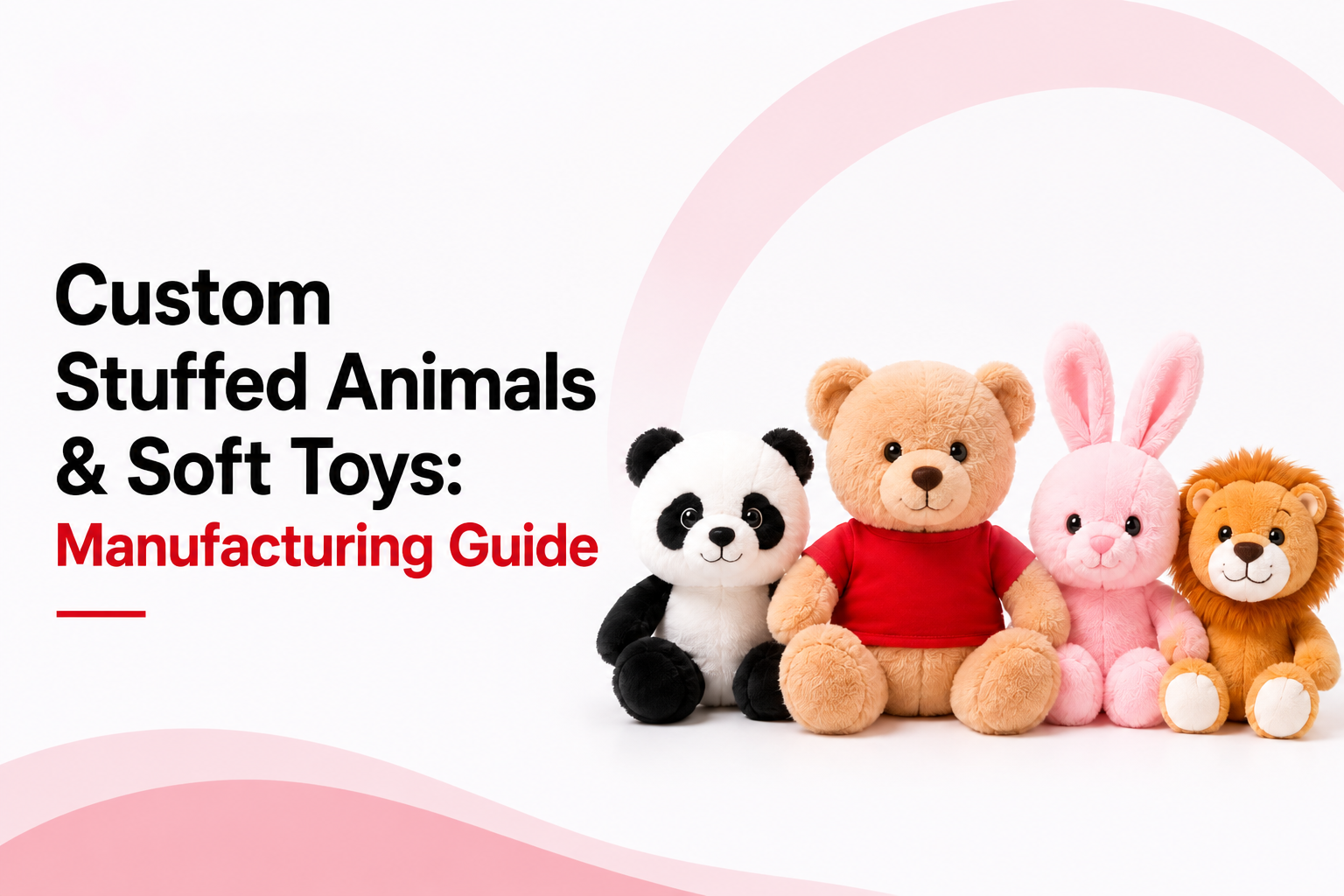
Stuffed toys, also called soft toys or plush toys, are toys made from fabric and filled with a soft material so they hold a shape while staying squeezable. “Soft toy” is the broad category; “plush toy” refers specifically to those made from plush fabric, the short-to-medium pile textile most stuffed animals use. For brands, retailers, and promotional buyers, custom stuffed toys are made to your own design rather than bought as stock, which means the outcome depends heavily on how well you brief the factory and which manufacturer you choose.
This guide explains what these products are, how they are made from artwork to finished toy, and what to check when sourcing them in bulk.
What stuffed toys and soft toys are
A stuffed toy is a sewn fabric shell filled with a soft stuffing. The term covers stuffed animals, character plush, dolls, and novelty shapes. People use “soft toy,” “plush toy,” and “stuffed animal” more or less interchangeably, but there is a useful distinction: soft toy is the umbrella term, while a plush toy is a soft toy made from plush fabric. A custom stuffed animal is simply one produced to a buyer’s own design, whether an original character, a mascot, or a licensed property.
Plush keychains and bag charms sit in the same family, made the same way at a smaller scale. If a keychain is your goal, the format changes some design choices, which our plush keychain sourcing guide covers in detail.
How a stuffed toy is made
Custom soft toys follow a consistent production path. Knowing the stages helps you brief clearly and understand where cost, quality, and lead time come from.
Materials and fabric
Fabric sets the look and feel of the toy. Short-pile fabrics such as velboa hold fine detail; longer-pile minky feels softer and more premium but can blur small features. The choice affects cost, minimum quantities, and how much detail the design can carry, so it is worth understanding the tissus peluche courants and how minky, velboa, and super-soft fabrics compare before you finalise a design.
Filling and stuffing
Most stuffed toys are filled with polyester fibre, often called PP cotton, which is soft, lightweight, and holds its shape. Some designs add plastic pellets or beads for weight and a beanbag feel, common in sitting characters and smaller collectibles. The filling is chosen for softness, shape retention, and safety compliance for the destination market.
Pattern making and cutting
A flat drawing has to become a three-dimensional pattern. The factory develops pattern pieces that, once sewn together, produce the intended shape and proportions. Fabric is then cut to those pieces, either by hand for complex or low-volume work or by die and machine for larger runs.
Sewing and assembly
Cut pieces are sewn together, usually inside out, then turned so the seams sit inside the toy. This stage determines durability. Seam strength, stitch density, and reinforcement at stress points such as necks and limbs are where a well-made toy differs from a fragile one.
Decoration: embroidery and printing
Faces and details are added by embroidery or printing. Embroidery suits eyes, mouths, and small features because it stays sharp and durable; printing suits flatter, graphic artwork across a larger surface. Many toys combine both. The right method depends on your design and the level of detail it needs.
Stuffing, shaping, and finishing
The sewn shell is filled to the correct firmness, which affects both feel and how well the toy keeps its form. Details like eyes or accessories are attached, the closing seam is finished, and each unit is trimmed and cleaned. Consistency across the run matters here: uneven stuffing is one of the most common complaints in bulk stuffed toy production.
Customization options
Custom soft toys can be adapted in many directions: original character shapes, sizes, fabric and colour choices, embroidered or printed branding, accessories, outfits, and packaging. You can either add branding to a stock-style shape, an ODM approach, or commission an entirely original toy from your artwork under an OEM model. Our overview of Fabrication de peluches en sous-traitance (OEM et ODM) explains the difference and what each means for design ownership and cost.
Samples, quality control, and safety
Prototype and sample development
Before bulk production, the factory sews a pre-production sample from your artwork. This is where you catch problems with proportion, colour, and construction before they are repeated across thousands of units, so it is the most important checkpoint in the process. Expect one or more revision rounds. Our guide to Comment sont fabriqués les échantillons de pré-production ? covers turnaround and what to review.
Contrôle qualité
Reputable manufacturers inspect during and after production rather than only at the end. A common benchmark is Contrôle AQL 2,5, a sampling method used to accept or reject a batch, followed by a inspection avant expédition before the order ships. How a factory approaches contrôle qualité is one of the clearest signals of how the finished order will turn out.
Safety and testing
Because stuffed toys are usually children’s products, they are regulated, but requirements depend on where you sell rather than on the factory alone. Toys for the US market generally fall under CPSIA and the ASTM F963 standard; toys for the EU fall under the Toy Safety Directive and EN 71. A responsible manufacturer builds to the relevant standard and arranges third-party testing, but no factory can promise a product is compliant for a market without testing that specific product for that market. Our comparison of ASTM F963 et EN 71 explique quelles règles s'appliquent dans chaque cas.
Packaging and bulk production
Packaging is briefed alongside the toy and ranges from a simple polybag to a header card or retail box, each carrying any required safety labelling. Minimum order quantities, pricing, and timelines vary with design complexity, size, fabric, and manufacturer, so there is no universal figure. For realistic expectations, see our breakdowns of Quantités minimales de commande (QMC) pour les peluches et manufacturing cost.
How to evaluate a stuffed toy manufacturer
- Fabricant direct, et non négociant. Confirm the factory sews in-house.
- Expérience pertinente. Ask for samples in your category and size range.
- Sampling capability. A good supplier revises until the sample is right.
- Quality and testing support. Confirm inspection practices and experience with your market’s standards.
- Clear technical communication. Detailed answers matter more than fast sales replies.
Our checklists for choosing a usine de peluches en Chine et vetting a soft toys supplier for a USA brand go deeper on due diligence.
Common sourcing mistakes
- Sending vague artwork, then blaming the factory for a poor first sample.
- Choosing on price alone and finding quality or compliance gaps later.
- Skipping or rushing the sample stage.
- Assuming one safety test covers every market.
- Not confirming stuffing firmness and finishing standards before bulk.
A well-sourced custom stuffed toy comes from a clear brief, a carefully reviewed sample, and a manufacturer that keeps design, production, and quality control together. As a China-based OEM and ODM manufacturer, Plush Toys Factory produces custom peluches, stuffed animals, keychains, and licensed products. With artwork ready, the next step is usually a sample, which you can start through our processus de commande.
Foire aux questions
1. What is a stuffed toy?
A stuffed toy is a sewn fabric shell filled with a soft stuffing so it holds a shape while staying squeezable. The term covers stuffed animals, character plush, dolls, and novelty shapes. People use soft toy, plush toy, and stuffed animal more or less interchangeably, though there is a useful distinction. A custom stuffed toy is simply one produced to a buyer’s own design rather than bought as stock, whether an original character, a mascot, or a licensed property.
2. What is the difference between a soft toy and a plush toy?
Soft toy is the broad umbrella category, while a plush toy refers specifically to a soft toy made from plush fabric, which is the short to medium pile textile that most stuffed animals use. In other words, every plush toy is a soft toy, but not every soft toy is made from plush fabric. The terms are often used interchangeably, but this distinction is useful when specifying materials for a custom order.
3. How is a custom stuffed toy made?
Custom soft toys follow a consistent production path. It starts with choosing the fabric and filling, then pattern making and cutting turn a flat drawing into three dimensional pattern pieces. The cut pieces are sewn together and assembled, faces and details are added by embroidery or printing, and the shell is stuffed, shaped, and finished. Knowing these stages helps you brief clearly and understand where cost, quality, and lead time come from.
4. What fabric is used for custom stuffed animals?
Fabric sets the look and feel of the toy. Short pile fabrics such as velboa hold fine detail, while longer pile minky feels softer and more premium but can blur small features. The choice affects cost, minimum quantities, and how much detail the design can carry, so it is worth understanding how the common plush fabrics compare before finalising a design. Matching the fabric to the level of detail your character needs is a key early decision.
5. What filling is used inside stuffed toys?
Most stuffed toys are filled with polyester fibre, often called PP cotton, which is soft, lightweight, and holds its shape well. Some designs add plastic pellets or beads for weight and a beanbag feel, which is common in sitting characters and smaller collectibles. The filling is chosen for softness, shape retention, and safety compliance for the destination market, so the right choice depends on both the toy’s form and where it will be sold.
6. Why does the sewing and assembly stage matter?
The sewing and assembly stage determines durability. Cut pieces are sewn together, usually inside out, then turned so the seams sit inside the toy. Seam strength, stitch density, and reinforcement at stress points such as necks and limbs are where a well made toy differs from a fragile one. This is why construction quality, not just appearance, should be checked carefully on any sample before a bulk run.
7. When should I use embroidery versus printing on a stuffed toy?
Embroidery and printing serve different purposes. Embroidery suits eyes, mouths, and small features because it stays sharp and durable, while printing suits flatter, graphic artwork across a larger surface. Many toys combine both methods on the same design. The right choice depends on your artwork and the level of detail it needs, so a good factory will advise which method suits each element before sampling.
8. Why is stuffing consistency important in bulk production?
The sewn shell is filled to the correct firmness, which affects both how the toy feels and how well it keeps its form. Consistency across the run matters here, because uneven stuffing is one of the most common complaints in bulk stuffed toy production. Confirming the stuffing firmness and finishing standards before bulk production helps ensure every unit in the order matches the approved sample rather than varying from piece to piece.
9. What safety testing do custom stuffed toys need?
Because stuffed toys are usually children’s products, they are regulated, but the requirements depend on where you sell rather than on the factory alone. Toys for the US market generally fall under CPSIA and the ASTM F963 standard, while toys for the EU fall under the Toy Safety Directive and EN 71. A responsible manufacturer builds to the relevant standard and arranges third party testing, but no factory can promise a product is compliant for a market without testing that specific product for that market.
10. How do I evaluate a stuffed toy manufacturer?
Confirm the supplier is a direct manufacturer that sews in house rather than a trader. Ask for samples in your category and size range to check relevant experience, and confirm the factory’s sampling capability, since a good one revises until the sample is right. Also check its quality and testing support, including inspection practices and experience with your market’s standards, and pay attention to clear technical communication, because detailed answers matter more than fast sales replies.
À propos de l'auteur
Zhang Wei is a custom plush toy manufacturing specialist at Plush Toys Factory, where he works alongside the in-house design and production team behind the Ziyee Family range. Drawing on years of hands-on experience in OEM and ODM plush production, he writes practical, straightforward guides on designing, sampling, testing, and sourcing custom soft toys and stuffed animals. His work helps brands, retailers, and promotional buyers turn artwork into safe, well-made plush they can put their name on with confidence.