
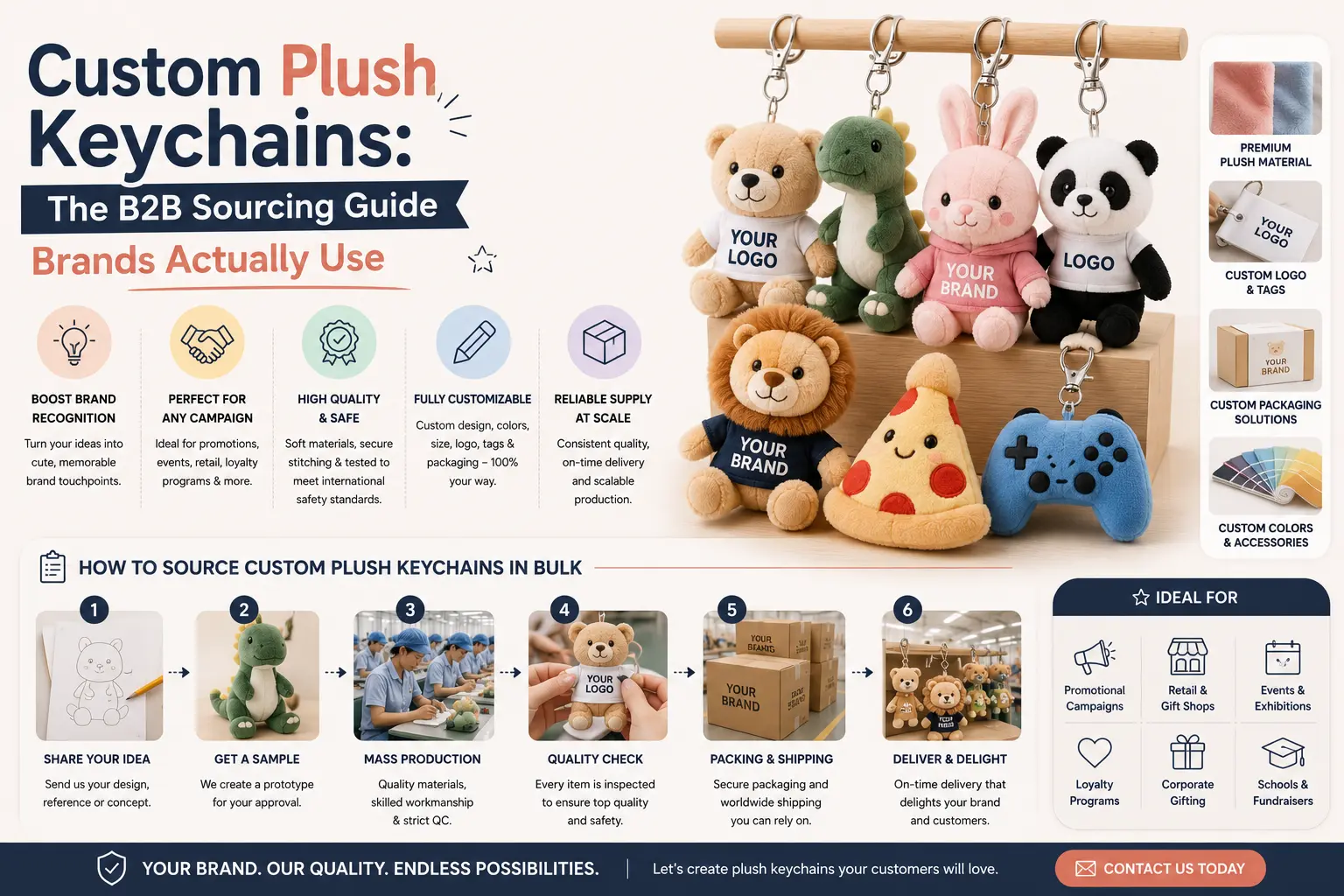
Walk any pop-mart aisle, comic con, or airport gift shop right now and you’ll see the same thing dangling off backpacks and tote bags: a tiny plush character clipped to a keyring. Custom plush keychains have quietly become one of the fastest-moving impulse categories in the soft-toy world, and for brands they solve a very specific problem. They give you a licensed, huggable product at a price point people buy without thinking twice.
I’ve helped brands move keychain programs from a napkin sketch to a container on the water, and the ones that succeed treat the keychain as a real product, not an afterthought. This guide walks through how to source custom plush keychains properly, what a good plush keychain manufacturer should be doing for you, and where most first orders go sideways.
Réponse rapide : A custom plush keychain is a small stuffed toy (usually 8–15 cm) fitted with a metal keyring, ball chain, or lobster clasp. For B2B orders, expect MOQs of 500–1,000 pieces per design, unit costs of roughly $1.20–$3.50 depending on size and detail, and a 30–45 day production window after sample approval.
Why plush keychains punch above their size
The math is what makes this category attractive. A full-size plush might retail at $25–$40 and sit on a shelf. A plush keychain retails at $8–$15, clips onto something the customer already carries, and turns them into a walking advertisement. That’s free reach you don’t pay for again.
There’s also the collectibility angle. Because the unit cost is low, brands can release a keychain as a whole series — six characters, seasonal variants, blind-box drops — and let fans chase the set. We’ve seen this drive repeat purchases in a way single hero products rarely do. If you’re already exploring viral plush toy trends for 2026, keychains are the lowest-risk way to test a character before committing to a large plush run.
The anatomy of a good custom plush keychain
Not all keychains are built the same, and the differences show up fast once a customer is tugging on them daily. Here’s what actually matters when you spec one.
| Component | Options | What to pick and why |
|---|---|---|
| Body fabric | Super-soft plush, minky, velboa, cotton velvet | Minky and super-soft feel premium at small sizes; velboa hides seams better on tiny bodies |
| Filling | PP cotton, poly-fiber, bean-pellet base | Add a small pellet base if you want it to sit upright; PP cotton alone for pure softness |
| Attachment | Split keyring, lobster clasp, ball chain, carabiner | Lobster clasp for bags, carabiner for the “gear” aesthetic, split ring for classic keys |
| Detailing | Embroidery, sublimation print, appliqué | Embroidery reads as higher quality; print is cheaper and better for complex art |
| Reinforcement | Fabric loop tab, webbing tab, D-ring anchor | Non-negotiable — this is the #1 failure point |
The single most important line in that table is the last one. A plush keychain lives a hard life: yanked out of pockets, dropped, swung around. If the keyring is sewn directly into a seam without a reinforced webbing tab, it will tear out, and you’ll be handling returns. A good factory bar-tacks a webbing loop into the seam and anchors it to the internal structure. Always ask to see this on the sample. If you want to go deeper on material trade-offs, our guide to the best fabric for plush toys covers hand-feel versus durability in detail.
What sourcing actually looks like, step by step
People imagine sourcing as “email a factory, get boxes.” The real sequence has more checkpoints, and each one protects you.
- Brief and reference art. Send your character sheet, brand colors (Pantone if you have them), size, and the vibe you’re after. The more reference angles you give, the closer the first sample lands.
- Costing and MOQ. A serious plush keychain manufacturer comes back with a per-unit cost tied to a minimum order quantity, not a vague “it depends.” If they can’t quote against a spec, they haven’t understood it.
- Sample round. You’ll get a pre-production sample. This is where you catch a muzzle that’s too flat, a color that reads pink instead of coral, or a keyring that feels flimsy. Two sample rounds is normal; needing five means the brief was thin.
- Approval and bulk. Once you sign off, bulk production runs. Knowing how to read a plush toy spec sheet here is genuinely useful — it’s the document that holds the factory accountable to exactly what you approved.
- Inspection and shipping. A pre-shipment inspection catches loose clasps and off-tolerance sizing before the goods leave. Skip it and you inherit the problem.
Costs, MOQs, and lead times you can plan around
Numbers vary by factory and complexity, but these ranges hold true for most keychain programs and will keep your first budget honest.
| Order size | Typical unit cost | Sample lead time | Bulk lead time |
|---|---|---|---|
| 500 pièces | $2.20 – $3.50 | 7–12 days | 30–35 days |
| 1,000 pcs | $1,80 – $2,80 | 7–12 days | 35–40 days |
| 3,000 pcs | $1.40 – $2.20 | 7–12 days | 40–45 days |
| 5,000+ pcs | $1.20 – $1.90 | 7–12 days | 45+ days |
A few things worth flagging. Tooling for embroidery and any custom hang-tag or backer card is usually a one-time charge folded into the first order. Freight is separate and swings with season — book earlier for Q4. And if you’re importing into the US, keychains still fall under toy safety rules, so build testing into the timeline and budget from the start rather than bolting it on at the end.
Compliance: small product, same rules
This trips up a lot of first-time buyers. A plush keychain is legally a toy, and if it’s marketed to or appealing to children, it must meet the same safety standards as a full-size plush — ASTM F963 in the US, EN71 in Europe. Small parts, the pull-strength of the attachment, and any embroidered eyes all get scrutinized. Our breakdown of normes de sécurité relatives aux peluches covers what testing you’ll need and roughly what it costs, so there are no surprises at customs.
If your keychain is genuinely adult-collector positioned, labelling matters even more — get the “not intended for children under 3” language and packaging right, because that classification changes which tests apply.
Where first orders go wrong
The most common mistake isn’t quality — it’s ordering the wrong quantity split. Brands fall in love with one character, order 3,000 of it, and under-order the two variants that fans actually wanted to collect. Spread your first run across the series and let sell-through tell you where to reorder.
The second most common miss is under-speccing the attachment. A ball chain feels cheaper in the hand than a lobster clasp, and at the $12 retail tier that hand-feel is the whole sale. Spend the extra few cents.
Foire aux questions
What’s the smallest quantity I can order for a custom plush keychain?
Most factories set a minimum of 500 pieces per design, and there’s a real reason behind it. Custom fabric cutting, embroidery tooling, and setup costs need a base volume to be worth running. You can sometimes negotiate 300 pieces on a very simple design, but the per-unit price climbs sharply below 500, and some suppliers will decline the job entirely because the setup eats the margin.
How long does the whole process take from art to delivered goods?
Budget around 8–10 weeks door to door. That breaks into roughly 1–2 weeks for sampling, a few days for your review and approval, 4–6 weeks for bulk production, and then ocean freight on top, which is another 3–5 weeks to the US or EU. Air freight compresses the shipping leg but adds meaningfully to unit cost, so it’s usually reserved for launch samples or urgent restocks.
Can I mix several characters in one production order?
Yes, and you generally should. As long as each character hits the per-design minimum, factories will run a multi-character order together and ship it as one consolidated shipment. This is exactly how brands launch a collectible series efficiently. Just keep in mind that each new character needs its own sample round, so more designs means slightly more sampling time up front.
Do plush keychains really need safety testing if they’re small?
They do, and size makes no difference to the law. If the product is a toy that could appeal to a child, it falls under ASTM F963 or EN71 depending on your market, and the tiny parts on a keychain actually attract more scrutiny, not less. The attachment’s pull strength and any small decorative elements are common failure points, so testing is a real line item you should plan for, not skip.
Which attachment type is most durable for daily use?
A lobster clasp or a proper carabiner anchored to a reinforced webbing tab is the most durable setup by a wide margin. The weak point in almost every keychain is where the metal meets the fabric, so the attachment style matters less than the reinforcement behind it. Insist on a bar-tacked webbing loop rather than a keyring sewn straight into an open seam, and pull-test the sample yourself before you approve bulk.
À propos de l'auteur
Zhang Wei has spent years inside the plush and soft-toy supply chain, working directly with brands, licensors, and manufacturing partners to take products from concept art to finished container. He writes about sourcing, product development, and toy safety with a focus on the practical decisions that make or break a first order. When he’s not reviewing spec sheets, he’s usually pulling apart a sample to see how it was built — and whether the keyring will survive a year in someone’s pocket.
Ready to test a keychain series? Explore our plush keychain range or send your character art for a quick costing.