
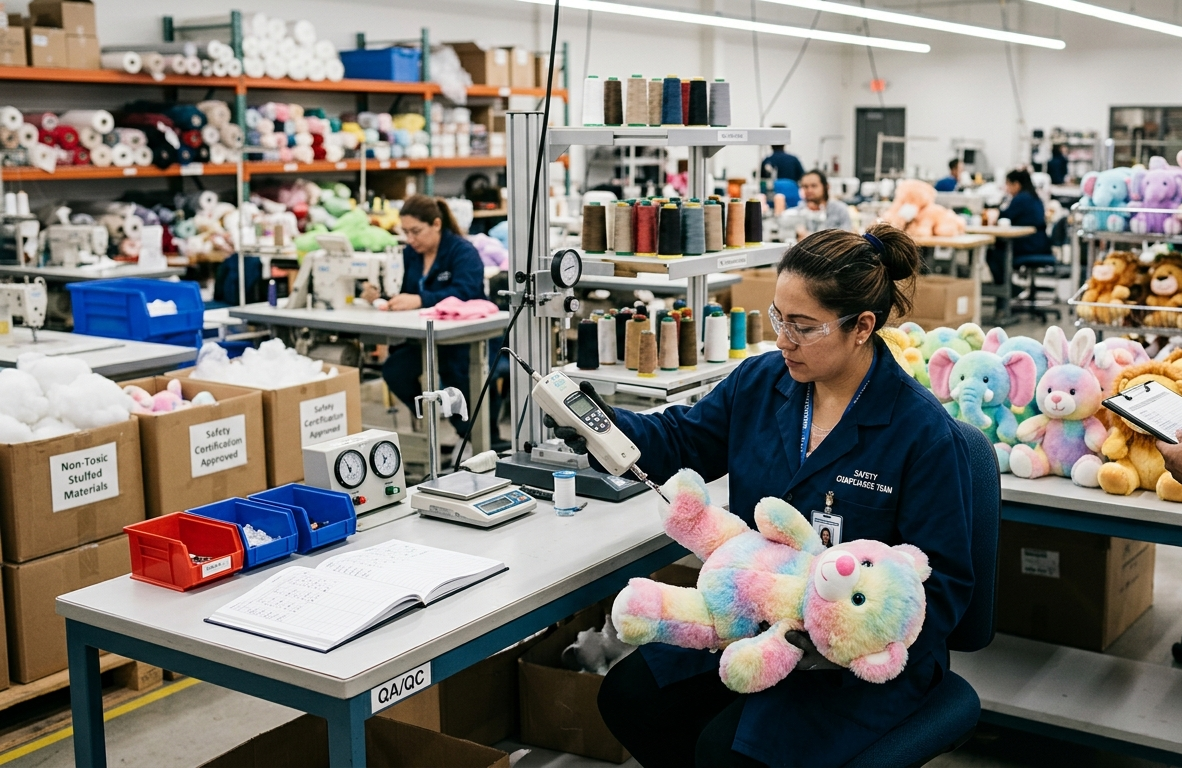
A cute character means nothing if it isn’t safe to put in a child’s hands — or, increasingly, an adult collector’s bag. Behind every compliant plush toy manufacturer is a layered system that runs from raw material sourcing through final shipment documentation, built around a small set of internationally recognized standards: ASTM F963 in the United States, EN71 in the European Union, and a handful of market-specific equivalents elsewhere.
The Standards a Manufacturer Has to Meet
Compliance isn’t one universal checklist — it’s market-specific, and a toy legally sellable in one country can be non-compliant in another.
United States: ASTM F963 and CPSIA
ASTM F963 is the mandatory US toy safety standard, made legally binding by the Consumer Product Safety Improvement Act (CPSIA) of 2008. The current enforced version is ASTM F963-23. For plush specifically, it covers seam strength, fiber length limits, fastener pull-test requirements, flammability, and labeling. CPSIA layers on additional requirements, including a 100ppm lead limit in accessible substrate materials and restrictions on phthalates. Testing must be performed by a CPSC-accepted accredited laboratory, and the result is documented in a Children’s Product Certificate (CPC) that must reference the correct standard version and be retained for five years after the last unit sells.
European Union: EN71 and CE Marking
Entering the EU requires the CE Mark, which is a self-declaration that’s only valid when it’s backed by a complete EN71 testing dossier. Plush toys must pass three parts of the standard: EN71-1 for mechanical and physical safety (using a small-parts cylinder to check that no component can detach and become a choking hazard), EN71-2 for flammability (surface burn testing, with a strict “no molten droplets” requirement), and EN71-3 for chemical migration, which screens for up to 19 heavy metals — considerably more than the US standard covers. Technical documentation has to be kept on file for 10 years.
Other Markets
The UK requires UKCA marking alongside EN71 testing; Australia and New Zealand use AS/NZS 8124, which is broadly equivalent to EN71 and ISO 8124; Canada applies the Canada Consumer Product Safety Act (CCPSA), with requirements similar to ASTM F963; and Japan has its own ST Mark and chemical regulations. Manufacturers selling into multiple regions typically map a single design against all applicable standards at once, since there’s significant overlap in what gets tested even though the pass/fail thresholds differ.
Where Compliance Actually Happens: Four Stages
1. Material Sourcing
Compliance starts before a single stitch is sewn. Reputable manufacturers source fabric, stuffing, and hardware (eyes, noses, joints) from suppliers who already provide OEKO-TEX and REACH compliance documentation, which narrows the risk before the design phase even begins.
2. Design Engineering
Small parts, sharp points, and attachment methods are engineered against EN71-1 / ASTM F963 requirements from the start — not retrofitted after a failed lab test. This includes things like tension-testing the strength of sewn-on eyes and noses and controlling cord or ribbon length to prevent entanglement risk.
3. Third-Party Lab Testing
Before mass production begins, samples go to an accredited, CPSC-accepted lab such as SGS, Intertek, or Bureau Veritas. Standard plush testing typically takes 10–14 working days and covers mechanical/physical safety, flammability, and chemical content (lead, phthalates, heavy metals, formaldehyde). Third-party lab testing generally costs $300–$800 per design, depending on the number of materials and colors and which regional standards apply.
4. In-House Quality Control
Paper certificates alone don’t guarantee that every unit shipped matches the unit that was tested. A reliable manufacturer runs its own physical checks on the full production run — most notably 100% needle detection to catch any broken needles left in the stuffing, and a tension test on every unit to rule out choking hazards from a weak seam or loose component.
Why “Passing a Test Once” Isn’t Enough
One of the most common compliance failures isn’t a bad lab result — it’s a mismatch between what was tested and what actually ships. A few specific risks manufacturers have to control for:
- Material substitution. Swapping fabric, filler, or hardware suppliers without new testing can quietly change a product’s chemical composition or mechanical strength, even if it looks identical.
- Design drift. Small changes — thinner seams, looser joints, a different assembly method — can affect small-parts or tension-test results even though nothing looks different to the eye.
- Outdated certificates. A Children’s Product Certificate that references an old ASTM version, or a factory-supplied CE certificate used for a new custom design, doesn’t hold up — safety certificates are design- and material-specific, not transferable between products.
- Sample-to-shipment mismatch. Customs and marketplaces (Amazon, Walmart, major EU retailers) increasingly cross-check documentation against the actual product; a mismatch can mean a seized container or a delisted product.
The standard practice to guard against this is annual re-testing for ongoing production, plus immediate re-testing any time a material, component, or factory changes.
Documentation a Compliant Manufacturer Should Provide
- US: ASTM F963 test report from a CPSC-accepted lab + Certificado de productos infantiles (CPC)
- EU: CE Declaration of Conformity + EN71 Parts 1–3 test reports + REACH compliance documentation
- UK: UKCA declaration + EN71 test reports
- Material-level certificates (OEKO-TEX, REACH) for fabric and filling
- Production and inspection records showing the tested sample matches the shipped batch
Buyers sourcing from a factory should ask to see this documentation directly rather than accepting a general compliance claim — a manufacturer with a clear compliance process will have these on hand for every SKU.
Preguntas frecuentes
Does every plush toy design need its own safety test?
Yes. Certification is design- and material-specific — a factory’s existing CE certificate or CPC can’t be reused for a new custom design, and any change to fabric, stuffing, or supplier typically requires new testing.
How long does plush toy safety testing take?
Standard plush toy testing under EN71 or ASTM F963 generally takes 10–14 working days at an accredited lab; electronic or sound-enabled plush can take 14–21 days due to additional testing requirements.
What happens if a shipment doesn’t have valid compliance documents?
Customs can seize a container that arrives without valid ASTM/CPSIA documentation for the US or a complete CE/EN71 dossier for the EU, and marketplaces like Amazon can remove listings that lack the required certificates.
Is CE marking enough on its own for the EU market?
No. The CE Mark is a self-declaration, and it’s only legally defensible when it’s backed by a complete EN71-1/-2/-3 testing dossier kept on file for 10 years.