
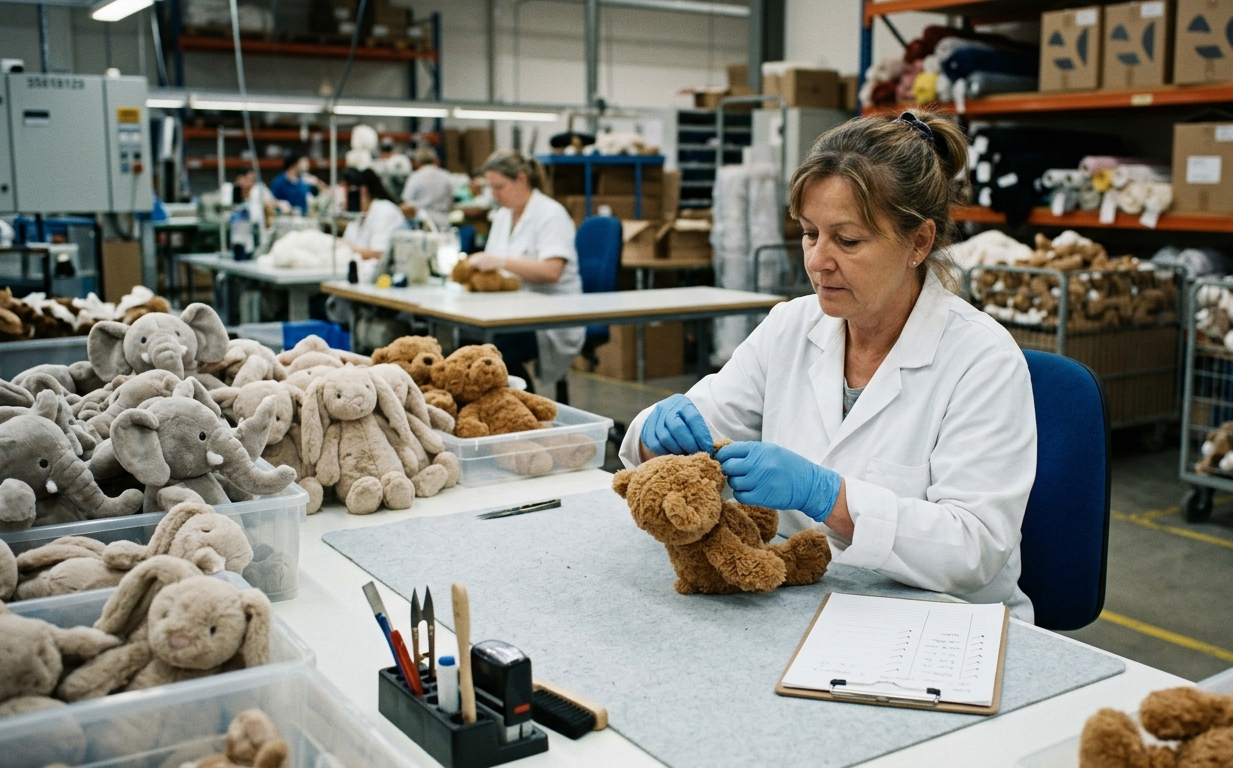
A plush toy that passes its safety lab test can still leave the factory with crooked eyes, uneven stuffing, or a seam that wasn’t sewn to spec. Lab testing confirms a design is safe; quality control (QC) confirms that every unit rolling off the line actually matches that design. At a well-run fábrica de peluches, that’s not a single final check — it’s a layered system that starts before cutting begins and doesn’t end until the container is loaded.
It Starts Before Production: The Golden Sample and Spec Sheet
Quality control doesn’t begin on the factory floor — it begins with documentation. Before bulk production starts, a serious manufacturer works from a clearly defined set of references:
- Golden sample — an approved physical reference toy showing agreed materials, colors, size, and stuffing density
- Measurement chart — key dimensions with tolerances (for example, head width ±1 cm)
- Material specification sheet — every fabric, trim, and filling material, with supplier source and color code
- Labeling instructions — placement of hangtags, brand labels, and care/safety labels
- AQL standard — the agreed sampling plan and defect thresholds for inspection (commonly AQL 2.5 for major defects)
Without these locked in advance, “quality” has no fixed definition, and inspectors have nothing concrete to measure against. Industry sourcing guidance puts it bluntly: a large share of a plush toy’s final quality is effectively determined before bulk production even starts — through fabric selection, stitch density planning, pattern accuracy, and stuffing ratios decided at this stage.
Stage 1: Incoming Quality Control (IQC)
Before a single piece of fabric gets cut, raw materials are checked on arrival. This covers colorfastness, pile direction, chemical safety, and dimensional stability of the fabric, along with verification that materials match the approved specification sheet. Non-conforming fabric is quarantined rather than sent to the cutting floor — catching a bad fabric batch here is far cheaper than discovering it in a finished toy.
Stage 2: In-Process Quality Control (IPQC) / Inline Inspection
As cutting, stitching, and stuffing happen, inspectors perform random checks on the live production line rather than waiting for a batch to finish. This is where problems like asymmetric shapes, weak seams, or inconsistent stuffing density get caught and corrected immediately, instead of being discovered after thousands of units are already assembled. Some factories also run a small pilot batch before scaling up production specifically to catch mold, pattern, or assembly errors while the cost of a mistake is still low.
Buyers sourcing from overseas factories are often advised to request mid-production sample photos or inline inspection reports during this stage, since it’s the point where quality is easiest — and cheapest — to correct.
Stage 3: Final Quality Control (FQC)
Once units are fully assembled, FQC inspects finished toys for softness, proportion, symmetry, and packaging cleanliness, comparing them directly against the golden sample. This stage typically includes:
- Pull/tension testing on seams, eyes, and attached components — for example, applying a defined force (commonly around 70 Newtons, held for several seconds) to confirm nothing detaches under stress
- Metal detection on every unit, to catch any broken sewing needles left in the stuffing
- Visual workmanship checks, comparing color, materials, and accessories against the approved sample
- Label and marking checks, confirming all required safety and tracking information is present and legible
Workmanship issues found at this stage are typically sorted into severity categories — critical, major, or minor — so the factory and buyer can agree on what triggers rework versus what’s acceptable within tolerance.
Stage 4: Pre-Shipment Inspection (PSI)
The final gate before a shipment leaves the factory is a formal AQL (Acceptable Quality Limit) sampling inspection, often conducted by the buyer’s own QC agent or an independent third-party inspection company such as SGS, TÜV, or Bureau Veritas. Rather than checking every single unit, PSI uses a statistically defined sample size based on total shipment quantity — inspectors pull a representative sample, inspect it against the checklist and golden sample, and classify results as pass, fail, or requiring corrective action. If the shipment fails, the standard outcome is a full rework and re-inspection before goods are released.
What a PSI Checklist Actually Covers
A comprehensive plush toy inspection checklist generally spans five categories:
- Mechanical safety — pull tests on eyes, buttons, and attachments; confirmation that no small parts can detach under specified force; small-parts cylinder verification for toys aimed at children under 3
- Inflamabilidad — confirming fabric and filling meet the applicable burn-rate limits for the destination market
- Chemical/material verification — spot-checking textile batches against approved material specs to catch unauthorized substitutions
- Labeling — required markings present and accurate for the destination market
- Packaging — carton strength, correct configuration, and protection against transit damage (some factories run drop tests, such as ten repeated carton drops, to confirm packaging holds up)
Some checks — like pull tests and metal detection — happen on-site during inspection. Others, particularly chemical composition tests, require samples to be sent to an accredited lab, which typically takes a further 3–7 days to return results.
Why Layered Inspection Beats a Single Final Check
A factory that only inspects at the very end of production tends to carry a higher defect rate, because problems compound silently through the whole run before anyone catches them. Layered inspection — IQC, inline, FQC, then PSI — catches issues at the cheapest possible point to fix them: a bad fabric roll is far less costly to reject at IQC than a finished toy is to scrap at PSI. When evaluating a factory, it’s reasonable to ask directly what AQL level they use, who conducts each inspection stage, and whether there’s a documented corrective-action process for when something fails — a factory that can’t answer clearly, or that only checks at final packing, is a meaningful red flag.
Common Defect Categories Inspectors Look For
- Critical defects — issues that create a safety hazard, such as a detachable small part, open seam, or failed pull test. These typically halt a shipment outright.
- Major defects — issues that would likely cause a customer to reject the product, such as visibly asymmetric features, incorrect color, or missing accessories.
- Minor defects — cosmetic issues, like light stray threads, that fall within agreed tolerance and usually don’t block shipment.
Classifying defects this way lets a factory and buyer agree in advance on what’s acceptable, rather than negotiating severity after a batch has already failed.
Preguntas frecuentes
What is a golden sample, and why does it matter for QC?
A golden sample is the physical reference toy both the buyer and factory approve before mass production. Every inspection stage compares production units against it, so without one, there’s no fixed standard for “correct” color, size, or stuffing density.
What does AQL mean in plush toy inspection?
AQL (Acceptable Quality Limit) is a statistical sampling standard — commonly ANSI/ASQ Z1.4 — that defines how many units from a shipment get inspected and how many defects are allowed before the batch is rejected, based on shipment size and defect severity.
Is pre-shipment inspection the same as lab safety testing?
No. PSI is a physical, on-site inspection of the shipment against the approved sample and checklist; lab safety testing (for ASTM F963, EN71, etc.) is a separate chemical and materials analysis usually performed earlier, during pre-production sample approval.
Who typically performs pre-shipment inspection?
It can be done by the buyer’s own in-house or agent QC team, or by an independent third-party inspection company. Using a third party adds an extra layer of objectivity, since the inspector has no production-side incentive to pass a marginal batch.