
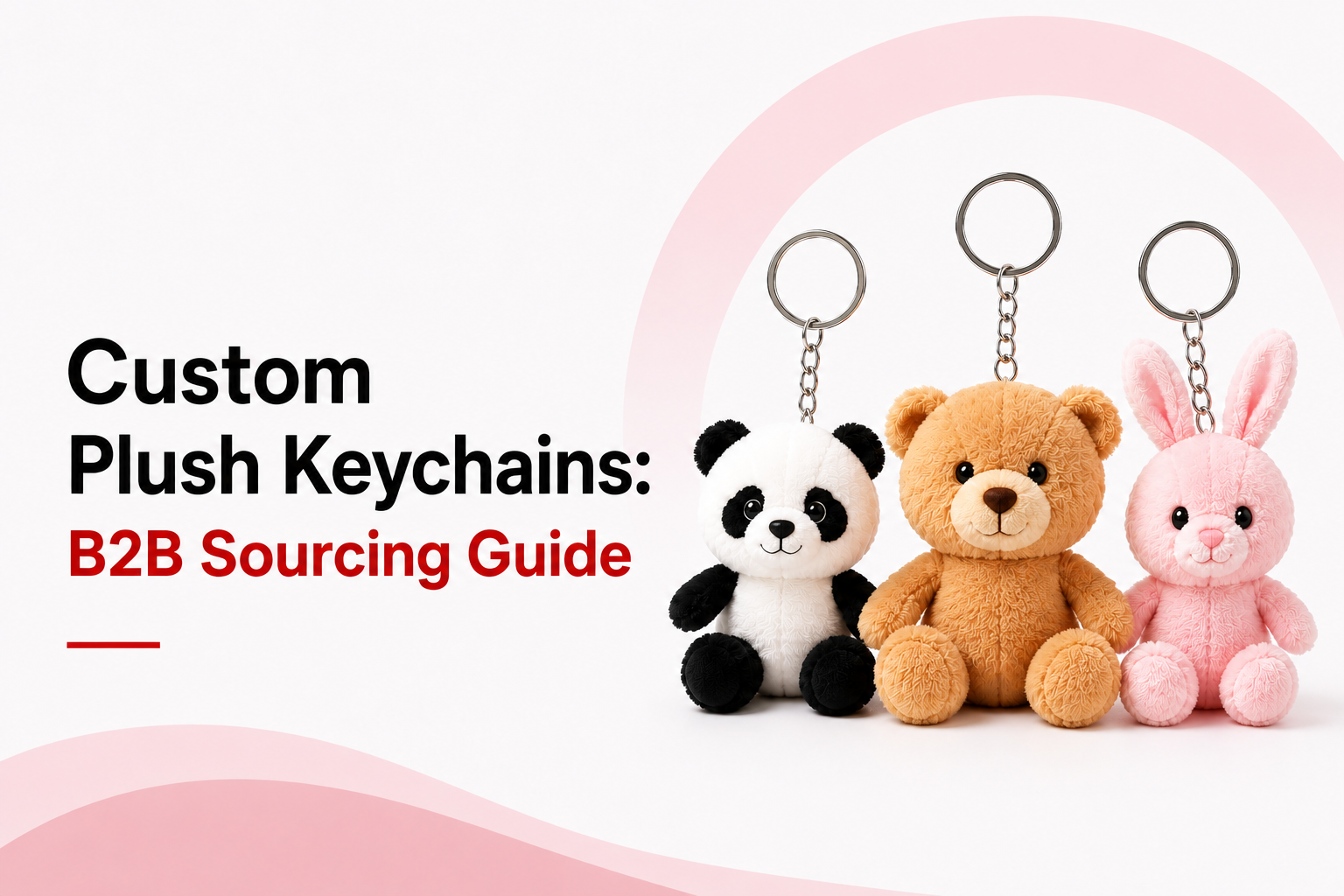
A custom plush keychain is a small soft toy, usually 8 to 15 cm, made to your own design and fitted with hardware so it can clip to a bag, backpack, or set of keys. For brands, retailers, and promotional buyers, it is one of the most accessible custom plush products to source: low unit cost, broad appeal, and quick to turn a character or logo into something people actually keep and carry. Sourcing one well comes down to a few decisions about design, hardware, materials, and the factory you choose.
This guide covers how a plush keychain is designed and made, and what to check when ordering in bulk.
What a custom plush keychain is
At its simplest, a plush keychain is a miniature version of a stuffed toy with an attachment point. The soft body is sewn and stuffed like any custom plush toy, then finished with a metal or fabric fitting. Because the product is small, the same design decisions carry more weight: at this size, thick seams, oversized eyes, or fine text can overwhelm the shape, so the design usually has to be simplified rather than shrunk directly.
Popular formats include character keychains, mascots, animals, and food or novelty shapes. Bag charms, a slightly larger and more fashion-led version, sit in the same category and are made the same way. Themed sets, like our Die Brot-Familie characters, show how a small plush series can work as a collectible line rather than a single item.
How a plush toy is adapted into a keychain
The main question buyers ask is how to make a plush into a keychain, and the answer is that you design for the format rather than shrinking an existing toy.
A larger plush can carry detail across a big surface. A keychain cannot, so the design is adapted: bold silhouettes, fewer colour breaks, and simplified features that still read at a glance. Embroidery is often used for small details like eyes and mouths because it stays crisp at scale, while printing suits flatter, graphic designs. A good custom stuffed animal maker will flag which elements of your artwork will and won’t translate before sampling begins.
Suitable designs, shapes, and sizes
Compact, rounded shapes hold up best. Long thin limbs or delicate protrusions are weak points on something that gets tossed in a bag and clipped to a zip. Most keychains land between 8 and 15 cm, though the right size depends on your use case: promotional giveaways trend smaller and cheaper, while retail bag charms are often larger to justify a shelf price.
Fabric, filling, and hardware
Stoff und Füllung
Fabric choice affects look, feel, and cost. Short-pile fabrics such as velboa hold detail well on a small item, while softer minky reads as more premium but can blur fine features. It helps to understand the common plush fabrics and how minky, velboa, and super-soft options compare before briefing. Filling is typically polyester fibre, chosen for softness and shape retention; small items need enough fill to hold form without going stiff.
Keychain hardware and attachment
Hardware is where a lot of quality issues hide. Common options include a split ring, a lobster clasp, a spring hook, or a ball chain, each attached with a sewn fabric loop or a bar tack. The attachment is the part most likely to fail, so it should be reinforced and pull-tested rather than simply stitched on. The right fitting depends on how the product will be used: a promotional item clipped once behaves differently from a bag charm moved daily.
Branding, custom characters, and IP
Keychains are effective brand merchandise because they are small, affordable, and carried in public. You can add a logo to a stock-style shape (an ODM-style approach) or commission an original character from your artwork (OEM). If you are producing your own character or a licensed property, confirm who owns the design and that you hold the rights before sharing files. Our overview of OEM and ODM plush manufacturing explains the difference and what each means for design ownership.
Samples and prototype approval
Never approve a bulk keychain order from a photo. Because the product is small, proportions and colour shift easily between artwork and a sewn sample, and hardware placement affects how it hangs. A pre-production sample lets you check all of this before it is multiplied across a large run. Our guide to Wie Vorproduktionsmuster hergestellt werden covers what to review and how many rounds to expect.
MOQ, quality control, and safety
MOQ and bulk orders
Minimum order quantities, pricing, and timelines vary with design complexity, fabric, hardware, size, and the manufacturer. There is no fixed number, and keychains often carry different minimums than full-size plush because of how they are cut and finished. Rather than assume, see our breakdown of plush toy MOQs and how quantity affects manufacturing cost.
Quality control
On a small item, small defects are obvious: uneven eyes, loose hardware, thread ends. Reputable factories inspect during and after production, often against a sampling standard such as AQL 2,5, and run a Prüfung vor dem Versand before the order ships. Ask specifically how hardware is tested, since attachment failures are the most common keychain complaint.
Safety considerations
If a keychain could reach a child, it is treated as a toy and regulated accordingly, and requirements depend on the destination market rather than the factory. Small parts, the pull strength of the fitting, and material safety all come into play. Toys for the US market generally fall under CPSIA and ASTM F963; toys for the EU fall under EN 71. Our comparison of ASTM F963 and EN 71 explains which applies where. A responsible manufacturer builds to the relevant standard, but no factory can call a product compliant for a market without testing it for that market.
Packaging, shipping, and sourcing
Packaging is briefed alongside the product. Options range from a simple polybag to a header card or hang tag that makes the keychain retail-ready and carries any required labelling. Because keychains are light and compact, they ship efficiently, though timelines still depend on quantity, testing, and season.
How to evaluate a plush keychain supplier
- Direct manufacturer, not a trader. Confirm the factory sews in-house rather than outsourcing.
- Keychain-specific experience. Ask to see small-format samples, not just large plush.
- Hardware quality. Check how attachments are reinforced and tested.
- Sampling willingness. A good supplier revises until the sample is right.
- Market compliance. Confirm experience with your destination’s safety rules.
For broader due diligence, our checklists for choosing a plush factory in China und vetting a supplier for a USA brand apply here too.
Common mistakes to avoid
- Shrinking a full-size design instead of adapting it for a small format.
- Underspecifying hardware, then dealing with attachment failures.
- Skipping the physical sample.
- Assuming one safety test covers every market.
- Sharing character artwork before IP ownership is agreed.
Sourced well, a custom plush keychain is a low-risk entry into custom plush and a strong piece of brand merchandise. As a China-based OEM and ODM manufacturer, Plush Toys Factory produces Plüsch-Schlüsselanhänger alongside Plüschtiere and licensed products. With artwork ready, the next step is usually a sample, which you can start through our Bestellvorgang.