
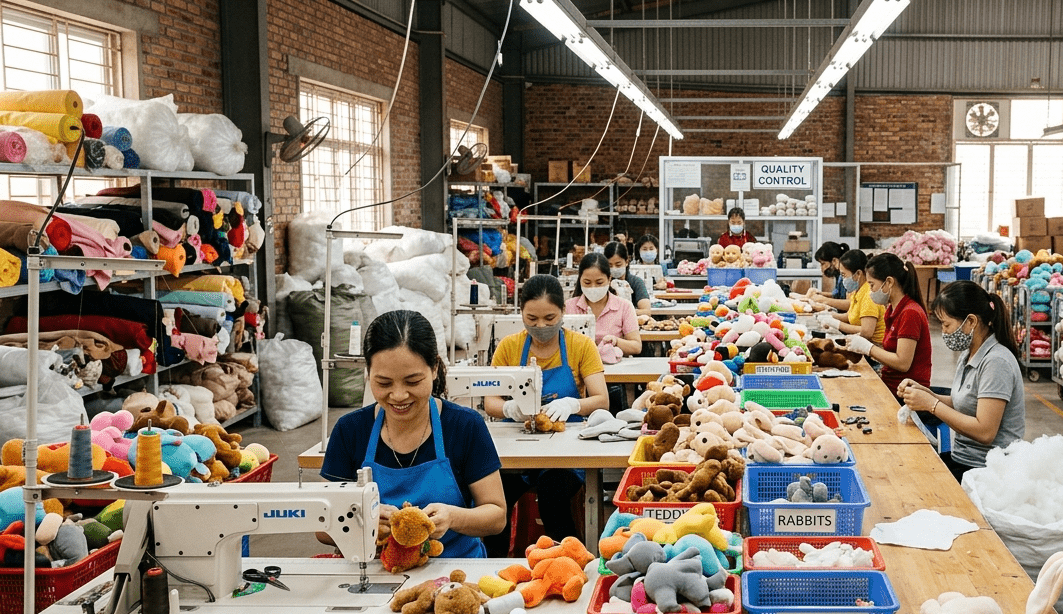
Zhang Wei | Produktionsleiter, Plüschtierfabrik
Veröffentlicht am 12. Juli 2026 | Auf Richtigkeit geprüft vom Produktionsteam der PlushToys Factory
Choosing a plush toy manufacturer is the decision that quietly determines whether your product line succeeds or stalls. Get it right and production becomes routine, samples arrive on time, and your toys clear customs without drama. Get it wrong and you inherit failed safety tests, inconsistent quality, and shipments held at the port. This guide is the checklist we would hand a brand owner evaluating suppliers, written from the production side by people who see exactly where the wrong factory costs you.
It is deliberately honest about trade-offs, because the goal is a supplier you can grow with, not the one with the lowest number on the quote.
Why the cheapest quote is usually the most expensive
The most common and most costly mistake is picking a manufacturer on unit price alone. A low quote often achieves that number by leaving things out: third-party safety testing, sealed inner bags for pellets, export documentation, or virgin fill. Every one of those omissions lands back on you, either as a cost you pay later or as a shipment that fails at the border. The number that actually matters is landed cost, which is the unit price plus testing, duty, freight, insurance, and broker fees spread across your order. Compare that, and the true ranking of suppliers often flips.
The five non-negotiables
Before you evaluate anything else, a plush toy manufacturer serving the US market must clear these five. If a supplier fails any of them, stop there.
| Requirement | What to ask for | Red flag |
| US compliance | Existing ASTM F963-23 and CPSIA reports | Cannot produce reports on request |
| Reasonable MOQ | The real minimum for your spec | Minimum jumps after the quote |
| Sampling process | A defined sample-and-approve flow | Straight to bulk, no golden sample |
| IP protection | NDA and design ownership in writing | Vague or verbal assurances only |
| Transparent pricing | A full landed-cost breakdown | One low number, no detail |
1. Proven US compliance
A plush toy sold in the United States is a children’s product under the Consumer Product Safety Improvement Act and must meet ASTM F963-23. A manufacturer that already exports to the US will have test reports on hand and will issue a Children’s Product Certificate without hesitation. One that stalls when you ask has probably never shipped to your market, which means you would be their compliance experiment. Ask for reports on a product similar to yours, and confirm the testing was done at a CPSC-accepted lab. We keep a Konformitätskalender für Plüschspielzeug von US-Marken precisely so our clients know which tests their product needs before production starts.
2. A minimum order that fits your launch
Minimum order quantity is where ambition meets reality. A factory built only for huge runs will not serve a brand testing its first design, and a factory with no minimum discipline often cannot hold quality. The honest answer is that MOQ depends on your fabric and accessories, so a good manufacturer will tell you the real minimum for your exact spec rather than a headline number that changes after you commit. Watch for the classic bait, where a low MOQ is quoted, then quietly rises once custom fabric or packaging enters the conversation. A low-minimum Fabrik für maßgeschneiderte Plüschtiere lets you validate a design before scaling, which is the single best way to protect your capital.
3. A real sampling process
Sampling is where a manufacturer proves it can actually build your product, not just quote it. A serious factory runs a defined flow: tech pack, first sample, refinement, pre-production testing, then an approved golden sample that becomes the quality benchmark for the whole run. A supplier that wants to skip straight to bulk is telling you it does not manage quality tightly, and you will discover the consequences a container at a time. The sampling stage is also where you settle materials, and choosing compliant fabric and fill early prevents most downstream failures, which we explain in our Leitfaden zu Füllmaterialien.
4. IP protection in writing
Your design is an asset, and it needs protecting before you share it. A trustworthy manufacturer will sign a non-disclosure agreement, agree in writing that you own the design and the tooling or molds you paid for, and keep your product off its public catalog. Vague verbal assurances are a warning sign. This matters most for original characters and distinctive designs, where a factory that reuses your work for another buyer can turn your investment into a competitor’s product. Put ownership in the contract, not the conversation.
5. Transparent, landed-cost pricing
A manufacturer worth working with will break down pricing rather than hand you a single number. You want to see the unit price, the cost of testing, packaging, and any accessories, and a clear picture of what ships when. Combined with your freight and duty, that gives you the landed cost you can actually plan a margin around. If a supplier resists explaining its pricing, that opacity usually hides either omitted compliance work or a number that will climb later. For imports specifically, tariff rates move, so ask how they handle classification and confirm current duty, a topic we cover in our US-China tariffs guide.
Beyond the basics: what separates good from great
Once a manufacturer clears the five non-negotiables, these factors separate a supplier you tolerate from one you grow with.
- Communication speed: a factory that answers clearly within a day saves you weeks over a production cycle. Slow, vague replies during courtship only get worse after you commit.
- Ethical and social audits: credentials like the ICTI Ethical Toy Program or amfori BSCI signal a factory that major US retailers will accept, which matters if you plan to sell through them.
- Range and flexibility: a manufacturer that can produce full plush, Schlüsselanhänger, and accessories lets you expand a line without onboarding a new supplier.
- Consistency across runs: ask how they ensure unit ten thousand matches the golden sample. The answer reveals whether they truly control quality.
How we evaluate our own work
To show what a real quality process looks like, here is the standard we hold ourselves to on every order. Use it as a benchmark when you assess any manufacturer, including us.
- Every product is tested against ASTM F963-23 on the exact production materials before bulk, not on a generic sample.
- An approved golden sample is sealed and every production unit is checked against it.
- Materials are traceable to the fabric mill and fill supplier, with lot-level reports on file.
- Pricing is quoted as a landed-cost breakdown so the brand can plan margin honestly.
- Design ownership and confidentiality are agreed in writing before the first sample is made.
A simple scorecard for your shortlist
When you narrow your options to two or three, score each one honestly on the criteria that predict a smooth partnership. The supplier that wins on this scorecard is rarely the cheapest, and almost always the one you keep.
| Criterion | The question that reveals the truth |
| Compliance | Can you send a recent ASTM F963-23 report right now? |
| MOQ honesty | What is the real minimum for my exact spec? |
| Sampling | Walk me through your sample-to-golden-sample flow |
| IP | Will you sign an NDA and confirm I own the design? |
| Pricing | Can I see the full landed-cost breakdown? |
| Communication | How fast, and how clear, were the answers above? |
Das Fazit
Choosing a plush toy manufacturer is a documentation decision dressed up as a price decision. The right factory proves US compliance on demand, holds an honest minimum, samples properly, protects your design in writing, and prices transparently in landed-cost terms. The wrong one quotes a low number and hands you the hidden costs later. Score your shortlist on the questions that reveal the truth, and pick the partner you can grow with, not the cheapest line on a spreadsheet.
If you want to test a supplier against this checklist, start with us. We will send compliance reports, quote the real MOQ for your spec, and walk you through our sampling process before you commit. Talk to our team to begin.
Häufig gestellte Fragen
How do I choose a plush toy manufacturer?
Evaluate manufacturers on documentation and repeatability, not the lowest quote. Confirm five non-negotiables first: existing US safety test reports, an honest minimum order for your spec, a real sampling process ending in an approved golden sample, IP protection in writing, and transparent landed-cost pricing. A supplier that fails any of these will cost you more than the price gap you saved.
What is a good MOQ for custom plush toys?
There is no single right number, because the minimum depends on your fabric and accessory choices. Stock fabrics keep the minimum low, which is ideal for testing a design before scaling, while bespoke printed fabric or custom packaging raises it. A trustworthy manufacturer tells you the real MOQ for your exact spec up front, rather than quoting a low figure that climbs after you commit.
How do I know if a plush manufacturer is compliant for the US market?
Ask for existing ASTM F963-23 and CPSIA test reports on a product similar to yours, and confirm the testing was done at a CPSC-accepted lab. A compliant manufacturer will also issue a Children’s Product Certificate and apply a tracking label. If a supplier cannot produce recent reports on request, treat it as a serious red flag.
Should I protect my plush design with an NDA?
Yes. Before sharing a design, have the manufacturer sign a non-disclosure agreement and confirm in writing that you own the design and any tooling or molds you paid for. This matters most for original characters and distinctive designs. Vague verbal assurances are a warning sign, because a factory that reuses your work can turn your investment into a competitor’s product.
Why is landed cost more important than unit price?
Because the unit price hides the true cost of an order. Landed cost adds testing, duty, freight, insurance, and broker fees to the unit price and spreads them across your order. A low quote that omits compliance or export work produces a higher landed cost than a slightly pricier factory that handles everything. Comparing landed cost is what separates importers who scale from those who get burned.
| Über den Autor
Zhang Wei – Produktionsleiter, PlushToys Factory Daniel has spent over a decade on the production side of plush, onboarding USA brands into custom manufacturing and fixing the messes left by the wrong supplier. He knows what separates a factory that ships a compliant, repeatable product from one that quotes low and disappears. To evaluate us against this checklist directly, start a conversation with our team. |