
A brand owner in Texas reached out to us in March. She had placed her first custom plush toy order eight months earlier. Found a factory on Alibaba. Good reviews. Responsive sales rep. Competitive price. She ordered 500 units of a custom mascot for her pet care brand. Paid 30% deposit upfront.
What arrived wasn’t what she approved in the sample. The fur was shorter. The eyes were a different shade of brown. The stitching on the tail was loose enough that three units failed a basic pull test she ran herself.
Ordering custom plush toys from China factory offered a 10% discount on her next order as compensation. She didn’t place a next order. That story isn’t unusual. We hear versions of it regularly. And the painful part is that most of these situations are completely avoidable. Not with luck. With the process.
Here’s what actually goes wrong — and what experienced B2B buyers do differently.
Mistake #1: Choosing a Factory Based on Price Alone
This one hurts brands most often. And it makes complete sense on the surface — you’re sourcing from China specifically because the economics work better than domestic manufacturing. Price matters.
But there’s a difference between competitive factory-direct pricing and suspiciously cheap pricing.
Ordering custom plush toys from China factory quoting 40% below every other factory you’ve spoken to isn’t finding efficiencies you can’t see. They’re cutting somewhere. Maybe fabric quality. Maybe stuffing density. Maybe they’re a trading company quoting factory prices they can’t actually deliver.
The question to ask isn’t “what’s your price?” It’s “What does this price include?” Get a full breakdown. Materials. Labor. Sampling. AQL inspection. Compliance testing. Packaging. When you compare fully-loaded quotes, the cheapest option often stops looking cheap.
We’ve had brands come to us after a failed first order with another factory. The comparison is always the same. Our initial quote was higher. The total cost of their first experience — failed product, storage fees, reorder, missed launch — was three times what the price difference was.
Mistake #2: Skipping the Sample Stage
We understand why this happens. Sampling takes time. It costs money. You’ve seen the reference images, you’ve reviewed the spec sheet, and the sales rep says the sample will look exactly like the reference. Why wait?
Because the sample stage is where you find out if the factory actually understood your brief.
Color matching looks different on screen than it does on fabric. Proportions that work in a 2D reference image sometimes look off in a three-dimensional toy. Embroidery detail that’s achievable at a large size becomes blurry at a small size. A floppy limb that wasn’t obvious in photos becomes obvious the moment you hold the toy.
Every single issue you catch at the sample stage costs you almost nothing to fix. The same issue discovered in a 500-unit production run costs you the run.
The sample stage isn’t a formality. It’s your last checkpoint before real money goes into production. Use it seriously. Request multiple revision rounds if you need to. A factory that pushes back on sample revisions is a factory telling you something important about how they’ll handle production problems.
Mistake #3: Not Understanding What “Certified” Actually Means
This is the mistake that creates the most serious downstream problems.
A factory tells you their products are “certified.” You see a CE logo on their website. You assume your toys are safe to sell in your target market. They’re not — or at least, you have no way to verify that they are.
CE marking on a website doesn’t mean the specific toys you’re ordering have been tested to EN71. A certificate from two years ago doesn’t apply to this production run if the factory has changed its fabric supplier since then.
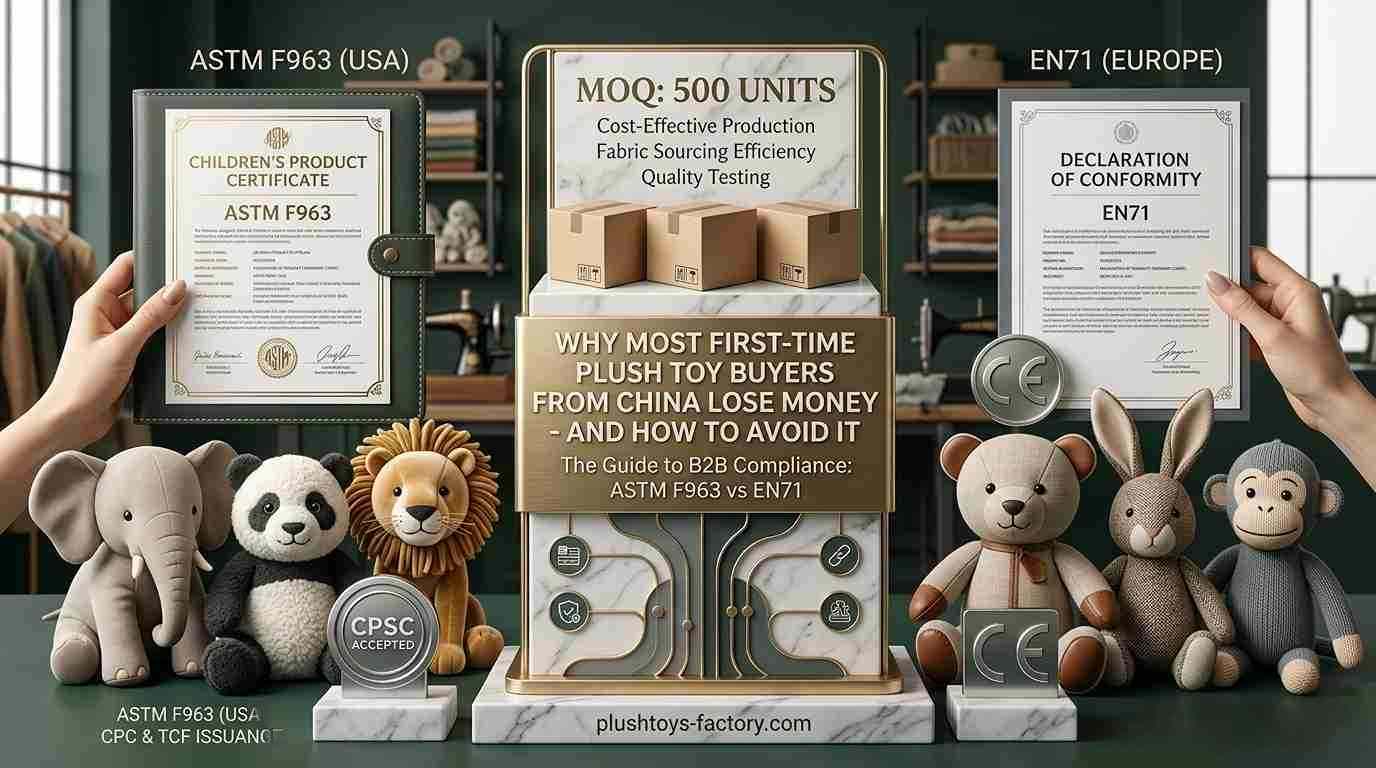
For US retail: you need a Children’s Product Certificate (CPC) issued by a CPSC-accepted third-party laboratory, specifically for the toys you’re ordering. Not a generic factory certificate. Not a certificate for a similar product.
For European retail: you need EN71-1, EN71-2, and EN71-3 test reports from an accredited laboratory, a Declaration of Conformity, and a Technical Construction File.
Before any order, ask the factory to provide the actual test reports — not certificates — for the specific product type you’re ordering. Ask which laboratory conducted the tests. Ask whether those tests were conducted under ASTM F963 or EN71. A factory that can’t answer these questions clearly hasn’t been shipping to compliant retail markets.
Mistake #4: Wiring Money Without a Proper Purchase Order
The standard payment structure in Chinese manufacturing is 30% deposit upfront, 70% balance before shipment. That’s reasonable. The problem isn’t the payment structure — it’s what’s documented before the deposit is sent.
We’ve seen purchase orders that are basically: “500 custom bears, $X per unit, delivery in 8 weeks.”
That’s not a purchase order. That’s a wishlist.
A proper purchase order for custom plush manufacturing should specify the product in enough detail that a dispute about quality has an objective reference point. Dimensions. Weight. Fabric type and pile height. Eye size and attachment method. Stuffing density. Color references in Pantone codes. Packaging requirements. Required certifications.
If the product that arrives doesn’t match the approved sample AND the specifications in the purchase order, you have a documented basis for dispute. Without that documentation, you’re arguing about subjective impressions — and you’ll lose.
Mistake #5: Treating the Factory Relationship as Transactional
This one is subtler. And it matters more than most buyers realize.
A factory that sees you as a one-time transaction will treat your order accordingly. Your order goes into the queue. The account manager who was responsive during the sales process becomes harder to reach once the deposit clears.
The brands that consistently get good outcomes from Chinese manufacturing treat their factory relationships like partnerships. They communicate clearly. They respond promptly to questions. They give feedback on samples professionally rather than just rejecting without explanation. They pay on time.
This isn’t about being naive. Contracts and documentation still matter. But a factory team that genuinely wants to do good work for you — because they believe you’re a long-term customer — will flag problems earlier, escalate issues faster, and find solutions more creatively than a factory team that’s processing your order like a ticket.
We’ve worked with brands that have been ordering from us for three years. They get better outcomes than first-time buyers. Not because we work harder for them — we apply the same standards to every order. But because the communication is efficient, the briefs are clear, and we understand each other’s expectations. That accumulated understanding has real value.
Mistake #6: Ignoring Lead Times Until It’s Too Late
| Stage | Zeitleiste |
|---|---|
| Sample development | 7-10 business days |
| Sample revision | 5-7 business days |
| Bulk production | 25-35 days |
| Sea freight to USA | 18-25 days |
| Customs clearance | 3-7 business days |
| Total minimum | 10-14 weeks |
Custom plush toy manufacturing takes time. Here’s the realistic timeline.
Sample development: 7-10 business days from brief submission. Sample revision (if needed): another 5-7 business days. Bulk production after sample approval: 25-35 days. Shipping (sea freight to US West Coast): 18-25 days. Customs clearance: 3-7 business days.
Total from brief to warehouse: 10-14 weeks minimum, assuming no revisions and no delays.
Most brands that discover this for the first time discover it when they’re already 6 weeks from their launch date.
Custom plush isn’t a two-week turnaround. If your product launch, campaign activation, or retail floor date is fixed — count backwards from that date and start your sourcing conversation accordingly. Build in a buffer for sample revisions. Build in a buffer for shipping delays. The brands that consistently hit their launch dates aren’t lucky — they started earlier.
What the Brands That Get This Right Do Differently
After 15 years of manufacturing plush toys in Dongguan, China for brands in the US and Europe, the pattern is consistent.
The buyers who get good outcomes ask more questions upfront. They read the factory’s compliance documentation before the first order, not after the first problem. They treat the sample stage as seriously as production. They document everything in writing — not because they expect disputes, but because clear documentation prevents most disputes from happening.
They also choose factories based on manufacturing capabilities and communication quality — not just price. A factory that responds within 12 hours, can explain its quality control process in detail, and proactively flags potential issues before they become problems, is worth more than a factory that’s $0.30 cheaper per unit.
That might sound like we’re describing ourselves. We are, honestly. But we’ve also helped brands fix problems created by other factories often enough to know that the selection criteria matter enormously.
Fazit
ordering custom plush toys from China isn’t complicated. But this manufacturing require knowing what questions to ask before the deposit is sent, not after the shipment arrives.
If you want to understand exactly what a compliant, well-documented first order looks like, we’re straightforward about our process and our pricing.
Talk to us before your next order →
Related: How to Choose a Reliable Plush Toy Manufacturer | How to Choose a Reliable Plush Toy Manufacturer | Custom Plush Toy MOQ Guide
Häufig gestellte Fragen
How do I verify that a Chinese factory actually has the certifications they claim?
Ask for the actual test reports — not just certificates. The report should include the testing laboratory’s name, accreditation number, test date, and the specific standard tested to (ASTM F963 or EN71). You can verify laboratory accreditation through the CPSC website for US-accepted labs or the EA (European co-operation for Accreditation) database for EN71 labs.
What should a proper sample approval process look like?
You should receive a physical sample — not just photos. Review it against your approved spec sheet point by point. Test pull force on all attached components. Check color accuracy against your Pantone reference. Confirm dimensions match your brief. Approve in writing only when every specification is met.
What’s a realistic budget for compliance testing on a new plush toy product?
Budget $400-700 for initial ASTM F963 testing for the US market, or $500-800 for EN71 testing for the European market, depending on the scope and laboratory. If you need both, budget separately for each. These costs are per product type, not per unit.
Is Alibaba a reliable way to source custom plush toy factories?
Alibaba lists both factories and trading companies, often without a clear distinction. It’s a starting point for finding suppliers, not a vetting mechanism. Any factory found through Alibaba requires the same due diligence: factory visit or third-party audit, reference checks, sample evaluation, and compliance documentation review before committing to production.