
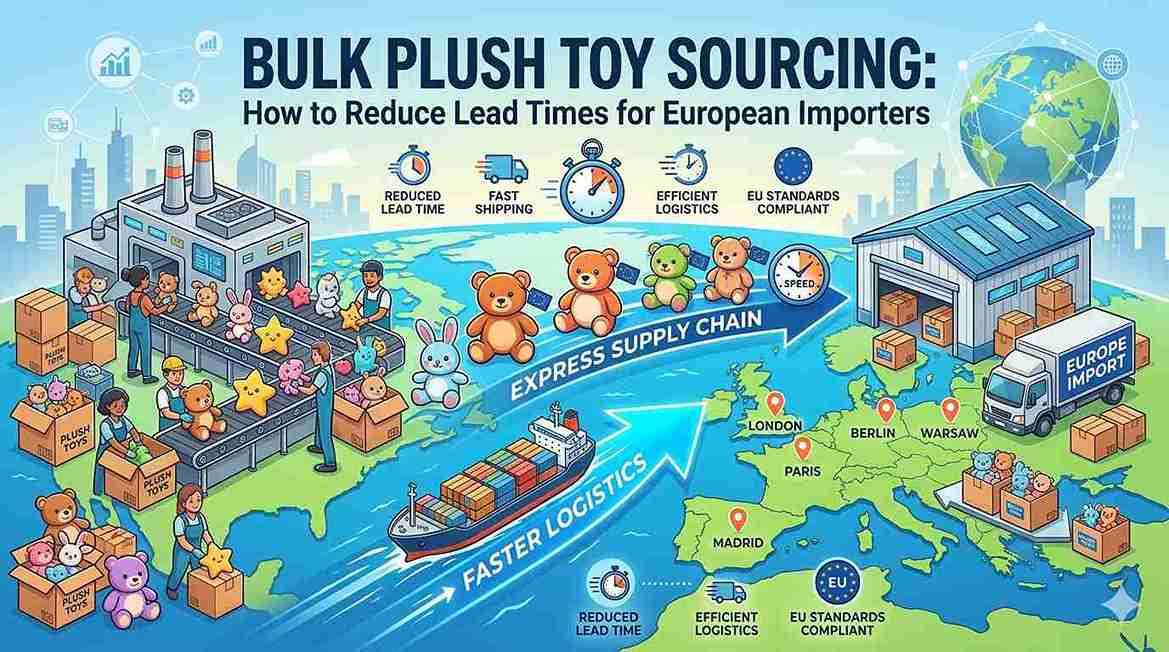
The demand for Plüschtiere stays strong throughout the year, especially during holidays like Christmas and events like birthdays. And importing bulk plush toys can be a profitable business in Europe. However, many importers face the common problem of long lead times. In simple terms, lead time refers to the total time from placing an order to receiving the goods. If your time is too long, you might miss out on sales opportunities, lose customers, or run out of stock.
What Is An Ideal Lead Time for Bulk Plush Toy Manufacturers?
Before reducing lead time, it’s essential to understand the normal timeline. For bulk plush toy orders, the typical lead time is divided into these days:
- Product design & sampling takes 7 to 21 days
- Material sourcing within 7 to 14 days
- Overall production in 30 to 60 days
- Quality inspection may take 3 to 7 days
Shipping to Europe Lead Time Estimate
You can ship to Europe by using these two pathways:
- Sea freight: It may take 25 to 45 days
- Air freight: For fast and urgent deliveries, the time may take 5 to 10 days
The overall estimated lead time is between 60 and 120 days, which means it can easily take up to 4 months from idea to delivery.
Factors that Make Lead Times Longer in 2026
As we can see, the rapid evolution in the global scenario has completely changed the shipping landscape. Experts say that several factors have increased delays:
- Global supply chain disruptions
- High demand during peak seasons
- Port congestion in Europe
- Raw material shortages (fabric, stuffing)
- Factory overbooking
These common issues urge importers to plan smarter and act earlier.
Choose the Right Supplier That Makes the Biggest Impact on Your Lead Times
This is the most important step that helps suppliers make the biggest impact on lead time. You must look for:
- Experience in exporting to Europe
- Good production capacity
- Strong communication
- In-house sampling team
Research claims that factories with better systems can reduce delays by 20 to 30% of their lead times. So choosing the right supplier for the right product is a good option. Plush Toy Factory experts suggest that you avoid choosing the cheapest supplier only. Because low-cost factories often face:
- Poor planning
- Longer queues
- Delays in communication
On the other hand, a reliable supplier saves time and money in the long run. They help in finalizing the design early. Many delays happen because of design changes. Because each time you change the size, color, fabric, or any other accessories, the factory must restart sampling.
Why It Happens in Sourcing Bulk Plush Toys
Every revision can add 5 to 10 extra days. One can reduce delays by:
- Approving the design quickly
- They may use clear drawings or references
- They must avoid last-minute changes
Because simple designs also shorten production time.
Use Pre-Approved Materials
Material sourcing takes time, especially for custom items. Some common delays occur only when special fabrics are not in stock. You can resolve this by asking your supplier:
- Do you already have this material in stock?”
- Can we use standard fabrics?
When you ask these questions, you can save 1 to 2 weeks.
Order Samples Smartly
Sampling is necessary, but it can slow things down. To save time and effort, you can request digital mockups first. Once approved, the details before physical samples. Then combine these changes into one revision. It is just so to do good sample management. It can reduce sampling time by 30%.
Plan Production in Advance
Factories get busy, especially before holidays. Their peak seasons include:
- August to November (Christmas production)
- January (Chinese New Year backlog)
If you place orders late, your production may be delayed.
How to Solve this:
- You can book production slots early
- Forecast demand at least 3 to 6 months ahead
- Early planning can significantly cut waiting time.
Improve Communication
Poor communication causes misunderstandings and delays. You can get unclear instructions, slow replies, and language barriers. To fix this, you need to use simple, clear English. Confirm all details in writing. Use images and videos for a better explanation. You can also use tools like email summaries or shared documents to track progress.
Combine Orders (Bulk Efficiency)
Factories work faster with larger, well-planned orders. For example, instead of 3 small orders at different times, you can do 1 large combined order. It’s a better production efficiency, shorter total lead time, and lower cost per unit.
Choose Faster Shipping Methods
Shipping is a significant part of the lead time. You can choose from:
- Sea Freight (Cheapest) is delivered in 25 to 45 days. This is the best for large orders
- Air Freight (Fastest) within 5 to 10 days, but it’s more expensive
- Rail Freight (Middle option) may take 15 to 25 days. And this method is growing in popularity in Europe.
You can also use a smart strategy. You can use split shipping. Send some goods by air (urgent stock). Send the rest by sea (bulk stock). This helps you start selling earlier.
Work with Local Warehousing
Having a warehouse in Europe can reduce delays for customers.
- It has faster delivery to buyers
- It has better inventory control
- It reduced stockouts
Some importers also use Third-party logistics (3PL) providers and fulfillment centers.
Conduct Quality Checks Early
Quality issues can cause significant delays if found late. For example, if defects are found after shipping, you might face the following issues:
- Returns
- Replacements
- Loss of time
Solution:
- Conduct inspections during production
- Not just at the end
- This helps fix problems early and avoid delays.
Use Long-Term Supplier Relationships
Working with the same supplier over time offers numerous advantages. The repeat customers often get shorter lead times compared to new buyers. It helps in:
- Faster communication
- Better priority in production
- Understanding of your requirements
The Use of Digital Tools
Modern importers use digital tools to reduce delays. They must use tools like:
- Order tracking systems
- Inventory management software
- Communication platforms
All these can help in
- Monitor progress
- Avoid surprises
- Make faster decisions
Realistic Planning is Key
Even with all improvements, delays can still occur. Always add a buffer of 10 to 15 days to your timeline. This protects your business from unexpected problems.
Final Checklist to Reduce Lead Time
Before placing your next order, make sure:
- Supplier is reliable and experienced
- Design is finalized early
- Materials are available in standard
- Samples are approved quickly
- Production is booked in advance
- Shipping method is optimized
- Quality checks are done early
- Communication is clear and fast
Fazit
Reducing lead time in bulk plush toy sourcing involves more than one action. It requires improving every step of the process. From choosing the right supplier to planning production and shipping smartly, each decision can save days or even weeks. In today’s competitive European market, faster delivery leads to:
- More sales
- Happier customers
- Stronger business growth
By following these simple and practical strategies, you can reduce lead times, avoid delays, and build a more efficient plush toy import business. Success comes from planning, working with the right partners, and staying organized at every stage. Reducing lead time in bulk plush toy sourcing involves more than one action. It requires improving every step of the process. From choosing the right supplier to planning production and shipping smartly, each decision can save days or even weeks.