
Zhang Wei | Head of Production, PlushToys Factory
Published July 12, 2026 | Reviewed for accuracy by the PlushToys Factory production team
The teddy bear is the most ordered plush shape in the world, which is exactly why a custom one is harder to get right than it looks. A generic bear competes with every other generic bear on the shelf. A well-specified custom teddy bear, with the right size, materials, and finishing details for its buyer, becomes a product people choose on purpose. This guide walks through every decision that goes into a custom teddy bear order, written for brands, retailers, and gifting programs sourcing for the US market.
We produce custom bears every week, so this covers what actually affects your cost, your compliance, and your shelf appeal, not just the fun part of picking a color.
The five decisions that define a custom teddy bear
Almost every question a brand asks about a teddy bear comes down to these five choices. Settle them before you request a quote and your sampling round gets far faster.
| Decision | Options | What it drives |
| Size | Keychain, small, standard, jumbo | Cost, MOQ, shipping volume |
| Fabric | Short pile, long pile, minky, boa | Feel, price point, detail level |
| Eyes and nose | Safety-lock plastic or embroidered | Age grade and safety testing |
| Fill | Fiberfill, pellet-weighted base | Huggable vs sitting posture |
| Add-ons | Shirt, bow, embroidery, hang tag | Branding and unit cost |
Size sets the economics
Size is the first lever because it changes everything downstream. A small bear uses less fabric and fill, ships in more units per carton, and carries a lower unit cost, which makes it ideal for promotional runs and impulse retail. A jumbo bear commands a premium price and makes a statement, but it eats fabric, fills a container fast, and raises freight cost per unit. Pick the size for the buyer and the price point, then design around it.
Fabric decides the feel and the shelf appeal
A teddy bear is judged by touch more than any other plush shape. Short pile gives a classic, tidy bear that holds embroidery and fine facial detail. Long pile and boa create a luxurious, fuzzy bear that feels premium but hides small features. Minky delivers the softest hand feel, which is why it dominates baby and keepsake bears. Fabric choice also sets a large part of your cost and your minimum order, so it is a business decision as much as a design one.
Eyes and nose are a safety decision, not a style one
This is where brands most often trip on compliance. Plastic safety eyes and noses are secured with a locking washer from the inside so they cannot be pulled out, and they must pass tensile pull testing under ASTM F963-23. For bears aimed at infants and children under three, many brands go fully embroidered, stitching the eyes and nose directly into the fabric to remove any small-part risk entirely. Never treat eye choice as purely aesthetic. It determines which age grade your bear can legally target.
Fill controls posture and huggability
A bear stuffed entirely with virgin polyester fiberfill is light and huggable and stands or slumps softly. Adding a sealed pellet pack in the base gives the bear a natural sit and a reassuring weight, which suits keepsake and premium bears. The fill also affects safety, since any pellets must be sealed in an inner bag. We break down the options in our plush toy stuffing materials guide, but the short version is that fiberfill is the default and pellets are the upgrade for a bear that sits.
Add-ons are where branding lives
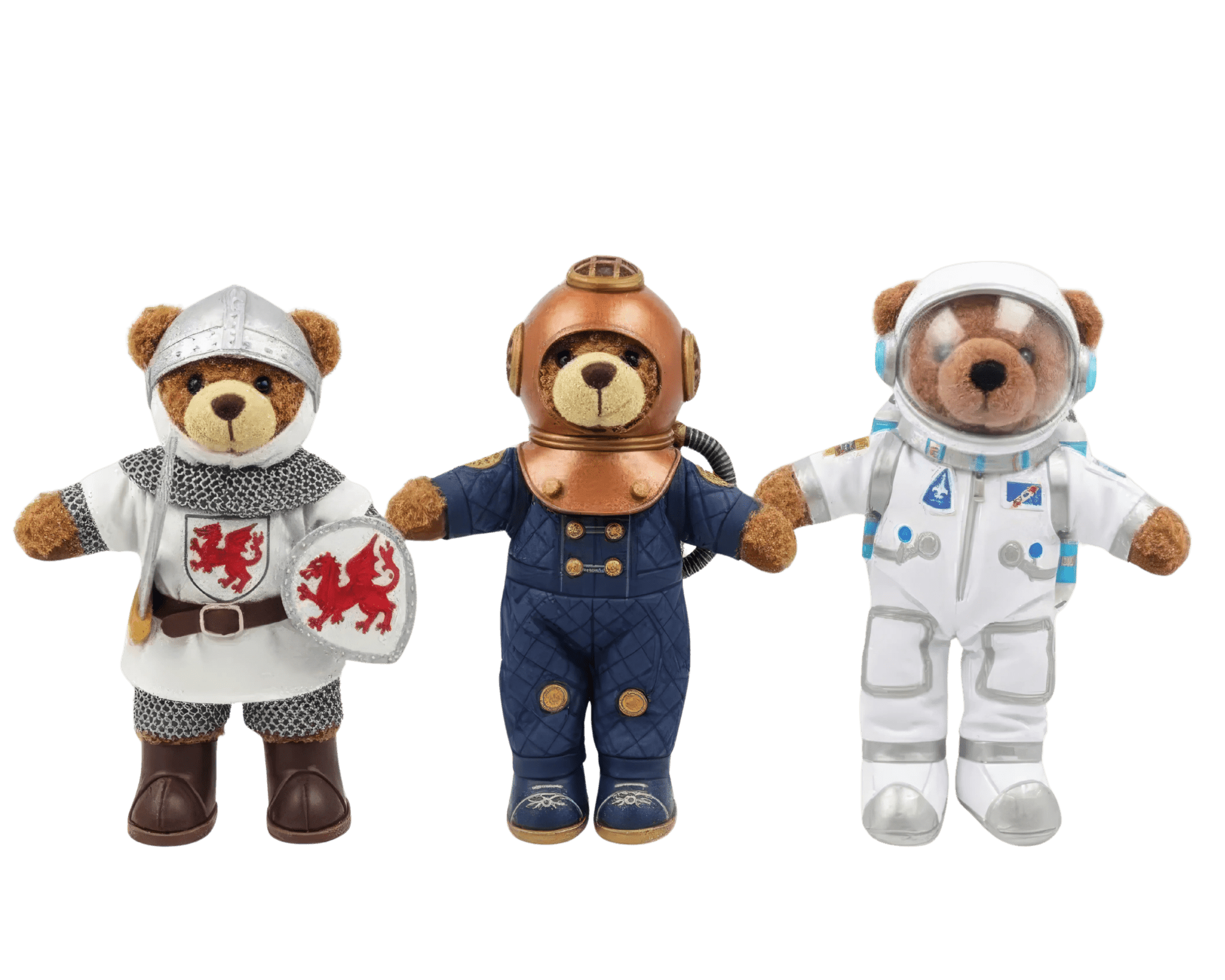
The accessories turn a generic bear into your bear. A printed or embroidered shirt, a branded bow, a woven chest logo, or a custom hang tag carry your identity and justify a higher price. Each add-on has a cost and sometimes its own minimum, so choose the ones that do real branding work. A single embroidered logo often earns its keep. Five separate accessories usually do not. For very small formats, a branded plush keychain bear can carry a logo at an impulse price point that a full bear cannot.
Use cases and how the spec changes
The right teddy bear spec depends heavily on why you are ordering. Here is how the decisions shift across the most common B2B use cases.
- Retail plush lines: distinctive fabric and a strong facial design matter most, because the bear competes on a shelf against dozens of others.
- Corporate and promotional gifts: a smaller bear with a clean embroidered logo keeps unit cost low across a large run.
- Baby and keepsake: OEKO-TEX certified minky, embroidered features, and no small parts, prioritizing safety and softness.
- Event and seasonal: fast sampling and a themed accessory, since the window to sell is short and timing beats perfection.
Compliance: a teddy bear is still a children’s product
Even when a bear is sold as a corporate gift or an adult keepsake, US law treats a teddy bear as a children’s product because a child could reasonably use it. That means it falls under the Consumer Product Safety Improvement Act and must meet ASTM F963-23, enforced by the Consumer Product Safety Commission. In practice your bear needs third-party testing at a CPSC-accepted lab covering lead, phthalates, small parts, and seam and pull strength, plus a Children’s Product Certificate and a tracking label.
The failures we see most often on bears are eyes that detach under pull force, seams that open under tension, and dyes above the lead limit. A capable plush toy factory tests for all of these before production and hands you the reports without being asked. We map the exact tests each product needs in our plush toy compliance calendar for USA brands so nothing is discovered at the border. If you are importing, the same reports keep your shipment moving, which we cover in our US-China tariffs and import guide.
How we sample a custom teddy bear
To make the process concrete, here is the order of operations we run from concept to approved sample. Following this sequence is what keeps a custom bear on schedule.
- Confirm size, fabric, eye type, fill, and add-ons, then build the tech pack from those five decisions.
- Produce a first sample and check facial symmetry, seam strength, and overall proportion against the sketch.
- Refine the face. The eyes and nose placement make or break a bear, so this is where a second sample usually goes.
- Run pre-production testing on the exact materials so the design is confirmed compliant before bulk.
- Approve the golden sample, which becomes the quality benchmark every unit in the run is measured against.
MOQ, cost, and the honest trade-offs
The minimum order quantity for a custom teddy bear is driven mostly by two things: the fabric and the custom accessories. A bear in a stock fabric with an embroidered logo can run at a low minimum, which is ideal for testing a design. A bear in a bespoke printed fabric with custom packaging carries higher minimums at the mill and print stage, which raises the floor on the whole order.
The trade-off is simple to state and easy to get wrong. Keep the fabric and packaging standard and you keep both cost and minimum low, which lets you test before you scale. Go fully bespoke and you get a unique product but commit more capital up front. Neither is right in the abstract. The right answer is the one that matches your launch volume and margin, which is the conversation we have during sampling at our custom plush toy factory.
The bottom line
A great custom teddy bear is not about picking a color. It is about making five decisions deliberately, treating the eyes and fill as safety choices, and confirming compliance before bulk. Match the spec to why you are ordering, test a low-MOQ sample before you scale, and get the golden sample right so every unit matches it.
If you have a teddy bear concept, send us a sketch or reference and your target retail price. We will turn it into a full spec, confirm it passes US testing, and quote the MOQ before you commit a dollar. Talk to our production team to get started.
Frequently asked questions
What is the minimum order for a custom teddy bear?
The minimum order quantity depends mainly on your fabric and accessory choices. A teddy bear in a stock fabric with an embroidered logo can run at a low minimum, which is ideal for testing a design before scaling. Bespoke printed fabric or custom packaging carries higher mill and print minimums, which raises the order floor. Ask your factory for the MOQ tied to your exact spec.
Are custom teddy bears safe for babies?
They can be, but only when specified and tested correctly. For infants and children under three, choose OEKO-TEX certified fabric, use fully embroidered eyes and nose to remove small-part risk, and confirm the bear passes ASTM F963-23 with a Children’s Product Certificate. Ask for third-party test reports covering the exact materials in your order.
How long does it take to produce a custom teddy bear?
Timelines vary by complexity, but the process runs in stages: tech pack, first sample, face refinement, pre-production testing, then bulk production. Sampling and testing typically take the most time up front, and bulk production and freight follow. Building in time for a second sample to perfect the face is the most common way to avoid delays.
Should teddy bear eyes be plastic or embroidered?
It depends on the age grade. Plastic safety eyes are secured with a locking washer and must pass tensile pull testing under ASTM F963-23, which suits bears for older children and adults. Fully embroidered eyes remove any small-part risk and are the safer choice for infants and children under three. Treat this as a safety decision, not a style one.
What makes a custom teddy bear stand out on a retail shelf?
Distinctive fabric and a strong, symmetrical facial design do most of the work, because a teddy bear is judged by look and touch before anything else. A well-placed embroidered logo or a signature accessory adds brand identity without cluttering the design. The single biggest quality signal is a clean, expressive face, which is why we usually invest a second sample in perfecting it.
| About the author
Zhang Wei — Head of Production, PlushToys Factory Daniel leads custom teddy bear development at PlushToys Factory, from the first sketch through safety testing and bulk production for USA brands, retailers, and corporate gifting programs. He has sampled teddy bears at every size from keychain to jumbo. To turn a teddy bear concept into a spec sheet and quote, start a custom project with our team. |