
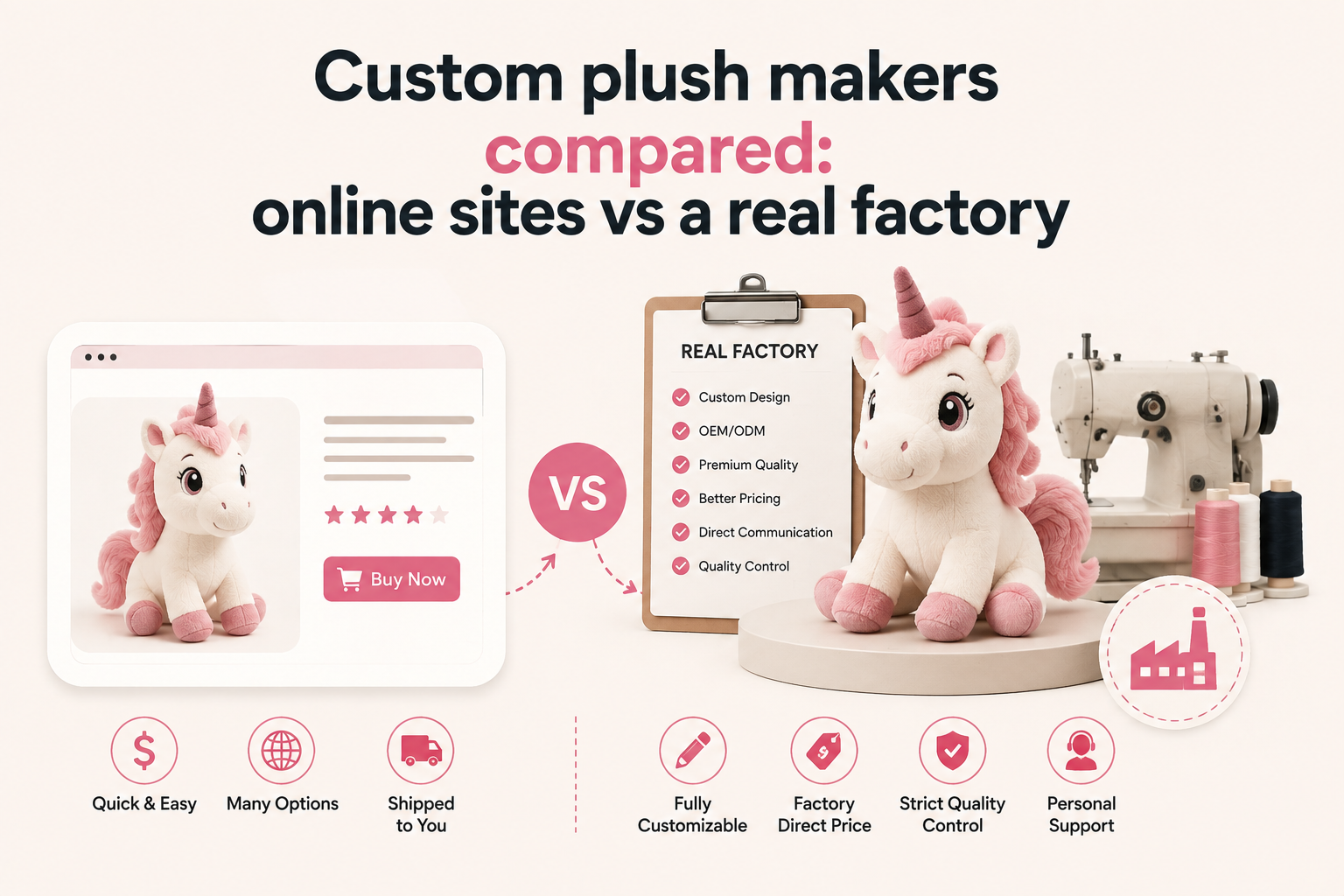
“Custom plush makers” covers three very different types of supplier, and picking the wrong one is the most common way a plush project goes over budget or falls short on quality. The three are online print-on-demand and instant-quote sites, individual artists on marketplaces like Etsy or DeviantArt, and manufacturing factories. They serve different quantities, price on different logic, and produce different quality. This compares them honestly so you can match the maker to what you are actually trying to do.
The short version: for one or two units, an artist or a print-on-demand site usually makes sense. For a product you intend to sell, a factory almost always wins on cost and consistency once you pass a modest quantity. The interesting decisions are in the middle, and that is where the numbers matter.
The three kinds of custom plush maker
Before comparing, it helps to be clear about what each one actually is, because the marketing blurs them.
An online plush maker or plush website gives you an instant quote and a slick ordering flow. Some are genuine factories with a web front end. Many are middlemen who take your order and place it with a factory, adding a margin for the convenience. The experience is easy. You pay for that ease.
An individual artist sells handmade plush, often through Etsy, DeviantArt, or their own commissions. Each piece is sewn by one person. The craft can be exceptional and the likeness personal, but capacity is one pair of hands.
A factory manufactures plush at volume. You work through a sampling process, approve a prototype, and produce a batch. There is more setup and more communication, and the payoff is far lower per-unit cost and consistent quality across hundreds or thousands of units. If you want the full picture of how that model works, see our custom plush toy manufacturer guide.
How each one prices, and why “cheap” is misleading
The word “cheap” hides the thing that actually decides your total cost, which is how each maker splits fixed costs from per-unit costs.
An artist charges mostly labor. Each plush takes hours to sew, so the price per piece is high and it barely drops if you order more, because more pieces just means more hours.
A print-on-demand site often shows a low sticker price per unit but bakes the setup into it and adds a convenience margin. It looks cheap for one, and it stays roughly the same for ten, which quietly makes it expensive at any real quantity.
A factory splits the cost in two. You pay a one-time fee to develop your design and make a sample, then a per-unit price for the run. The setup feels expensive when you are ordering a few. But because the per-unit price falls steeply as quantity rises, the factory becomes the cheapest option per plush the moment you order in volume. This is the whole reason minimum order quantities exist, and our low-MOQ custom plush overview shows where sensible minimums start.
So “cheap custom plush” depends entirely on quantity. Cheap for one and cheap for five hundred are almost never the same supplier.
Side-by-side comparison
| Factor | Print-on-demand / online site | Individual artist (Etsy, etc.) | Factory |
| Best quantity | 1 to a few dozen | 1 to a handful | Bulk, from ~100+ |
| Cost per unit at volume | High, barely drops | Highest, does not drop | Lowest |
| Upfront setup cost | Hidden in unit price | Low | Separate sampling fee |
| Likeness and detail | Standardized, limited | Can be excellent | High, with a proper sample process |
| Consistency across units | Good | Varies piece to piece | High once the sample is approved |
| Lead time | Fast for small orders | Slow, one maker’s queue | Longer, but scales to volume |
| Who it suits | A gift, a test, a single piece | A personal commission | A product you plan to sell |
No row makes one maker “best.” They are tools for different jobs. The mistake is using a print-on-demand site to launch a 500-unit product, or asking a solo artist to fulfill a wholesale order they physically cannot sew in time.
Quality and consistency: the part price hides
Price is easy to compare. Quality is where buyers get surprised after the money is spent.
With an artist, quality tracks that specific person’s skill, and it is usually high, but every unit is slightly different because it is handmade. That is charming for one keepsake and a problem for a retail line where customers expect the photo to match what arrives.
With a print-on-demand site, quality is whatever the underlying factory produces, and you often cannot see or influence it because there is no real sample step. You approve a digital mockup and hope.
With a factory, quality is controllable precisely because there is a sample stage. You get a physical prototype, correct it, and approve a benchmark that production is checked against. That is also where inspection happens before the batch ships. If consistency across a run matters to you, that controllable sample-and-inspect loop is the reason to accept the extra setup. Our look at how pre-production plush samples are made shows what that stage involves.
Reading reviews and vetting an online maker
“Custom plush maker reviews” is a sensible thing to search, but read them for the right signals. A single bad review means little. Patterns mean everything.
What to look for:
- Complaints about the finished plush not matching the proof. This points to a weak or nonexistent sample process.
- Repeated mentions of slow or vanished communication after payment. Common with thin middlemen.
- Consistency problems across a batch, which suggests no real quality control.
- Whether the maker showed the buyer a physical sample before the full run, or only a digital render.
The strongest signal that you are dealing with a real manufacturer rather than a reseller is a genuine sampling step and someone who talks about quality control before you ask. A site that will not produce a physical sample before a large order is asking you to gamble.
Which maker should you choose?
Match the maker to the job, not to the lowest headline price.
Choose an artist or a one-off maker when you want a single plush, likeness is personal, and you are happy to pay for handmade work. A memorial keepsake or a gift fits here.
Choose a print-on-demand or online plush site when you want a small quantity fast, the design is simple, and convenience is worth a premium. Testing a rough idea fits here.
Choose a factory when you plan to sell, when you need consistent quality across many units, or when per-unit cost decides whether the project is viable. Any real product line fits here. The trade-off is a longer, more involved process, and the guide to ordering custom plush walks through cost, minimums, samples, and timelines so you know what you are signing up for.
One more thing that applies to whoever you pick: if the plush will be sold to the public or handled by children, it has to meet the relevant safety rules regardless of which maker produced it. Our summary of plush toy safety standards covers what that means in the US and EU.
Frequently asked questions
Who is the cheapest custom plush maker?
It depends on quantity. For one or two units, an online print-on-demand site is usually cheapest. For a batch you intend to sell, a factory is cheapest per unit by a wide margin, because its setup cost spreads across the run while its per-unit price keeps falling.
Are online plush websites actually factories?
Some are, many are middlemen who place your order with a factory and add a margin. The tell is whether they offer a real physical sample and talk about quality control, or only show a digital mockup before a large order.
Can I get a custom plush from a single artist for my brand?
For a few units, yes. For a retail or wholesale quantity, one artist rarely has the capacity or the unit economics, and consistency across pieces becomes a problem. That is when a factory makes more sense.
Why do factories have minimum order quantities when online sites do not?
Factories split cost into a one-time setup and a low per-unit price, so they need a minimum quantity for the setup to be worth it. Online sites fold setup into a higher per-unit price, which is why they take small orders but cost more per plush at scale.
How do I judge a custom plush maker before ordering?
Look for a real sample step, clear communication after payment, and reviews that mention the finished product matching the proof. Avoid any maker that will not produce a physical sample before a large run.
Matching the maker to the plan
The right custom plush maker is a function of quantity and intent, not the lowest number on the quote page. One keepsake or a quick test belongs with an artist or an online site. A product you plan to sell belongs with a factory, where the setup cost buys you low per-unit pricing, controllable quality, and consistency across the whole run. Decide which of those you are actually doing first, and the choice of maker mostly makes itself.