
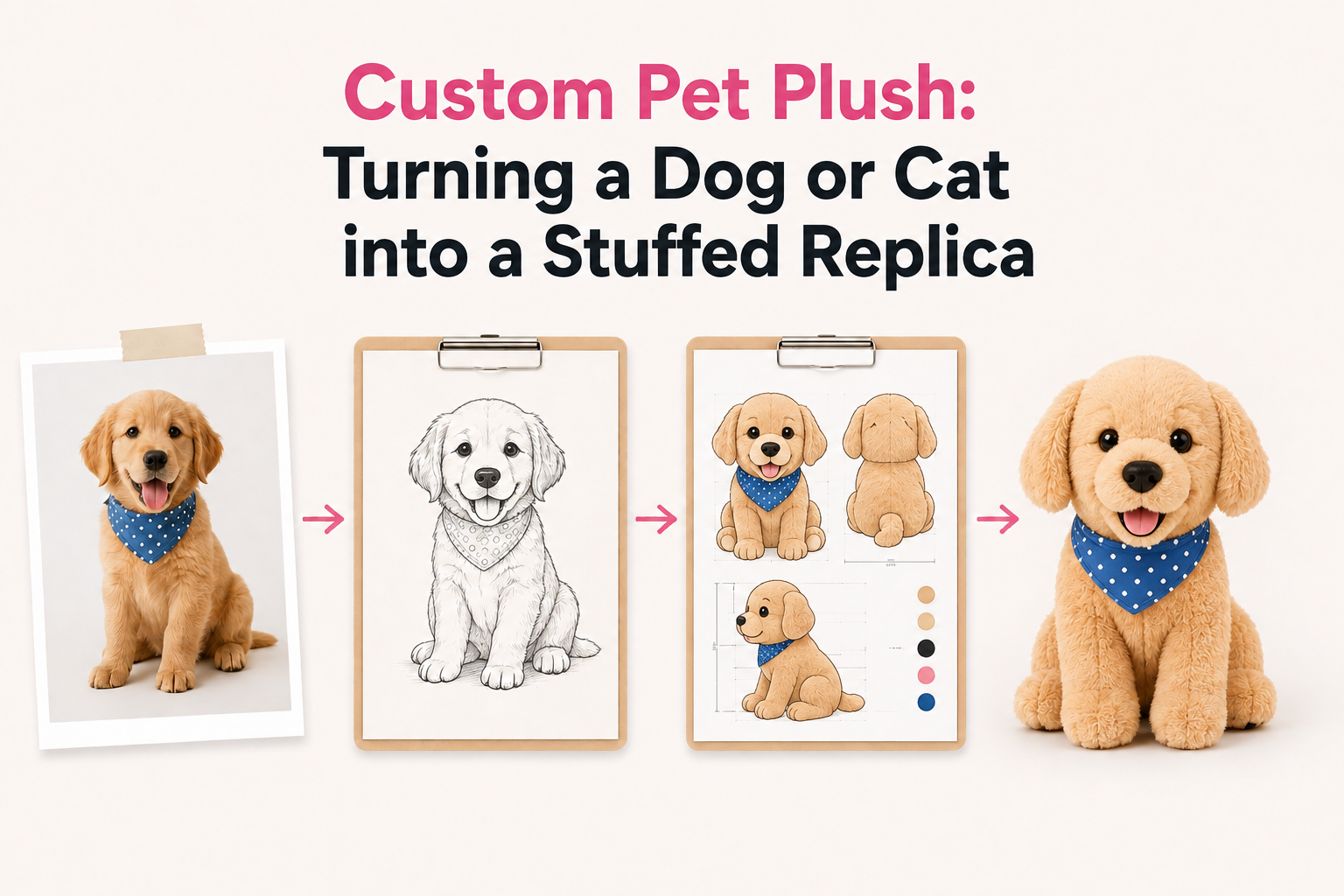
A custom pet plush is a soft toy made to resemble a specific animal, usually built from photos of a customer’s own dog, cat, or other pet. The maker studies the reference images, drafts a fabric pattern that captures the animal’s shape and markings, and sews a sample that reads as that pet rather than a generic breed toy. Owners buy them as keepsakes and gifts. Brands sell them as a personalized product line, either one at a time or as a repeatable range.
The category splits into two things that often get confused, so it helps to separate them before you order or before you build a business around them.
Pet plush replica vs. pet toy: two different products
“Pet plush” gets used for two products that share almost nothing except the word.
A pet toy is a plush made for a pet to chew and play with. It has to survive teeth, reinforced seams, sometimes a squeaker, and it gets tested against different safety expectations. If that is what you are sourcing, our pet plush toy factory guide covers it.
A pet plush replica is a plush made to look like a real animal, meant for a person to keep or display. The dog does not play with it. The owner does. This article is about the second product: the replica, the portrait, and the memorial keepsake.
Getting this distinction right changes everything downstream, because the two are engineered, priced, and sold to completely different buyers.
How a custom plush of your pet is actually made
There is no scanner that turns a photo of a labrador into a stuffed labrador. A person builds it. Your photos become the brief, and a sample maker interprets that brief in fabric.
The steps look like this:
- You supply reference photos of the pet.
- A designer identifies the shapes and markings that make the animal recognizable.
- Those shapes get drafted as flat fabric panels, the way a sewing pattern is.
- The maker sends a drawing or digital proof so you can approve proportions and colors.
- A physical sample is cut, sewn, stuffed, and finished.
- You compare the sample to your pet and request changes.
The part owners underestimate is step two. A photo shows one angle in one light. A plush gets seen from every side, so the maker has to invent the back of the head, the underside, and the far ear from whatever you gave them. The less you supply, the more they guess, and guesses are what pull the first sample away from the pet you had in mind.
What photos to send
The reference you provide matters more than any other single decision. A strong photo set turns three rounds of corrections into one.
Send these if you can:
- A clear front view and a clear side profile. This is the minimum for the face and head shape.
- A full-body shot if the plush is full-body. A face-only photo cannot tell the maker how the legs and torso are proportioned.
- Close-ups of markings that identify your pet. The white blaze on the chest, one odd-colored ear, the ring around a tail. These are the details people check first to decide whether it “looks like him.”
- Natural, even lighting. Screens and flashes distort color, and fur color is where replicas most often go wrong.
If a specific color has to be right, say so in words and, if you have one, give a reference swatch. “Match this brown” beats “he’s kind of caramel.” Fur color matching is one of the harder parts of the job, and a named target removes a lot of back-and-forth.
How close will it look?
This is worth being honest about, because expectations decide whether you are happy with the result.
A custom pet plush captures silhouette, proportion, coloring, and signature markings very well. For most dogs and cats, that is enough for the owner to recognize their animal instantly and get emotional about it. What plush does not do is photo-realism. It is a soft, rounded, low-detail medium. It will not reproduce the exact expression in one photo or the fine texture of individual fur.
Breed-accurate detailing helps here. A maker who understands that a shiba’s ears sit differently from a corgi’s, or that a tuxedo cat’s markings need clean edges, will produce something that reads as the right animal. But a plush is a faithful likeness, not a clone, and setting that expectation up front is the difference between a delighted customer and a disappointed one.
The memorial keepsake, and why it needs care
A large share of custom pet plush demand comes from people who have lost a pet and want something to hold. A custom pet memorial plush is emotionally loaded in a way an ordinary toy order is not.
Two practical points follow from that.
First, likeness matters more here than anywhere else, and the customer is often working from a limited set of photos because they can no longer take new ones. Handle those photos as the only reference that will ever exist. Get the markings right.
Second, if you are a brand selling memorial keepsakes, the buyer experience carries weight. Clear timelines, a proof step before production, and honest expectations about likeness protect a grieving customer from a bad surprise. This is a product where rushing the sample stage does real harm.
Selling custom pet plush as a brand
For a business, the appeal is obvious. Pet owners spend on their animals, personalized products resist discounting, and a good replica gets shared. But the economics only work if you understand how custom plush is priced.
Two models exist, and they suit different sellers.
| Model | How it works | Best for | Trade-off |
| Made-to-order replica | Each plush is built from one customer’s photos | Portrait and memorial sellers, gift brands | High price per unit, longer turnaround, more sampling work |
| Stocked personalized range | You produce a set of breed-based designs in bulk, then add light personalization | Pet retailers, dropship pet brands | Lower likeness to the exact pet, but far cheaper per unit |
The made-to-order route gives the closest likeness and the highest emotional payoff, which is why memorial and gift sellers use it. The stocked route trades exact likeness for margin and speed, which suits volume retail. Some brands run both: a breed-based hero range for stock, plus a premium made-to-order option.
Either way, the cost structure is the same as any custom plush. You pay a one-time fee to develop the design and a per-unit price for the run, and the per-unit price falls as quantity rises. That is the whole reason minimum order quantities exist. If your first run is small, our overview of low-MOQ custom plush shows where sensible minimums start. For how sampling fees, minimums, and unit pricing fit together, the guide to ordering custom plush lays out the full budget.
Cost and timeline, in plain terms
Price is driven by the plush, not by the fact that a pet is involved. The things that move it:
- Size. More fabric and stuffing per unit.
- Detail and color count. Complex markings and multiple embroidery colors add labor and setup.
- Sample rounds. Sampling is usually a separate upfront cost, and a detailed pet often needs a round or two of correction.
- Quantity. The single biggest lever on per-unit cost.
On timing, plan in weeks, not days. The design and digital proof take a few days to a couple of weeks depending on revisions. A physical sample adds one to a few weeks. Bulk production is a separate stage again. A memorial buyer in particular should be told this before they order, because they often expect it fast. If you want a realistic view of the prototype stage, see how pre-production plush samples are made.
Ordering just one
Owners regularly ask whether they can get a single plush of their pet. Yes, and one-off makers exist for exactly this. The catch is the math. With a single unit, the entire design and setup cost lands on that one piece, so a one-off custom pet plush is expensive per item compared with a production run. That is normal, and it is the price of not spreading fixed costs across a batch.
Safety, if a child will hold it
A pet replica is still a soft toy. If it will be given to a child, sold at retail, or handled by kids, it has to meet the same rules as any other plush: secure eyes and small parts, non-toxic materials, and the testing your market requires. It is easy to forget this when the plush feels like a private keepsake, but the moment a child is involved it applies. Our summary of plush toy safety standards covers what that means in the US and EU.
Frequently asked questions
Can you make a plush from one photo of my pet?
Yes, but a single photo forces the maker to guess the angles it does not show, which usually means more corrections. A front view, a side profile, and a close-up of the markings get you a much closer first sample.
Will it look exactly like my dog or cat?
It will capture the shape, coloring, and signature markings so the animal is recognizable. Plush is a soft, stylized medium, so expect a faithful likeness rather than a photo-realistic copy.
Can I order a custom pet plush as a memorial?
Yes, this is one of the most common reasons people order them. Because it is emotional and the photos are often irreplaceable, treat the reference carefully and confirm the likeness at the proof stage before production.
What is the difference between a pet plush replica and a pet toy?
A replica is made to look like a real animal for a person to keep. A pet toy is made for a pet to chew and play with, and it is built and tested for durability and pet safety instead of likeness.
Can I sell custom pet plush without holding stock?
Made-to-order works without inventory, since each plush is built after the order. A stocked breed-based range needs upfront production but costs far less per unit and ships faster.
Getting a plush that people recognize as their pet
The whole thing comes down to reference photos and honest expectations. A clear front-and-profile set, close-ups of the markings that make the animal itself, and a named color target will do more for the result than anything else. Add one or two patient sample rounds, decide early whether you are making one keepsake or a sellable range, and keep safety in mind if a child will handle it. Do that and a few photos become a plush the owner recognizes the second they see it.