
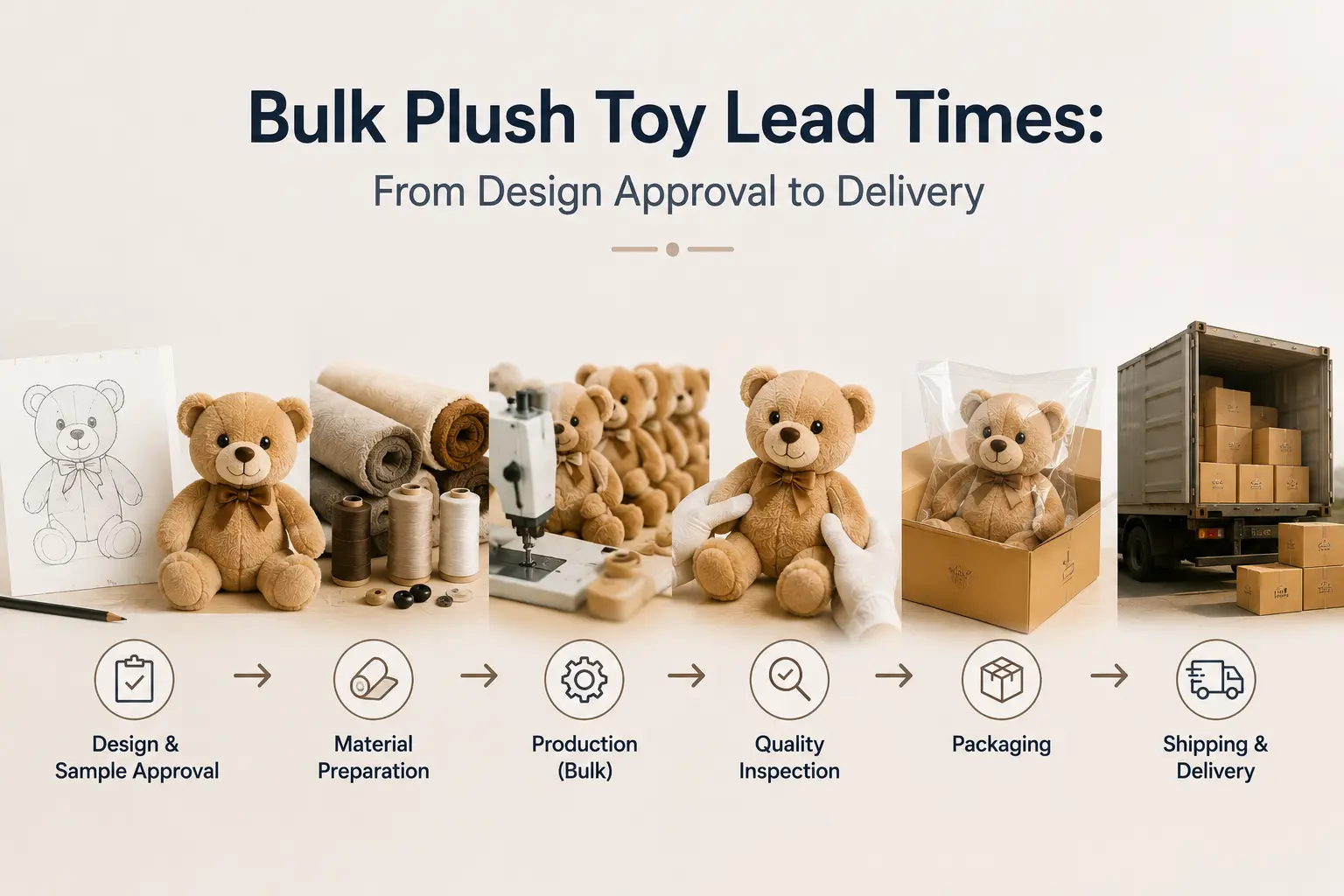
Bulk custom plush toys usually take 6 to 10 weeks from approved sample to delivery. Figure 25 to 45 days for mass production and QC. Then add 3 to 6 weeks of sea freight, or 5 to 8 days by air. Sampling adds 1 to 3 weeks before any of that. Peak season and custom dyeing stretch the windows, so plan backward from your launch date.
Nothing sinks a launch faster than misjudging the calendar. I’ve watched brands nail the design and love the sample. Then they miss the whole season. Why? They penciled in “a few weeks” for something that really takes two months. The good part is that plush toy manufacturing lead time is predictable once you know what’s moving underneath it. So let’s break it into stages you can actually plan against.
The Full Timeline, Stage by Stage
A bulk order moves through five phases, one after another. Most can’t overlap. You can’t cut fabric before the sample is signed off. You can’t ship before QC clears. Here’s the realistic breakdown for a standard, mid-complexity plush.
| Stage | Typical Duration | Notes |
| Sampling & approval | 1–3 weeks | Depends on revision rounds |
| Deposit & material sourcing | 3–7 days | Longer for custom-dyed fabric |
| Bulk cutting & sewing | 15–25 days | Scales with order size |
| Stuffing, QC & compliance | 7–12 days | Includes AQL inspection & lab testing |
| Shipping (sea) | 3–6 weeks | Air freight: 5–8 days |
Look at the bottom row. Shipping often rivals production for elapsed time. A four-week factory turnaround plus five weeks on the water is a nine-week reality. That’s why the freight decision deserves as much thought as picking the factory did.
What Actually Drives the Timeline
Two orders of the same size can land on very different dates. It’s rarely random. These are the levers that stretch or compress the schedule.
- Order volume. 3,000 units sew faster per line than 30,000. Big runs can split across lines, but they still take longer overall.
- Design complexity. Multi-color or poseable plush add sewing minutes per unit. It’s the same thing that stretched your sample turnaround.
- Custom vs. stock fabric. Pantone dyeing adds days. In-stock fabrics ship the timeline forward.
- Compliance testing. Lab turnaround on ASTM F963 or EN71 adds a few days before goods can leave.
- Season. Chinese New Year and the Q3–Q4 rush can double queue times. Book early or wait in line.
Sea Freight vs. Air Freight: The Timeline Trade-off
Shipping is the single biggest lever on total lead time. It’s a big lever on cost too. Sea freight is far cheaper per unit but slow. Air freight is fast and expensive. It only makes sense for light, high-value, or truly urgent shipments.
- Sea freight, 3–6 weeks. The default for bulk plush. Lowest cost per CBM. Build it into your calendar from day one.
- Air freight, 5–8 days. Keep it in reserve for samples, top-ups, or a blown deadline. Expect to pay several times more.
- Express courier, 3–5 days. Samples and tiny quantities only.
Here’s the quirk that catches people out. Plush is bulky but light. So freight gets priced by volume, the CBM, not by weight. That’s why compression and smart packing matter so much. Confirm your Incoterms and book early through the processo de pedido. Then factor duties with our US–China tariffs B2B guide.
Sea vs. Air: Cost and Time Side by Side
This one decision swings both the calendar and the budget. So it’s worth seeing side by side. The figures below are directional for a typical bulk plush shipment. The ratios hold up. Air buys weeks at a steep premium. Sea trades time for a much lower bill.
| Fator | Sea Freight | Air Freight | Express Courier |
| Transit time | 3–6 weeks | 5–8 days | 3–5 days |
| Relative cost | Mais baixo | 5–8× sea | Highest per kg |
| Priced by | Volume (CBM) | Weight & volume | Weight |
| Ideal para | Full bulk orders | Urgent top-ups | Samples only |
| Plush suitability | Ideal (bulky, light) | Costly (volume-heavy) | Tiny quantities |
For plush, the takeaway is blunt. The product is light but takes up space. So air freight hammers you on volumetric weight. Keep it for real emergencies. Build sea timing into the plan from the start. Lean on compression and smart packaging to shrink CBM and cut the bill directly.
A Sample Production Calendar You Can Copy
Abstract weeks are hard to plan around. So here’s how a straightforward 3,000-unit order with in-stock fabric tends to unfold. Slide the dates to fit your own start point.
- Weeks 1–2. Finalize artwork, the tech pack, and the first amostra de pré-produção.
- Week 3. Revision round, golden-sample approval, and the deposit.
- Weeks 4–7. Bulk cutting, sewing, stuffing, and finishing.
- Week 8. AQL inspection, compliance testing, and packing.
- Weeks 9–14. Sea freight, customs, and the last leg to your warehouse.
That’s a 10 to 14 week reality on a smooth run. And it assumes no peak-season queue. Cross Chinese New Year and you add weeks. That one fact trips up more brands than anything else on this page.
How to Plan Backward From Your Launch Date
The buyers I respect never open with “how long does it take?” They start from the on-shelf date and count backward. The method is simple.
- Fix the in-store or on-sale date.
- Subtract a week or two for domestic distribution and warehousing.
- Subtract 3 to 6 weeks for sea freight and customs.
- Subtract 4 to 6 weeks for production, QC, and quality inspection.
- Subtract 1 to 3 weeks for sampling and approval.
- What’s left tells you to start about 3 to 4 months before launch. Make it 5-plus if it crosses Chinese New Year.
That buffer feels generous right up until peak season eats it. Haven’t settled on where to produce yet? Our guides on choosing a plush toy factory in China and the broader fabricante de brinquedos de pelúcia personalizados decision will help you lock a partner in time.
Building Buffer: How Pros Protect the Date
Experienced buyers don’t just calculate the timeline. They defend it. Every stage carries some variance. The brands that ship on time plan for the version that goes slightly wrong.
- Budget two sample rounds. Hope for one. Treat a single round as a bonus, not the plan.
- Reserve line capacity early. A confirmed booking holds your slot before peak demand fills the calendar.
- Pre-book lab slots. Schedule testes de segurança alongside production so it never becomes the bottleneck.
- Keep an air option. Ship a small first tranche by air to hit an early launch while the bulk follows by sea.
- Leave room for customs. Clearance and tariff processing add days. Estimate them with our US–China tariffs guide.
None of these buffers cost much. Missing your season costs everything. The whole discipline comes down to one habit. Start earlier than feels necessary. Let the calendar carry your launch, not luck. When you’re ready to lock a slot, begin through the processo de pedido.
Perguntas frequentes
How long does bulk plush toy manufacturing take?
Roughly 25 to 45 days for production and QC after sample approval. Then add shipping, which is 3 to 6 weeks by sea. End to end, budget 6 to 10 weeks from golden sample to delivery. And add sampling time before that.
What causes plush toy production delays?
The usual suspects are extra revision rounds, custom dyeing, testing turnaround, and peak-season queues. Chinese New Year is the big one. Early booking and a clean tech pack head off most of them.
Can I speed up my plush toy order?
Within limits, yes. Approve samples fast. Choose in-stock fabrics. Keep the design simple. Ship urgent quantities by air. What you can’t safely do is skip QC or compliance testing.
Conclusão
Plush lead times aren’t mysterious. They’re just longer than most first-time buyers assume. Between sampling, production, testing, and weeks at sea, a bulk order runs two to three months from approved sample to warehouse. The brands that never miss a season count backward from launch. They book capacity early. And they buffer for the extra revision round and the customs delay they hope won’t happen. Treat the calendar as a design constraint from day one. Then you ship on time instead of air-freighting a rescue for a date that already slipped.
- 6–10 weeks from golden sample to delivery, and that’s before sampling.
- Sea freight is the default — bulky, light plush makes air brutal on cost.
- Plan backward from launch and start 3–4 months out, 5-plus across Chinese New Year.
Sobre o autor
Jack is a plush toy sourcing and manufacturing specialist with over a decade of hands-on experience scheduling custom production and freight across Chinese factories. He has planned launch timelines for seasonal and licensed programs, and writes to help B2B buyers hit their dates and source smarter. Plan your production calendar through the Processo de compra no site plushtoys-factory.com.