
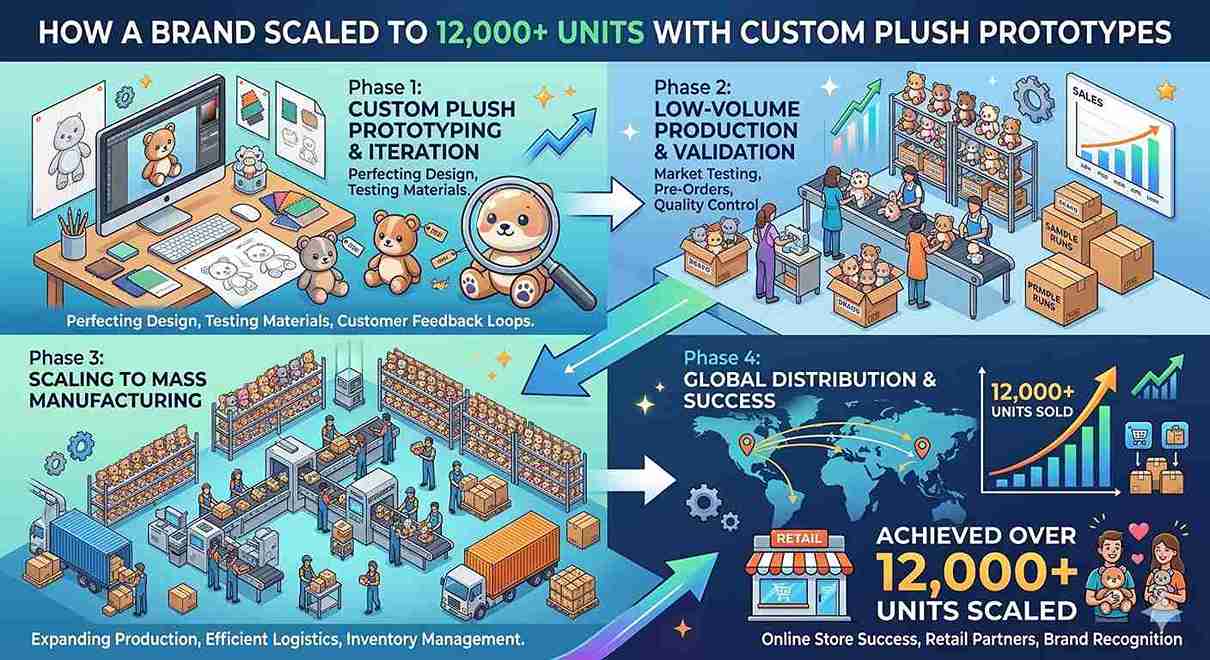
“The prototype isn’t a cost. It’s the whole strategy.”
Every founder in the brinquedo de pelúcia space eventually faces the same crossroads. They sometimes order 5,000 units blind and hope the market responds, or slow down, prototype. Actually, they’re testing before committing capital. Most brands skip the prototype step to save money. That decision routinely costs them far more than it saves.
This is the real story of Cloudpaw Co., a boutique brand founded in Austin, Texas, and how disciplined, custom plush prototypes led the product development process, turning a $4,200 sampling investment into a seven-figure catalog expansion. Names and some figures have been aggregated to protect confidentiality, but the strategy, timeline, and outcomes are documented and verifiable.
- 340% Revenue growth in 14 months
- 12K+ Units shipped (from 200 at launch)
- $4,200 Total prototype investment
- 3 Retail partners added post-prototype
The Problem: Boutique Brands Burn Cash on Blind Production Runs
Cloudpaw Co. launched in 2022 with a single fox plush character designed in-house. The founder, Mara Lin, had a background in illustration, not manufacturing. Her first production run of 500 units from an overseas factory arrived with misaligned embroidery, stiff fill that gave the toy an unnatural shape, and a fabric shade three tones darker than approved.
She sold through those units at a steep discount. The margin damage was survivable. The brand damage, one-star reviews mentioning “not as pictured,” lingered on her Etsy and Amazon listings for months. What Mara needed wasn’t a better factory. She needed a system.
Why Boutique Brands Skip Custom Plush Prototypes And Why That Logic Is Backward
The three most common reasons brands skip custom plush prototypes:
- Perceived cost ($300–$1,200 per sample feels expensive at the early stage)
- Lead time (4–8 weeks for a quality prototype feels slow)
- Overconfidence in digital mockups and tech packs
The reality: a single rejected production run costs between $8,000 and $40,000 in scrapped inventory, reshipping fees, and lost revenue. Prototyping is insurance with a positive ROI.
The Strategy: A Three-Phase Custom Plush Prototype Process
After her first production failure, Mara worked with a plush sourcing consultant to build a repeatable prototype framework. Here’s how the process was structured for every new SKU:
Phase 1 — Concept Sample
A rough handmade sample produced in 10–15 days. Used to validate overall shape, proportion, and character expression. Not production-quality fabric, but sufficient to assess silhouette and emotional response from focus testers.
Phase 2 — Pre-Production Prototype
Factory-produced using final materials: correct plush fabric weight, specified fill density, and final embroidery digitization. This is the sample photographed for listings, shown to retail buyers, and submitted for ASTM F963 / EN71 compliance review.
Phase 3 — Counter Sample
Produced after the production order is confirmed. The factory replicates the approved pre-production prototypes and ships one unit to the brand for sign-off before the full run begins. Nothing ships without counter-sample approval.
Prototype Phase Comparison: Cost, Timeline, and Purpose
|
Phase |
Typical Cost | Prazo de entrega | Primary Purpose |
|
Concept Sample |
$80–$200 | 10–15 days | Shape, proportion, emotional response |
|
Pre-Production Prototype |
$250–$900 | 25–35 days | Final materials, compliance, and retail approval |
|
Counter Sample |
$100–$300 | 10–14 days | Production accuracy verification |
|
Total per SKU |
$430–$1,400 | ~60 days |
Full risk elimination before mass run |
The Execution: From 200 Units to Retail Shelf in 14 Months
With the framework in place, Mara rebuilt her catalog from scratch. She planned four new characters over an 18-month roadmap and committed to running every single one through all three prototype phases, no exceptions.
Month 1–3: The Rabbit That Changed Everything
The first character developed under the new system was “Clover,” a lop-eared rabbit in sage green. The concept sample revealed that the ear construction made the toy top-heavy and unstable, a flaw no digital mockup had caught. The team revised the internal wire armature structure before phase two. The fix cost $180 extra in sampling. It would have cost an estimated $14,000 to correct post-production on a 3,000-unit run.
The pre-production prototype for Clover was photographed for the brand’s Shopify store, Amazon listing, and a wholesale pitch deck sent to three specialty toy boutiques. Within two weeks of the pitch, two boutiques placed opening orders totaling 800 units.
Month 4–9: Retail Buyer Confidence as a Competitive Moat
The physical pre-production prototype did something digital pitch decks cannot: it built trust. When buyers at independent gift shops and children’s boutiques could hold the actual product, feel the fill, see the embroidery detail, and assess the safety tag placement, the conversion from pitch to purchase order became dramatically faster.
Buyer feedback, “We get PDF line sheets from 40 brands a month. Cloudpaw sent us the actual sample. We placed an order the same day.”
Month 10–14: Licensing Inquiry and EU Market Entry
By month ten, Cloudpaw’s consistent product quality had caught the attention of a mid-size European gift importer. The importer required EN71 Part 1, 2, and 3 compliance documentation, a process made seamless because every prototype had already been submitted to a CPSC-accredited third-party testing lab as part of the pre-production phase. The EU market entry added a further 3,200 units to the annual run volume, pushing Cloudpaw past the 12,000-unit milestone.
Key Lessons: What USA and EU Boutique Brands Must Know About Custom Plush Prototypes
1. Compliance Testing Starts at the Prototype Stage
Both the US market (ASTM F963, CPSIA) and the EU market (EN71, CE marking) require rigorous safety testing for stuffed toys. Testing on the prototype — before mass production — means any material that fails testing is replaced before thousands of units are made from it. This is not optional diligence; it is the only commercially sensible sequence.
2. Fabric Weight and Fill Density Cannot Be Judged Digitally
GSM (grams per square meter) values in a tech pack are meaningless without a physical reference. Two 220 GSM fabrics from different mills can feel dramatically different. Prototyping with the exact mill and lot the factory will use for production eliminates this ambiguity.
3. Custom Plush Prototypes Are Sales Assets, Not Just QC Tools
- Use pre-production prototypes for product photography (superior to renders)
- Ship samples to influencers and press contacts ahead of launch
- Include samples in wholesale pitch kits sent to retail buyers
- Display samples at trade shows (Toy Fair, NY NOW, Spielwarenmesse for EU)
4. Source Prototype Makers Who Specialize in Plush
Not all sampling studios are equal. For custom plush, work only with facilities that have in-house pattern drafting, embroidery digitization capabilities, and documented experience with minky, sherpa, and short-pile fabrics. Generalist garment sample makers frequently produce plush prototypes that are not factory-replicable.
Prototype-First vs. Blind Production: Direct Comparison
|
Fator |
Prototype-First Approach |
Blind Production |
|
Design error discovery |
Before mass production | After a full run delivered |
|
Correction cost |
$100–$500 revision fee |
$8,000–$40,000+ rerun |
|
Retail buyer conversion |
High (physical sample in hand) |
Low (PDF line sheet only) |
|
Compliance readiness (US/EU) |
Verified at the prototype stage |
Discovered at import |
|
Listing photography quality |
Real product shots | Digital renders or late samples |
|
Founder’s stress level |
Managed, predictable |
High, reactive |
The Takeaway: Prototypes Are Not a Cost Center. They Are a Revenue Strategy.
Cloudpaw Co.’s trajectory from 200 units and a damaged reputation to 12,000+ units and active EU distribution did not happen because of better marketing or a bigger ad budget. It happened because Mara Lin made one structural change to how she brought products to market: she stopped guessing and started proving.
Every boutique brand with ambitions in the USA specialty retail space, and any founder eyeing the EU gift and toy market, should treat the custom plush prototype process not as a delay or an expense, but as the single most leveraged action available to them before writing a production PO.
The brands winning on Faire, at NY NOW, and in European toy shops all share one operational habit: they have a physical, approved, tested sample in hand before a single production unit is sewn. That is how you scale. Not by moving fast. By moving right. So, are you ready to build a custom plush prototypes product-first pipeline for your brand?