
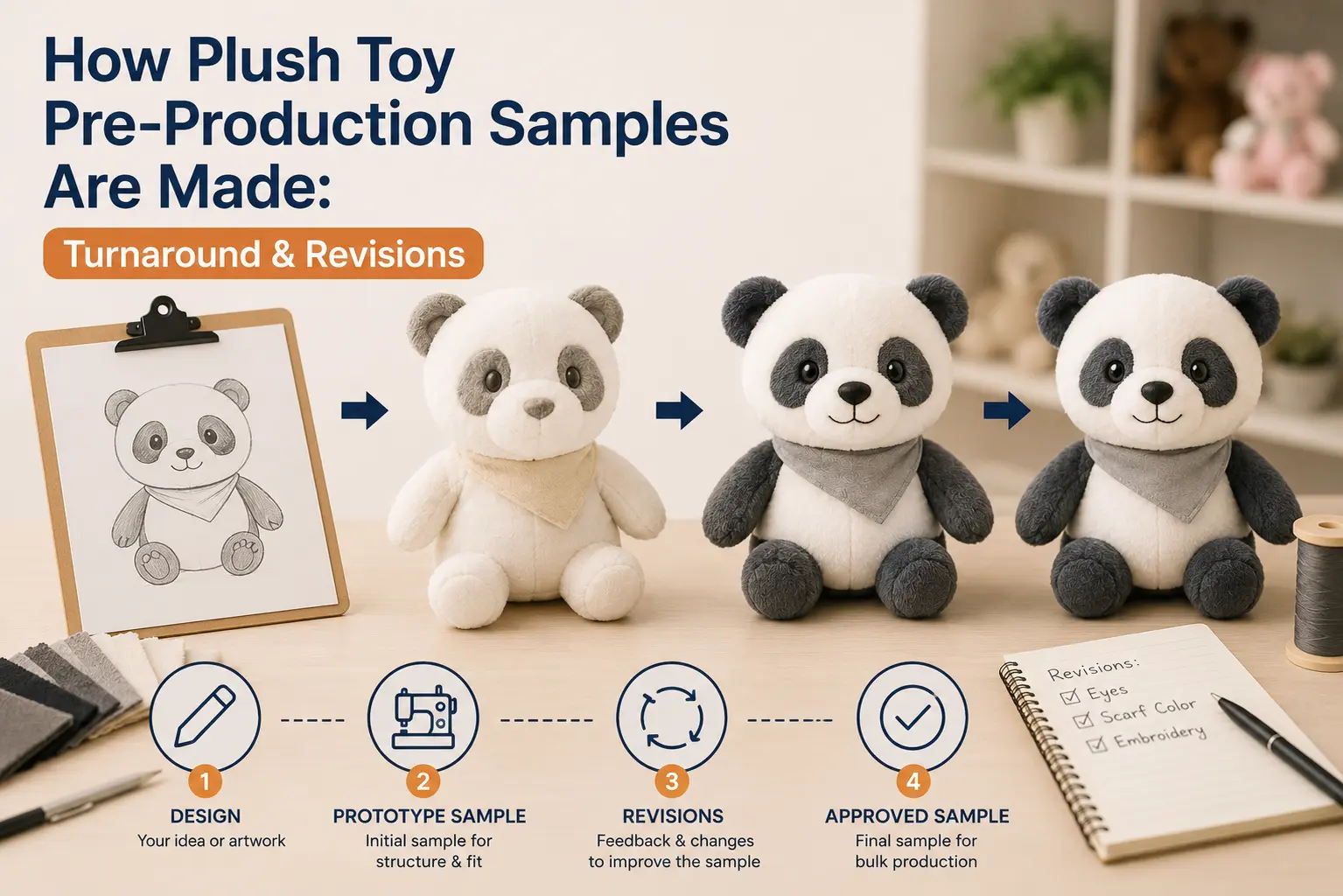
A custom plush pre-production sample is the first physical prototype a factory sews from your artwork, made to confirm shape, size, color, and construction before bulk production. It typically takes 7–15 days and 1–3 revision rounds. The approved version becomes the “golden sample” – the reference standard every mass-produced unit is measured against.
If bulk production is where money is spent, the sample stage is where money is saved. Every defect you catch on a prototype costs a few dollars to fix; the same defect discovered across 3,000 finished units costs a reorder. I treat sampling as the most important phase of any project, and the brands that respect it get the fewest surprises. Here is exactly how a custom plush prototype comes together and how to run the revision loop efficiently.
The Sampling Workflow, Stage by Stage
A sample is not sewn on a whim — it follows the same disciplined path as production, just at a quantity of one. Understanding the stages tells you where turnaround time actually goes.
- Artwork & tech pack review , the factory studies your files and flags anything that won't translate to 3D. A clean spec sheet here saves days.
- Pattern drafting , a technician deconstructs your flat design into sewable panels, the single most skill-intensive step.
- Fabric & color matching , Pantone-matched fabrics and threads are pulled from stock or dyed.
- Cutting & hand-sewing , panels are cut and assembled by a sample-room specialist, not the bulk line.
- Stuffing & finishing , filled, closed, groomed, and fitted with eyes, noses, or accessoires.
- Internal QC & photos , the factory checks it against your spec and sends detailed photos or a video before shipping it to you.
How Many Revision Rounds to Expect
Almost no plush is perfect on the first try, and that is normal , not a red flag. Translating a 2D drawing into a 3D object always surfaces small mismatches in proportion, expression, or firmness. Most projects settle in one to three rounds.
| Round | Typical Focus | What You Approve |
| Sample 1 | Overall shape, size, proportions | Silhouette & dimensions |
| Sample 2 | Color accuracy, face embroidery | Pantone match & expression |
| Sample 3 | Fine details, firmness, accessories | Final ‘golden sample’ sign-off |
Each round adds roughly 5–10 days of turnaround plus shipping. Disciplined, specific feedback , “move the eyes 3mm closer, deepen the pink to Pantone 1895C” , collapses three rounds into two. Vague feedback like “make it cuter” guarantees another cycle.
What a Sample Actually Costs — and Why
Buyers sometimes balk at paying for a sample, expecting it free. Here is the reality: a prototype consumes the same skilled labor and materials as a finished product, but without the efficiency of a batch. A fair sample fee covers pattern development, hand-sewing, and materials , and reputable factories credit it back against your bulk order once you proceed.
- Simple plush (single fabric, basic shape): lower sample cost, faster turnaround.
- Complex plush (multi-color, appliqué, poseable): higher sample cost, more pattern work.
- Added features (sound chip, weighting, embroidery): each raises development effort.
Think of the sample fee as insurance against a five-figure bulk mistake. It is the cheapest money you will spend on the entire project. Our processus de commande explains how sample costs are quoted and credited.
Sample Costs & Turnaround by Complexity
Sample fees and timelines scale with how much pattern engineering your design demands. The model below shows the relationship , directional figures, but the tiering mirrors what real factories quote. Use it to budget both money and calendar before you request a prototype.
| Design Complexity | Relative Sample Fee | First-Sample Time | Typical Revisions |
| Simple (1 fabric, basic shape) | Le plus bas | 5–8 days | 1 |
| Standard (multi-color, embroidered face) | Modéré | 8–12 days | 1–2 |
| Complex (appliqué, poseable, layered) | Élevé | 12–18 days | 2–3 |
| Feature-rich (sound chip, weighting) | Le plus élevé | 15–20 days | 2–3 |
Notice that complexity multiplies both cost and time , and each extra revision round adds a shipping leg. This is why front-loading a clean brief pays for itself, and why feature-heavy designs should build extra weeks into the overall lead time plan.
Reading and Approving Your Sample Like a Pro
When the prototype arrives, resist the urge to react emotionally. Inspect it methodically against your spec , this is a quality checkpoint, not an unboxing. Run through this checklist every time.
- Dimensions : measure against your tech pack tolerances, not by eye.
- Color: compare fabric and thread to your Pantone chips in daylight, not screen light.
- Face & expression: eye placement and stitch density define the character — scrutinize them closely.
- Firmness & symmetry: squeeze it; check that limbs and seams are even on both sides.
- Safety build: tug safety eyes and accessories to confirm they are anchored, especially for children’s items.
Document every requested change with a photo and a measurement. Precise, written feedback is the single biggest factor in whether you approve on round two or drag into round four.
Getting the Sample Right the First Time
You can dramatically shorten the revision loop by front-loading clarity. Before you request a prototype, supply the factory with everything it needs to interpret your intent correctly.
- A complete tech pack with dimensions, Pantone codes, and callouts — see how to read a plush toy spec sheet.
- Multiple artwork angles — front, back, and side views remove guesswork on 3D form.
- A reference object — even a rough size mock-up or a competitor plush communicates scale instantly.
- Firmness and fabric intent — specify soft vs. firm and your target fabric feel up front.
From Golden Sample to Bulk
Once you approve the golden sample, it becomes the contractual quality benchmark , QC inspectors literally compare production units against it. Keep it safe; you will use it for reorders too. With sign-off complete, production timing takes over, and you can map the road ahead using our délais de livraison des peluches en gros guide. If you are still selecting a partner, start with our hub on choosing a fabricant de peluches sur mesure.
Digital Samples: The Round That Saves You Money
Not every revision needs a physical prototype shipped across an ocean. Increasingly, factories confirm the big structural decisions digitally before cutting fabric — a step that quietly removes a whole round of cost and shipping from many projects. Knowing when to use each keeps your budget and timeline tight.
- Use a digital or pattern proof for: confirming panel layout, proportions, and construction logic before any material is cut , catching a fundamental shape problem here costs nothing to fix.
- Insist on a physical sample for: anything you cannot judge on screen , true softness, firmness, color under real light, face expression, and safety of eyes and attachments.
- Combine them: approve structure digitally, then order one physical golden sample to sign off feel and color. One physical round instead of three is a meaningful saving.
The goal is never to skip the physical sample , it is to arrive at it already correct on the fundamentals, so the physical prototype confirms rather than corrects. That discipline is what keeps sampling from eating into your production lead time and your budget alike.
Foire aux questions
Combien de temps faut-il pour réaliser un échantillon de peluche ?
Expect 7–15 days for the first sample, plus 5–10 days per revision round and shipping time. Complex designs with custom dyeing sit at the longer end.
Is the plush sample fee refundable?
Most reputable factories credit the sample fee against your bulk order once you place it. Confirm this policy in writing before you pay.
Why does my sample look different from my drawing?
Converting a flat illustration into a stuffed 3D object naturally shifts proportions and expression. That is precisely why the sample stage exists , to correct those shifts before mass production. Provide specific, measurable feedback each round.
En résumé
The sample stage is the cheapest insurance in plush manufacturing. A prototype that costs a few dollars and a couple of weeks protects you from a container of product that misses the mark. Give the factory a complete brief, expect one to three revision rounds, inspect each sample against your spec rather than your emotions, and treat the approved golden sample as the contract for everything that follows. Get this stage right and bulk production becomes a formality; rush it and you inherit every uncaught flaw at scale.
- Budget 1–3 revision rounds , perfection on sample one is rare and normal.
- Specific, measured feedback collapses the revision loop faster than anything else.
- The golden sample is your quality contract , keep it for production and reorders.
À propos de l'auteur
Jack is a plush toy sourcing and manufacturing specialist with over a decade of hands-on experience managing custom production across Chinese factories. He has personally reviewed and signed off thousands of pre-production samples, and writes to help B2B buyers run tighter revision loops and source smarter. Begin a sample request through the Processus de commande sur plushtoys-factory.com.