
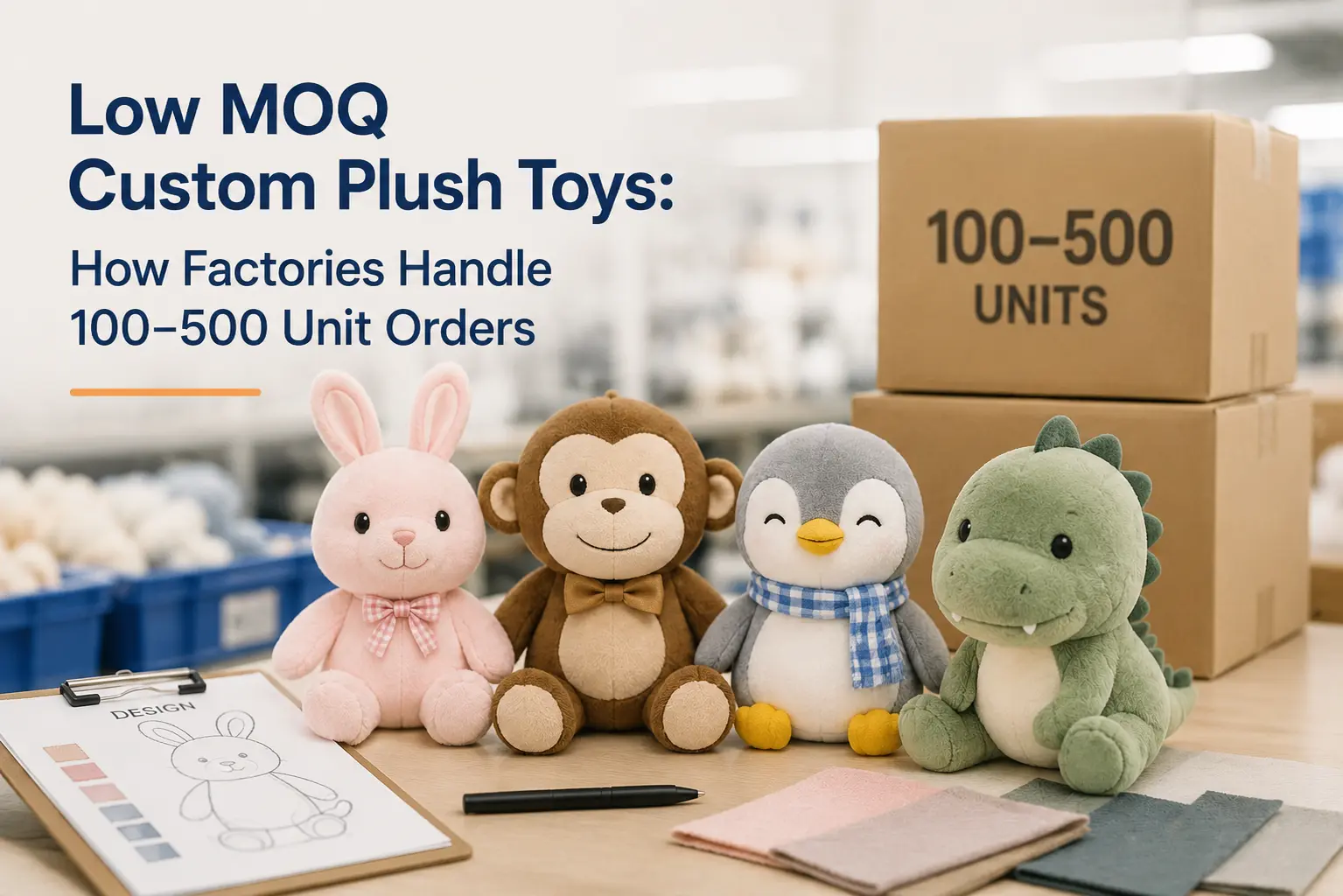
Low MOQ custom plush toys are small runs, usually 100 to 500 units per design. They let a brand test a product before betting on thousands of pieces. The one-time tooling and sample costs spread across fewer units, so each piece costs more. But the total cash at risk stays low. That makes it the smart entry point for a new SKU.
Every founder I’ve worked with wants the same thing. Test a design in the real world. Do it without betting the whole budget on a 3,000-unit container that might not sell. Good news: a flexible low-MOQ stuffed animal manufacturer can run you 100 to 500 pieces. The part nobody explains is why those units cost more each. And how to set up the order so the math still works. That’s what this guide is for.
Why Small Orders Cost More Per Unit
Plush manufacturing carries fixed setup costs. Those costs don’t care whether you order 100 pieces or 10,000. Divide them across a small run and each unit absorbs a bigger slice. This isn’t a factory padding its margin. It’s just arithmetic. Once you see the pieces, it stops feeling unfair.
- Pattern and sample. Drafting the 3D pattern and building a muestra de preproducción takes the same hours at any volume.
- Dies and digitizing. Embroidery digitizing and the cutting die are one-time charges. They don’t shrink for a small run.
- Material minimums. Mills sell fabric by the roll. Specialty dyeing has its own floor. A tiny order can pay for more fabric than it uses.
- Line changeover. Setting up and tearing down a line for a short batch is less efficient than one long run.
| Cantidad del pedido | Relative Per-Unit Cost | Mejor caso de uso |
| 100–300 | El más alto | Proof of concept, crowdfunding, event samples |
| 300–500 | Alto | Soft launch, boutique retail test |
| 500–1,000 | Moderate | Confident first retail run |
| 1,000–5,000 | Bajo | Established SKU, wholesale |
| 5,000+ | Mínimo | Mass retail, licensed programs |
How Factories Make Small Runs Viable
A factory that genuinely likes low-MOQ work has systems for it. It doesn’t treat your batch as a favor. When you weigh partners, watch for these signals. They separate a real small-order specialist from a place that pushes your run to the back of the queue.
- Shared stock. Keeping common minky, velboa, and PP cotton on hand kills the roll-minimum penalty. See the range on our tejidos habituales página.
- Standard parts. Reusing stock safety eyes, clips, and accesorios avoids custom-part minimums.
- Batch pooling. Grouping several small runs on one changeover spreads the setup cost around.
- Digital first. Confirming the pattern digitally cuts down on wasted physical samples.
Smart Strategies to Stretch a Low-MOQ Budget
You can bring the effective cost down without cheapening the product. These are the moves I hand first-time buyers who still want a premium feel.
- Simplify the design. Fewer color blocks and seams strip out sewing minutes. Those minutes are the biggest small-run cost.
- Use in-stock fabric. Skip custom dyeing on batch one. The soft-toy options already on the shelf are plenty.
- Start with a keychain. A mini plush keychain uses less material and often carries a lower MOQ. It’s a cheap way to test a character.
- Approve the sample first. Sign off one perfect golden sample before you commit the batch. It de-risks the whole run.
Once the test batch sells through, the numbers get friendlier fast. Move from 300 units to 3,000 and the per-unit cost drops sharply. Line that up against production timing with our bulk plush toy lead times guide. Then confirm the reorder path on the proceso de pedido página.
A Real Cost Picture: 300 Units vs. 3,000 Units
Numbers land harder than words. The table below is an illustrative model, not a live quote. But the shape of the curve is exactly what shows up on real quotations. Watch the fixed costs dominate the small run, then all but vanish at volume.
| Cost Element | 300 Units | 3,000 Units | What Changes |
| Tooling & sampling (fixed) | Spread over 300 | Spread over 3,000 | Same total, tiny per-unit share at volume |
| Material per unit | Standard | Slight bulk discount | Roll/dye minimums stop hurting you |
| Labor per unit | Higher (short run) | Lower (line efficiency) | Uninterrupted batch is cheaper |
| Effective per-unit price | El más alto | 30–50% lower | Economies of scale kick in |
| Total capital at risk | Bajo | Alto | The core small-batch advantage |
Read the last two rows together. The little run costs more per piece but risks far less cash. That’s the whole point of starting small. Prove demand, and the reorder rewards you. The tooling already exists, so the jump to 3,000 is cheaper per unit than your first 300 ever was. Confirm tier pricing on the proceso de pedido page before you scale.
Who Should Order Low MOQ, and Who Shouldn’t
Small-batch production is a tool, not a default. It’s genuinely wrong for some situations. It shines for a few clear ones, though.
- Great fit: crowdfunding fulfilment, boutique retail tests, event merch, influencer collabs, and proving a new character before you scale.
- Wrong fit: committed wholesale orders, an established SKU with real sell-through, or a licensed program with guaranteed demand. There, bulk pricing beats the capital you’d save going small.
Sitting in the middle? Run a 300 to 500 unit pilot. Prove the numbers. Then reorder at volume against the same approved golden sample so quality doesn’t drift between batches.
Low MOQ vs. Bulk: Choosing Your Entry Point
There’s no universally right answer here. Only the right one for your risk tolerance and your bank balance. A low-MOQ pilot protects capital and teaches you what buyers really think. A larger first order locks in a better unit price. But it only pays off if the demand is already there. Still deciding who to build with at all? Our hub guide on choosing a fabricante de peluches a medida frames that whole decision.
Pricing a Low-MOQ Product So It Still Turns a Profit
The higher per-unit cost only becomes a problem if you price like you ordered ten thousand. So don’t. Treat the pilot as a market test with its own margin logic.
- Price for the pilot. Cover the real small-run cost plus a proper margin. Buyers of a new product expect a premium, not a clearance price.
- Sell the story. Limited first editions or a founder’s-batch number justify a higher price. They also move units faster.
- Protect margin with simplicity. Every seam you remove widens the margin more on a short run than a long one.
- Model the blend. Plan margin across the pricey pilot and the cheaper reorder together. Early break-even units are funding the scale-up.
Done right, a low-MOQ launch isn’t a compromise. It’s how you earn the data and the cash flow that justify going big. When the numbers say go, come back to the fabricante de peluches a medida hub and scale with the same partner.
Preguntas frecuentes
What is the lowest MOQ for custom plush toys?
Flexible factories will take pilot runs as low as 100 pieces per design. Still, 300 to 500 is the more comfortable sweet spot. That’s where the per-unit cost starts to feel reasonable. Below 100, most factories can’t cover their setup.
Are low MOQ plush toys lower quality?
No. A small order runs through the same cutting, sewing, and control de calidad stations as a big one. Only the per-unit cost changes. The construction and safety don’t.
Can I reorder more units later at a lower price?
Yes, and you probably should. The tooling and patterns already exist after run one. So reorders skip most of the setup cost and qualify for volume pricing. Just keep your approved sample as the reference.
Conclusión
Low-MOQ plush toys take the risk out of the hardest moment in a product’s life. That’s the launch, before anyone has proven the market wants it. You pay more per piece. In exchange you protect your capital and learn from real buyers. And you keep the option to scale on your own terms. Find a factory that supports small runs. Keep the first design simple. Lock quality with a golden sample. Price the pilot to earn its keep. Do that, and 300 units become the smartest research budget you’ll ever spend.
- Start small to validate, not to shave cents off the per-unit cost.
- Simplify the design to protect margin, because short runs punish complexity most.
- Reorders are cheaper once tooling exists, so plan the scale-up from day one.
Sobre el autor
Jack Wilson is a plush toy sourcing and manufacturing specialist with over a decade of hands-on experience managing custom production across Chinese factories. He has guided dozens of new brands through their first low-MOQ runs into full retail programs, and writes to help B2B buyers source smarter. Start a project through the Proceso de pedido en plushtoys-factory.com.