
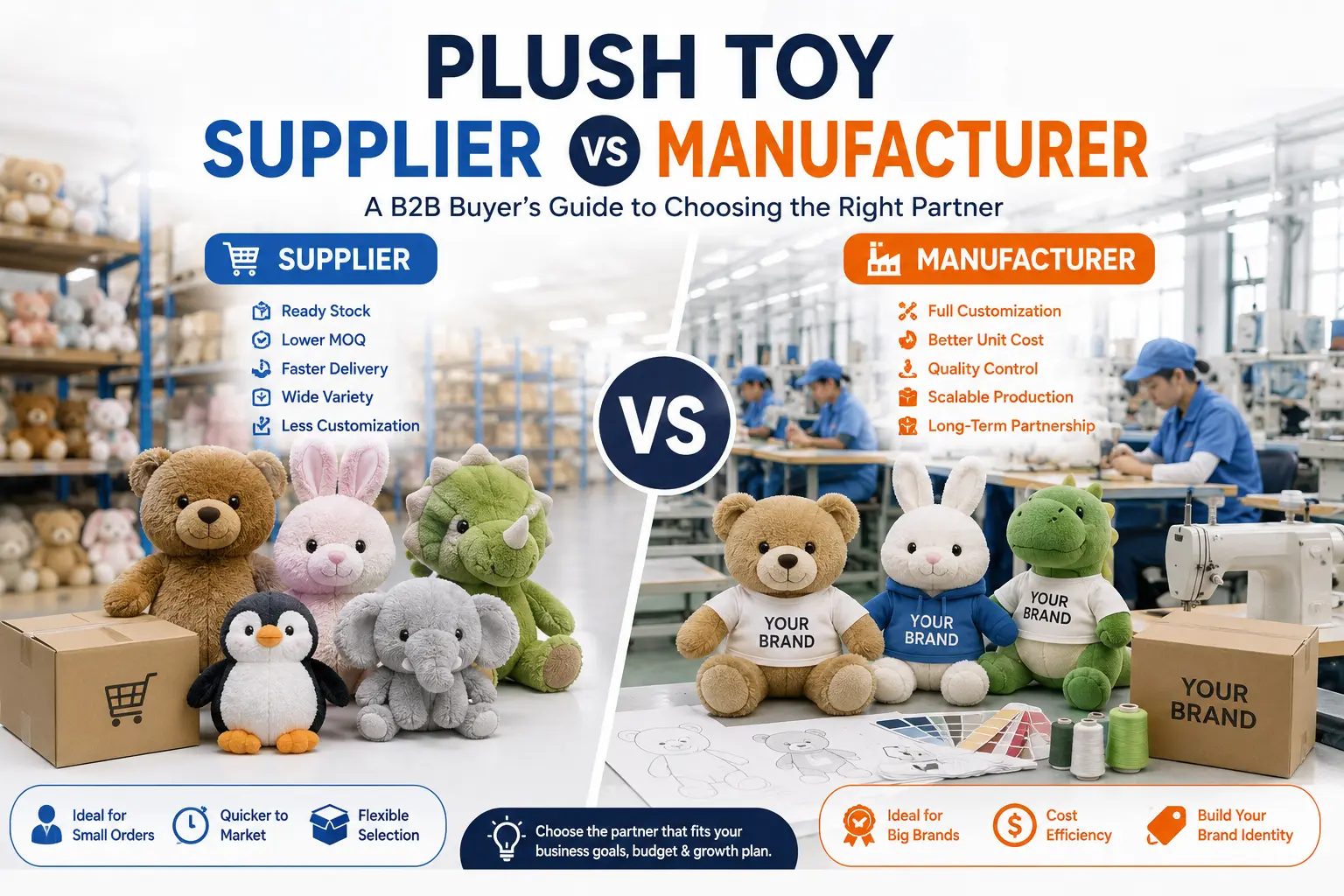
“I need a plush toy manufacturer.” I hear that sentence constantly, and about half the time the person saying it actually needs a supplier — or doesn’t know there’s a difference. It sounds like semantics. It isn’t. Whether you buy from a fabricante de peluches or a plush toy supplier shapes your price, your quality control, your minimums, and how much can go wrong between your purchase order and your loading dock.
I’ve sat on the sourcing side of enough deals to have seen both go beautifully and both go badly. This guide lays out the real difference, how to tell which one you’re actually talking to, and how to choose the right partner for the order you’re placing — not the order you imagine you’re placing.
Respuesta rápida: A plush toy manufacturer owns the factory and physically produces the toys; a plush toy supplier sources or resells toys, sometimes without owning production at all. Manufacturers usually offer better pricing, deeper customization, and direct quality control but higher minimums. Suppliers and trading companies offer flexibility, lower minimums, and convenience — at a markup and with less direct control.
What each term actually means
The words get used loosely, so let’s pin them down. These are the partner types you’ll actually encounter.
| Partner type | Owns production? | Typical role | Where they add value |
|---|---|---|---|
| Manufacturer (factory) | Sí | Makes the toys directly | Best price, full customization, direct QC |
| Trading company | No | Sources from factories on your behalf | Convenience, language, coordinating multiple products |
| Supplier / distributor | A veces | Sells stock or sources to order | Lower MOQs, faster for standard items |
| Agent / sourcing partner | No | Represents you, finds and vets factories | Advocacy, on-the-ground QC, negotiation |
The critical distinction is that first column: does this partner own the machines and the people making your toy, or are they a layer between you and whoever does? Neither is inherently better — but the answer changes everything about how you should work with them.
Manufacturer: when going direct wins
Buying directly from the factory that makes the plush has clear advantages, and for the right order they’re decisive.
Price. With no middle layer taking a margin, direct-from-factory pricing is usually the lowest available for a given quality. On a large order, that difference is substantial.
Customization depth. If you want a truly bespoke toy — your own character, specific materials, particular construction — you need to talk to the people who actually build it. A factory can engineer to your Ficha técnica del peluche; a reseller can only offer what they can find.
Direct quality control. When something’s wrong, you’re talking to the source, not a messenger relaying your complaint to a factory you’ve never met. That shortens the loop enormously.
The trade-off is minimums and hand-holding. Factories run efficiently at volume, so MOQs are higher, and a good factory expects you to arrive with a clear brief. If you’re placing a serious custom order at scale, direct is almost always the right answer — and knowing how to choose a reliable plush toy manufacturer becomes the most valuable homework you can do.
Supplier or trading company: when the middle layer earns its cut
Middlemen have a bad reputation they don’t always deserve. In the right situation, that markup buys you something real.
Lower minimums. A supplier holding stock, or aggregating several buyers’ orders, can often sell you a few hundred pieces where a factory wants a thousand-plus. For a small brand or a market test, that’s the difference between placing an order and not.
Convenience across multiple products. If you’re sourcing plush plus accesorios, llaveros, and packaging from different factories, a good trading company coordinates all of it, handles the language, and hands you one point of contact. That coordination has genuine value.
Speed on standard items. For a non-custom or lightly branded toy, a supplier with existing relationships or stock can move faster than starting a fresh factory relationship from zero.
The cost is exactly what you’d expect: you pay a markup, and you have less direct control and visibility. Sometimes that’s a smart trade. Sometimes it hides quality problems behind a friendly account manager.
How to tell which one you’re actually dealing with
This is the part that saves buyers real pain, because plenty of trading companies present themselves as “manufacturers.” A few questions cut through the fog fast:
- “Can I visit your factory / do a video walkthrough of the production line?” A real manufacturer can show you the floor. A trading company will get evasive or offer to “arrange it.”
- “What’s your monthly production capacity for this product?” Factories know their capacity cold. Resellers give vague answers.
- “Who handles quality control, and can I see in-line inspection photos?” Direct factories own this; middlemen relay it.
- “Can you make a change to the internal construction, not just the outside?” Only the people building it can truly answer.
None of this is about catching anyone out — it’s about knowing what you’re buying so you can price, plan, and control quality accordingly. A trading company that’s honest about being one can be a great partner; one pretending to be a factory is a red flag.
Matching the partner to the order
The right choice depends entirely on what you’re placing. Here’s the decision I’d actually make in each case.
| Your situation | Better fit | Why |
|---|---|---|
| Large, fully custom order | Manufacturer | Best price, full control, worth the higher MOQ |
| Small market test | Supplier | Lower minimum, less capital at risk |
| Multiple product types, one shipment | Trading company | Coordination across factories |
| Unique IP / licensed character | Manufacturer | Needs direct engineering and confidentiality |
| First-ever plush order, learning the ropes | Supplier or agent | Guidance and lower stakes |
| Repeat, high-volume program | Manufacturer | Margin and consistency compound over time |
The meta-lesson: the best buyers don’t marry one model. They start with a supplier or agent to learn cheaply, then move direct to a factory once volume and clarity justify it — the same graduation path smart brands follow across the whole sourcing journey.
Protecting yourself either way
Whichever partner you choose, a few safeguards are non-negotiable. Always get a pre-shipment inspection, whether it’s your own inspector or a third party — trust is earned across orders, not assumed on the first. Always confirm the safety compliance paperwork is real, current, and covers your market; ASTM F963 or EN71 obligations land on tú regardless of who you bought from, as our Guía de normas de seguridad explains. And always put your spec, tolerances, and quality expectations in writing before money moves. A great partner makes all of this easy. A bad one makes it complicated — and that reaction tells you most of what you need to know.
Preguntas frecuentes
What’s the actual difference between a plush toy manufacturer and a supplier?
A manufacturer owns the factory and physically produces the toys, so you’re dealing directly with the people cutting fabric and running the production line. A supplier — which can mean a trading company, distributor, or agent — sits between you and production, sourcing or reselling toys and sometimes owning no factory at all. The practical consequences are real: manufacturers typically offer lower prices, deeper customization, and direct quality control, while suppliers offer lower minimums and convenience in exchange for a mark-up and less direct visibility.
Is it always cheaper to buy directly from a manufacturer?
On a per-unit basis for a comparable product, direct-from-factory is usually the cheapest because there’s no middleman margin — but “cheaper per unit” isn’t the whole picture. Manufacturers require higher minimum order quantities, so for a small test order the total cost or the risk of over-buying can actually be worse than paying a supplier’s markup for a smaller run. The honest answer is that direct is cheaper at volume, while a supplier can be the smarter financial choice when your order is small or your demand is still unproven.
How can I tell if a “manufacturer” is really just a trading company?
Ask questions only a real factory can answer easily: request a live video walkthrough of the production floor, ask for their specific monthly production capacity on your product, and ask to see in-line quality inspection photos. A genuine manufacturer handles these effortlessly because they own the operation, while a trading company tends to get vague or offers to “arrange” access to a factory they don’t control. The goal isn’t to disqualify middlemen — an honest trading company is a fine partner — but to know exactly what you’re buying so you price and plan correctly.
Which is better for a small brand placing its first plush order?
For a genuine first order, a supplier, trading company, or sourcing agent is often the better starting point because the lower minimums keep your capital at risk small and you get guidance while you learn the process. Placing a large direct-from-factory order before you understand your own demand risks tying up cash in inventory that may not sell. The proven path is to start with a lower-stakes partner, learn what your market actually buys, and then move direct to a manufacturer once your volume and clarity justify the higher minimums.
Who is responsible for safety compliance — me or my supplier?
Legally, the responsibility lands on you, the brand or importer whose name is on the product, regardless of whether you bought from a factory or a middleman. A good partner will provide current test reports proving compliance with ASTM F963 in the US or EN71 in Europe, but you must verify those reports are real, up to date, and cover the exact product and market you’re selling into. Treating “my supplier handles it” as good enough, without seeing valid paperwork, is how brands end up with fines or seized shipments.
Sobre el autor
Zhang Wei has spent years helping B2B buyers navigate the plush supply chain, from vetting factories to untangling the difference between a real manufacturer and a middleman in a good suit. His work on the sourcing side has made him a firm believer that the right type of partner matters as much as the right partner — and that the biggest sourcing mistakes come from buying the wrong relationship, not the wrong toy. He writes about manufacturing, sourcing strategy, and toy safety for teams that want to buy smart.
Deciding how to source your next plush program? Start with our guide to choosing a reliable plush toy manufacturer, or tell us your order size and we’ll be straight with you about which model fits.