
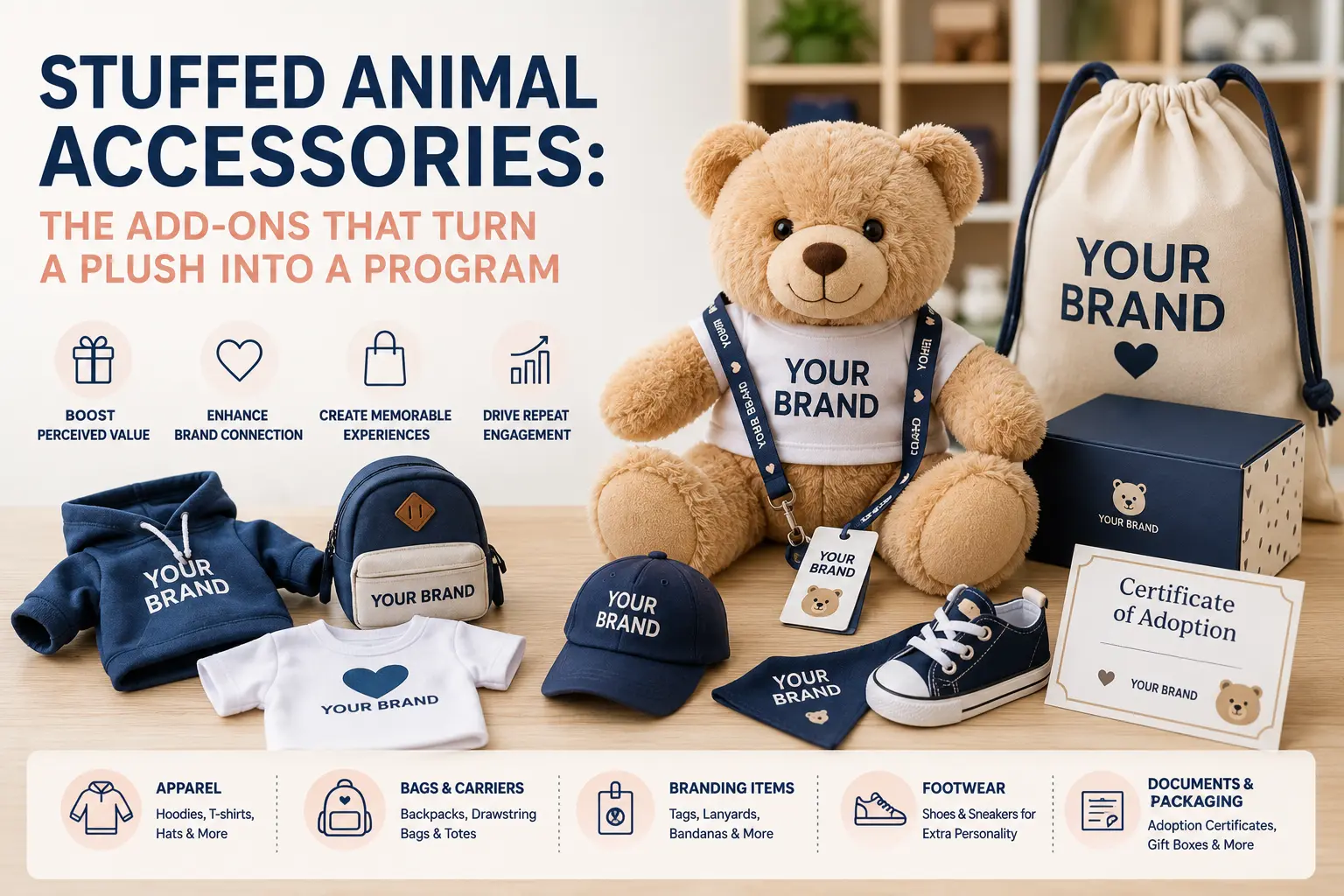
Here’s a pattern I’ve watched play out dozens of times. A brand launches a single hero plush, it sells fine, and then it just… sits there. No repeat purchases, no collection, no reason for a customer to come back. The brands that break that ceiling almost always do the same thing: they build an ecosystem of stuffed animal accessories around the toy.
Accessories are the quiet workhorse of the plush business. Little outfits, tiny backpacks, clip-on charms, keychains, and carriers cost a fraction of a full plush to make, yet they multiply the reasons a customer buys and re-buys. This guide covers what counts as a plush accessory, why they matter more than their price tag suggests, and how to source them without cluttering your line with junk nobody wants.
Quick answer: Stuffed animal accessories are small add-on products — outfits, keychains, clip-on charms, carriers, and themed props — designed to complement a plush toy. They boost average order value, drive repeat purchases, and extend a product’s life by turning a single toy into a collectible, customizable ecosystem.
Why accessories punch far above their cost
The economics are the whole story. A plush outfit or a clip-on charm might cost you a fraction of what the plush itself costs, but it can carry a healthy standalone retail price and pull the customer back to your store weeks after the original purchase. That’s the magic: accessories convert a one-time buyer into a returning one.
There’s a psychological lever underneath it, too. Once someone owns and loves a plush, they’ve made an emotional investment — and dressing it, accessorizing it, or completing its “set” feels like caring for something they already treasure. You’re not selling a new product from scratch; you’re selling a small upgrade to something they already love. That’s a much easier sale, and it’s exactly why the accessory attach rate can be so high when the range is designed well.
Accessories also solve the trend problem. A seasonal outfit or a limited charm refreshes an evergreen plush without the cost and risk of developing a whole new toy. You keep the hero product and re-merchandise it four times a year.
The main categories of plush accessories
Not every accessory earns its place. These are the categories that consistently pull their weight, and roughly what each is good for.
| Accessory type | Typical unit cost | Role in the range | Repeat-purchase power |
|---|---|---|---|
| Outfits & costumes | Low–medium | Personalization, seasonal refresh | High |
| Clip-on charms | Very low | Impulse add-on, collectibility | Very high |
| Mini plush companions | Low | “Buy the friend” upsell | Medium |
| Carriers & backpacks | Medium | Play value, gift-ability | Medium |
| Keychains | Very low | Entry price point, brand visibility | High |
| Themed props (food, hats) | Very low | Photo appeal, meme moments | Medium–high |
A couple of these deserve a note. Keychains blur the line between accessory and standalone product, and they’re one of the strongest entry points into a brand — we cover the sourcing side in our custom plush keychains guide. Themed props — the tiny orange hat, the little bowl of ramen — are underrated because they drive the customer photos that fuel organic reach. In a category where social sharing is a sales channel, a prop that makes a plush photograph well is doing marketing, not just adding SKUs.
The strategy: build a ladder, not a pile
The mistake I see most is treating accessories as a random grab-bag. “Let’s make some outfits” is not a plan. The brands that win think in terms of a ladder of price points and commitment levels.
At the bottom rung sits the impulse buy — a charm or keychain a customer adds without thinking. In the middle sit outfits and mini companions, the considered add-ons that deepen the relationship. At the top sit carriers or premium sets, the “I’m all in” purchase. Each rung feeds the next: the keychain buyer becomes the outfit buyer becomes the carrier buyer.
Crucially, accessories should be compatible. If every outfit fits every plush in your core size, you’ve built a system where any new plush instantly works with your entire back catalog of accessories. That compatibility is what turns a product line into a genuine platform, and it’s worth locking down your core body dimensions early — the same discipline that makes a good plush toy spec sheet so valuable.
Sourcing accessories: what’s different from sourcing plush
Accessories look simple, so buyers assume they’re trivial to source. They’re not — they’re just differently tricky.
Fit tolerance is everything. An outfit that’s a centimetre too tight won’t go on the plush, and a centimetre too loose looks sloppy. Because plush bodies are soft and slightly variable, accessory patterns need real tolerance built in and should be sampled on the actual production plush, not a drawing.
Small parts multiply your compliance load. Buttons, snaps, tiny zippers, and clip hardware are exactly the components toy safety testing scrutinizes. Every accessory aimed at children still has to clear ASTM F963 or EN71, and small detachable parts are the classic failure point. Our plush toy safety standards guide covers what applies — don’t assume a “simple” outfit skips testing.
MOQs behave differently. Because accessories are small and material-light, some factories will run them at lower minimums than full plush — but setup and tooling for snaps or printed fabric still need a base volume. Below are realistic planning ranges.
| Accessory | Typical MOQ | Unit cost band | Sample lead time |
|---|---|---|---|
| Clip-on charm | 500–1,000 | Very low | 7–10 days |
| Fabric outfit | 500 | Low–medium | 10–14 days |
| Mini plush companion | 500–1,000 | Low | 10–14 days |
| Backpack/carrier | 300–500 | Medium | 12–18 days |
Sourcing accessories from the same factory that makes your core plush is usually the smart move — they already have your body dimensions, your fabric, and your color standards, which keeps everything consistent and the fit correct.
Merchandising: where the money actually shows up
Great accessories sourced badly still fail if you merchandise them wrong. Two rules I’d tattoo on every product page. First, always show the accessory on the plush, never floating alone — customers need to see the payoff. Second, bundle strategically at the top of the funnel (a plush-plus-starter-outfit set as the flagship) while keeping charms and keychains as standalone impulse adds at checkout.
Done right, the accessory range does something a single plush never can: it gives your best customers a reason to keep coming back, and it turns your evergreen hero into a product that quietly earns for years.
Frequently asked questions
Do stuffed animal accessories actually increase revenue, or just add complexity?
When they’re built as a coordinated system rather than a random assortment, they reliably lift revenue in two ways: they raise the average order value at the first purchase, and they bring customers back for repeat buys long after. The key word is coordinated — a ladder of compatible price points from impulse charms up to premium carriers gives every customer a natural next step. A scattered pile of unrelated add-ons, on the other hand, just adds inventory complexity without the sales lift.
Can I make accessories that fit plush toys I’ve already sold?
You can, as long as you designed to a consistent core body size, which is exactly why locking down your standard dimensions early matters so much. If your existing plush shares a common size, new outfits and carriers can be patterned to fit the whole back catalog, instantly making every past product part of the new ecosystem. If your earlier toys were all different sizes with no standard, retrofitting accessories becomes far harder and you may need size-specific versions.
Do small accessories like outfits and charms need safety testing?
Yes — if the accessory is intended for or appealing to children, it falls under the same standards as the toy itself, ASTM F963 in the US or EN71 in Europe. In fact, accessories often carry more compliance risk than the plush because of their small parts: buttons, snaps, tiny zippers, and clip hardware are precisely what testing targets as choking or detachment hazards. Never assume a simple-looking outfit is exempt; build testing into the plan from the start.
Should I source accessories from the same factory as my plush?
In most cases, yes. Your plush factory already holds your exact body dimensions, fabric specs, and color standards, which means outfits fit correctly and colors match across the whole range. Splitting accessories to a separate supplier introduces fit and color-consistency risk, plus extra coordination overhead. The main exception is a specialized item — a technical backpack with hardware, say — that a dedicated accessory maker genuinely does better.
What’s the single most underrated plush accessory?
Themed props — the tiny hat, the little food item, the miniature prop that matches a meme or season. They cost very little to make but they do something no other accessory does: they make the plush photograph well, and customer photos are one of the strongest organic sales channels in this category. A prop that gives buyers a reason to post their plush is effectively paying for your marketing while also carrying its own margin.
About the author
Zhang Wei helps plush brands think beyond the single hero product, with a focus on the accessory ecosystems that turn one-time buyers into collectors. His background on the manufacturing side means he approaches accessories the way a factory does — obsessing over fit tolerance, compatibility, and the small-parts details that make or break both safety and sell-through. He writes about product strategy, sourcing, and toy safety for brands building lines that last.
Want to build an accessory range around your core plush? Explore our plush toy accessories or send your core body dimensions for a compatibility check.