
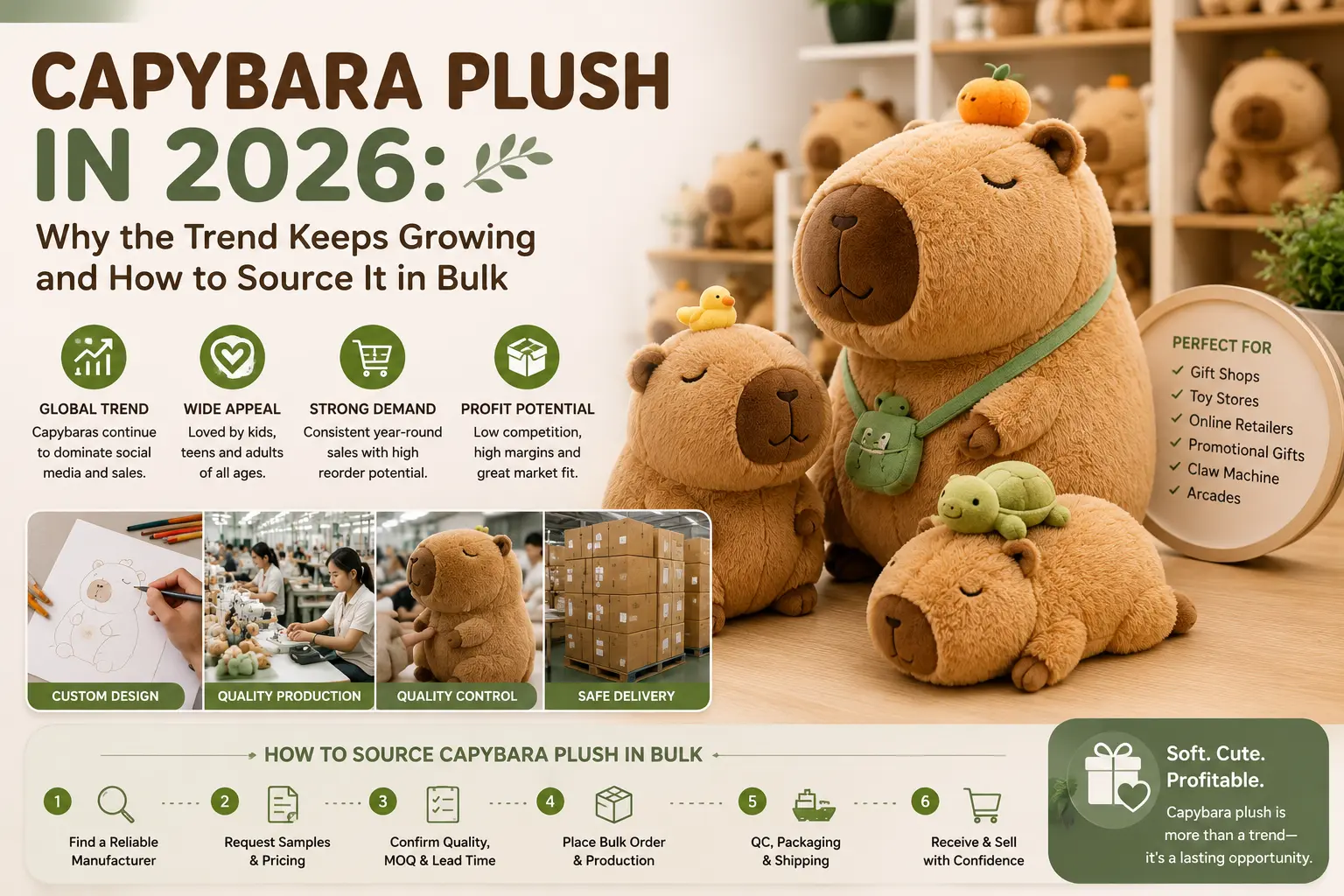
A few years ago, if you’d told a buyer that a stocky South American rodent would outsell teddy bears in certain gift channels, they’d have laughed. Then the capybara happened. The world’s largest rodent — calm, chunky, permanently unbothered — turned into an internet mascot for staying relaxed while everything around you falls apart, and the capybara plush rode that wave straight onto retail shelves.
The interesting part, and the reason I’m writing this for buyers rather than fans, is that the trend hasn’t cooled the way most meme products do. It’s matured. That changes how you should source it. This guide covers why the capybara plushie still has legs in 2026, what a good version actually looks like, and how to buy bulk capybara plush without getting stuck with the wrong SKUs.
Quick answer: Capybara plush toys remain a strong seller in 2026 because the character crossed over from a passing meme into a stable “calm/cozy” lifestyle icon. For bulk sourcing, expect MOQs of 500–1,000 per size, unit costs of roughly $2.50–$8.00 depending on size, and the best sell-through from a small size range (keychain, sitting, jumbo) rather than a single hero size.
Why capybara didn’t fade like other meme toys
Most viral toys follow a spike-and-crash curve. The capybara didn’t, and understanding why helps you forecast demand instead of guessing.
First, it detached from any single piece of content. Fidget spinners needed the fad; the capybara became a mood — “unbothered,” “zen,” “just vibing.” Moods outlast memes because people keep needing them. Second, it’s genuinely well-suited to plush. That rounded, loaf-like body is easy to make huggable and instantly recognizable in silhouette, even at keychain scale. Third, it slots neatly into the broader cozy-plush and blind-box movements we’ve tracked in our viral plush toy trends coverage, so it rides adjacent trends rather than standing alone.
For a buyer, the takeaway is simple: this is a character you can build a small range around, not a one-and-done novelty.
What a good capybara plush actually looks like
The market is now crowded, which means a mediocre capybara gets ignored. The winners get a few specific things right, and these are the details worth pushing your factory on.
| Feature | Cheap version | Version that sells |
|---|---|---|
| Body shape | Round blob, no structure | Flat-bottomed “loaf” that sits upright on its own |
| Face | Printed, flat | Low-set embroidered eyes and nostrils with a subtle muzzle |
| Fabric | Shiny short-pile velboa | Matte super-soft or minky in a warm brown |
| Weighting | Fully loose fill | Light pellet base so it plants and stays put |
| Accessories | None | Optional orange-slice hat or yuzu topper (the signature meme detail) |
That last row matters more than it looks. The “capybara with an orange on its head” is a recognized meme motif, and offering it as a variant gives collectors a reason to buy two. The upright sitting posture is the other quiet winner — a capybara that flops over face-first photographs badly, and in this category the customer’s phone camera is your real sales channel.
Fabric choice makes or breaks the hand-feel. A warm, matte brown super-soft plush reads “premium cozy,” while a shiny velboa reads “claw machine.” If you’re weighing options, our comparison of minky, velboa and super-soft plush breaks down exactly how each reads in the hand and on camera.
Sizing strategy: the mistake almost everyone makes
Here’s where buyers lose money. They fall for one size — usually the big cuddly 40 cm version — order deep, and discover the keychain and mid-size were the volume drivers. Capybara sells as a ladder, and each rung does a different job.
- Keychain (10–13 cm): the impulse buy and the free advertising. Lowest cost, highest attach rate. Pairs perfectly with a broader plush keychain program.
- Sitting plush (20–28 cm): the core SKU. This is the desk companion and the gift, and it’s usually your best margin-to-velocity balance.
- Jumbo (40 cm+): the hero shot and the photo prop. Lower volume, but it anchors the display and drives the “aww” that pulls people to the smaller sizes.
Order the middle deep, the keychain medium, and the jumbo shallow. Let the first sell-through tell you where to reorder rather than betting the whole budget on one size.
Sourcing bulk capybara plush: costs and lead times
These ranges reflect typical B2B pricing for a well-made capybara across common sizes. Use them to sanity-check quotes.
| Size | Typical unit cost (1,000 pcs) | Suggested retail | Common MOQ |
|---|---|---|---|
| Keychain 10–13 cm | $1.80 – $2.80 | $9 – $14 | 500 |
| Sitting 20–28 cm | $3.50 – $5.50 | $22 – $32 | 500 |
| Large 35–40 cm | $6.00 – $8.00 | $40 – $55 | 300–500 |
| Jumbo 60 cm+ | $12.00 – $20.00 | $75 – $120 | 200–300 |
A few planning notes. Sampling runs about 1–2 weeks, bulk production 30–45 days depending on total quantity, and ocean freight adds several weeks on top — so a launch you want on shelves for the holidays needs to be locked by late summer. If you’re building a full budget, our custom plush toy manufacturing cost breakdown shows how fabric, size, and detailing each move the number.
Because capybara is a “trend-adjacent” product, I’d also weigh air-freighting a small first drop to test the market fast, then following with an ocean bulk once you’ve confirmed which sizes move. It costs more per unit up front but de-risks the big order.
Don’t forget compliance
A capybara plush is still a stuffed toy, and if it’s aimed at children it needs to meet ASTM F963 in the US or EN71 in Europe — the embroidered eyes, any pellet fill, and small accessory parts all get tested. If you’re selling into the US, factor testing into both your timeline and your landed cost; our plush toy safety standards guide walks through what applies. Getting this right up front is far cheaper than a shipment held at the border.
The realistic outlook for 2026
I won’t pretend the capybara will trend forever — nothing does. But it has done the rare thing of converting from meme to staple, which means steady, plannable demand rather than a spike. Treat it like a category you’ll carry, keep the range tight and well-made, and refresh it with seasonal variants (a Santa-hat capybara moves in December) instead of chasing whatever the next rodent is. That’s how you keep a trend product earning long after the hashtag cools.
Frequently asked questions
Is the capybara plush trend still worth investing in for 2026?
Yes, and the reason is that it stopped behaving like a meme and started behaving like a staple. The character now represents a durable “calm and cozy” mood rather than a single viral moment, so demand has flattened into something steady and forecastable instead of spiking and crashing. The smart play is to carry it as an ongoing line with seasonal refreshes rather than betting on a single huge one-time buy.
What size of capybara plush sells best?
The mid-size sitting version, roughly 20–28 cm, is almost always the volume and margin sweet spot because it works as both a desk companion and a giftable price point. That said, the real answer is a size ladder, not a single winner — the keychain drives impulse sales and free visibility, while the jumbo anchors your display and photographs well. Order the middle size deep and use the others to support it.
How much does bulk capybara plush cost per unit?
For a well-made piece at around 1,000 units, expect roughly $1.80–$2.80 for a keychain, $3.50–$5.50 for a mid-size sitting plush, and $6–$8 for a large version. Prices drop as your quantity climbs and rise with size, fabric quality, and added detailing like the signature orange-slice hat. Always confirm whether tooling and packaging are bundled into the quote or billed separately on the first order.
What makes one capybara plush look better than another?
It comes down to posture, face, and fabric. The best versions have a flat-bottomed loaf shape that sits upright on its own, low-set embroidered eyes with a subtle muzzle rather than a flat print, and a warm matte super-soft or minky fabric instead of a shiny short pile. A light pellet base that keeps it planted upright is the detail that makes it photograph well — and in this category, customer photos are your marketing.
Do I need safety testing for capybara plush toys?
If the product is intended for or appealing to children, absolutely — it’s legally a stuffed toy and must pass ASTM F963 in the US or EN71 in Europe. The embroidered features, any bean-pellet fill, and small accessory parts are exactly what testing scrutinizes. Build the testing time and cost into your plan from day one, because discovering a compliance gap after production is expensive and can strand an entire shipment.
About the author
Zhang Wei works at the intersection of trend forecasting and plush toy manufacturing, helping brands and retailers turn viral characters into products that actually sell through. He’s watched plenty of toy fads spike and vanish, which is why he pushes buyers to size their orders around real sell-through data rather than hype. He writes about sourcing strategy, product development, and toy safety for teams that want to ride a trend without getting stuck holding the inventory.
Curious what a capybara program would cost for your channel? Browse our capybara plush series or send us your target sizes for a quote.