
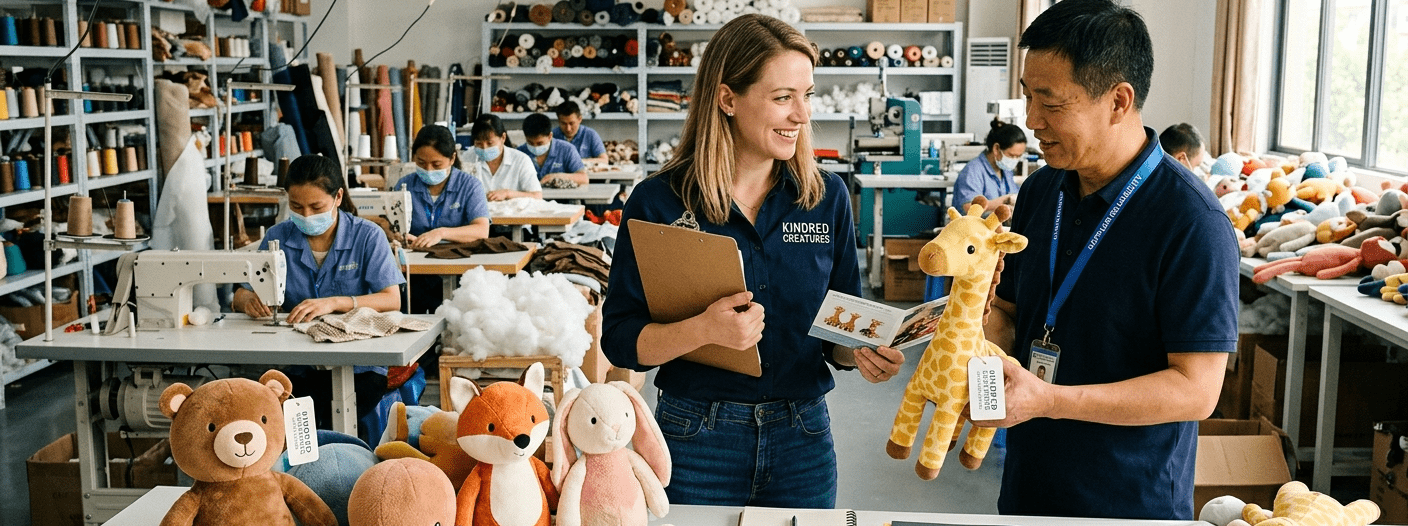
What Makes a Good Plush Toy Supplier in 2026?
A reliable plush toy supplier is a manufacturer or sourcing partner that consistently delivers product matching the pre-approved sample, at the agreed unit cost, within the committed lead time, with all required safety documentation in place before shipment. That definition sounds obvious, but inconsistency across one or more of those four criteria is the most common reason USA brands switch suppliers.
The global stuffed animals and plush toy market was valued at $13.68 billion in 2025 (Grand View Research, 2025). Within that market, the USA is the largest single-country consumer. American brands sourcing plush from overseas manufacturers place orders totaling hundreds of millions of dollars per year, and supply chain disruptions in 2020 through 2024 forced many brands to reevaluate their supplier relationships.
Factory-Direct vs Trading Company: Which Plush Toy Supplier Is Better?
A factory-direct plush toy supplier manufactures the product in-house. They own or operate the cutting, sewing, stuffing, and finishing equipment. When you order from a factory-direct supplier, your margin benefit is direct: no trading company markup (typically 15% to 25% of factory cost). Communication goes to the people who actually make the product. Problem-solving is faster because decisions happen at the point of production.
A trading company acts as an intermediary. They source from multiple factories, provide a single point of contact for buyers who need multiple product categories, and often manage the export documentation and logistics.
For most USA brands building a plush toy product line, a direct factory relationship is the right structure after the initial sourcing phase. A plush toys factory with in-house capability can absorb order growth, respond to quality issues at the production level, and offer genuine exclusivity on custom designs.
Eight Criteria for Vetting a Plush Toy Supplier
- In-House vs Outsourced Production — Ask directly: does your factory cut, sew, stuff, and finish in-house? Request photos of the production floor. Our production process page shows every stage of our in-house operation.
- Current Third-Party Safety Certifications — Request ASTM F963 and EN71 test reports dated within the past 12 months from an accredited lab.
- Factory Audit Documentation — BSCI, SEDEX, or ISO 9001 audit reports confirm the factory operates to documented labor and quality management standards.
- Sample-to-Bulk Quality Consistency — Ask the factory how it ensures production consistency: what is the inline QC frequency? What AQL standard is used for pre-shipment inspection?
- NDA and IP Protection Policy — Ask to see the factory’s standard NDA before sharing any design files.
- Production Capacity — Ask for current monthly production capacity and utilization rate. A factory at 90% utilization has little flexibility for rush orders.
- Communication Speed and Accountability — Response time during the sourcing phase predicts behavior during production.
- References from USA Buyers — Ask for the names and contact details of two or three existing USA clients with order histories of 12 months or longer.
How to Verify Compliance Certifications for Plush Toy Suppliers
- Check the lab accreditation — Any test report should name a recognized accredited laboratory: Intertek, SGS, Bureau Veritas, UL, or TUV Rheinland.
- Confirm the test scope matches your product — A test report for a 15 cm stuffed bear does not cover a 5 cm keychain bear. See our plush keychains page for keychain-specific product specifications.
- Check the issue date — ASTM F963 was most recently revised in 2023 (ASTM F963-23). Test reports referencing older versions may not reflect current requirements.
- Verify CPC status for children’s products — For plush toys sold to children under 12 in the USA, the importer of record must have a Children’s Product Certificate on file.
- Cross-reference factory audit status — BSCI and SEDEX maintain publicly searchable databases.
MOQ, Pricing, and Lead Time: What to Expect from a Plush Toy Supplier
| Product Type | MOQ | Unit Cost (500 pcs FOB) | Lead Time |
| 15 cm stuffed animal, standard velboa | 300-500 pcs | $4.00 – $7.00 | 35-45 days |
| 25 cm stuffed animal, premium minky | 500 pcs | $8.00 – $14.00 | 40-50 days |
| 10 cm plush keychain | 300 pcs | $2.50 – $5.00 | 30-40 days |
| 30 cm soft toy with accessories | 500 pcs | $10.00 – $18.00 | 45-55 days |
For stuffed animal options across size and fabric ranges, browse our soft toys and custom plush stuffed animal pages. For keychain-specific pricing, visit our keychains catalog. Full fabric and material pricing context is available on our common fabrics page.
Red Flags That Signal an Unreliable Plush Toy Supplier
- Sample fees that are not refundable against the bulk order — Reputable factories credit sample fees against production.
- Unwillingness to sign an NDA before receiving design files — Resistance to IP protection is a signal.
- Bulk pricing dramatically below market range — If a quote is 40% below market, it will be explained by lower-grade materials or production subcontracting.
- No physical factory address with verifiable presence — Trading companies sometimes present as factories.
- Bulk production quality significantly below sample quality.
- Unclear or verbal communication on lead times — Every date commitment should be documented in writing.
- No references from current customers.
- Pressure to skip pre-production sampling — A supplier pushing you to proceed directly to bulk production is eliminating your only checkpoint before committing full order costs.
Plush Toy Supplier Types Comparison
| Supplier Type | MOQ | Per-Unit Cost | Quality Control | Best For |
| Factory-Direct | 100-500 pcs | Lowest | In-house, direct control | Brands with clear designs |
| Trading Company | 50-200 pcs | Medium (markup added) | Outsourced | Multi-category sourcing |
| Agent-Managed Factory | 300-1,000 pcs | Low to medium | Factory + agent oversight | First-time importers |
| Domestic Distributor (US) | 24-144 pcs | Highest | Pre-inspected inventory | Speed and compliance simplicity |
FAQ: Plush Toy Supplier Selection
How do I find a reliable plush toy supplier for my USA brand?
Start with supplier directories that require factory verification: Alibaba’s verified manufacturer program, Global Sources, and Made-in-China.com. Cross-reference any supplier against their factory audit documentation and request current ASTM F963 test reports before requesting samples. Referrals from other USA brand buyers are the most reliable starting point.
What is the difference between a plush toy factory and a plush toy supplier?
A plush toy factory is a manufacturer with in-house production equipment and workforce. A plush toy supplier is a broader term that includes factories, trading companies, and import distributors. Working directly with a factory typically delivers lower cost and faster problem resolution.
How do I verify that a plush toy supplier is ASTM compliant?
Request the original test reports from the factory. Each report should name an accredited testing laboratory, include a specific issue date, identify the exact product tested, and reference the relevant ASTM F963 clause for each test.
Can a small USA brand get a low MOQ from a plush toy supplier?
Yes. Factories with flexible programs accept MOQs from 100 to 300 units for standard designs. MOQs below 100 units are generally only available for ODM in-stock designs or samples.
What payment terms do plush toy suppliers typically require?
Standard payment terms are 30% deposit before production begins and 70% balance payment before shipment release. Letter of Credit is accepted by most mid-size and large factories. Wire transfer (T/T) is the most common payment method for initial orders.
How long does it take to qualify a new plush toy supplier?
A thorough supplier qualification process takes 4 to 8 weeks: 1 to 2 weeks for document review, 1 to 2 weeks for sample production and evaluation, 1 to 2 weeks for safety compliance verification, and 1 to 2 weeks for a trial order.
Should I use a sourcing agent or approach factories directly?
A sourcing agent adds value when you lack language capability, need multi-factory sourcing, or are navigating the market for the first time. For brands with clear product specifications and repeat order history, direct factory relationships offer better cost, communication, and quality control.