
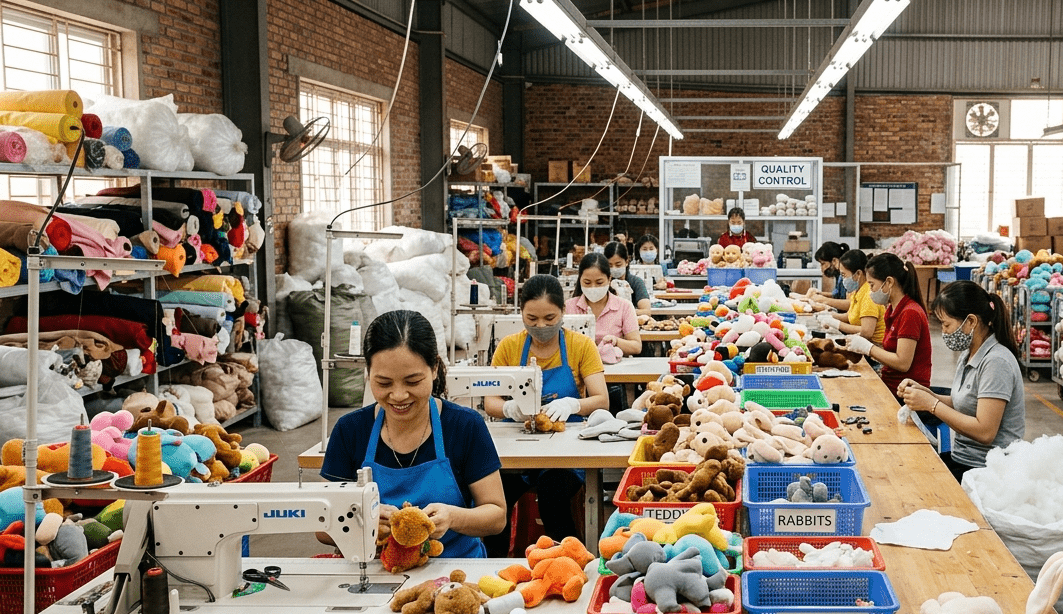
What Is Soft Toys Manufacturing and How Does It Work?
Soft toys manufacturing is the industrial process of designing, cutting, sewing, stuffing, and finishing plush stuffed animals, fabric dolls, and textile products for retail, promotional, and commercial use. The global market for soft toys was valued at $13.68 billion in 2025 (Grand View Research, 2025) and is expanding at an 8.4% CAGR through 2033, driven by adult collectors, branded merchandise programs, and sustained gifting demand in the USA.
At its core, the soft toys manufacturing process runs through seven distinct stages: design and pattern making, fabric cutting, component sewing, stuffing, finishing, safety testing, and final packaging. Each stage requires specialized equipment and trained labor. A full-service plush toys factory handles all seven stages in-house, which gives brands consistent quality, faster communication, and shorter lead times compared to split-vendor supply chains.
Stage 1: Design, Pattern Making, and Pre-Production Samples
The soft toys manufacturing process begins before a single piece of fabric is cut. Design and pattern making account for 20% to 30% of total development time but determine the quality ceiling for everything that follows.
Design development starts with a concept brief from the buyer. A capable plush toys factory converts that brief into 2D design sketches, then into a technical design pack including front view, back view, side view, dimensions for each component, color specifications in Pantone codes, embroidery detail maps, and material callouts.
Pattern making translates the 2D design into individual flat fabric templates for each component. An experienced pattern maker adjusts seam allowances, accounts for fabric stretch, and considers stuffing pressure to ensure the finished product matches the design intent.
Pre-production sampling produces a physical prototype before any bulk material is ordered. A skilled plush toys factory produces the first sample in 7 to 10 working days after design confirmation. Sample fees typically range $80 to $200 depending on complexity and are credited toward the bulk order.
Stage 2: Fabric Selection and Material Sourcing
Fabric selection in soft toys manufacturing directly affects the finished product’s feel, durability, safety compliance, and retail price positioning.
- Velboa (short-pile polyester) — the most widely used plush fabric in global soft toy production. Smooth, consistent surface that accepts embroidery cleanly.
- Minky (long-pile microfiber) — the premium option. Ultra-soft surface and longer fiber length create a distinctly luxurious hand feel. Used for collectible lines and adult-market products.
- Sherpa and teddy fur — replicate the texture of natural animal fur, used for realistic stuffed animals and high-end gift products. See how these fabrics are applied in our scented posture pal plush toys range.
- RPET (recycled polyester) — manufactured from post-consumer plastic bottles, carries OEKO-TEX or GOTS certification. Increasingly specified by US retail partners with sustainability mandates.
- Cotton and cotton-blend — used for rag dolls, children’s fabric toys, and educational soft toys where a natural fiber hand feel is required.
Stage 3: Cutting, Sewing, and Assembly
Fabric cutting is performed using either manual die-cutting (for simple shapes) or computer-controlled CNC cutting machines (for precision on complex multi-part designs). CNC cutting reduces material waste by 8% to 15% compared to manual cutting and improves component dimensional consistency.
Assembly follows a documented sequence. Facial features are embroidered or attached before the head is closed. Limbs are sewn, turned right-side-out, lightly pre-stuffed, and attached to the body before the final body seams are closed. Sound modules, scent packs, or weighted pellet inserts are placed at this stage. Browse our Wobble & Squeak Puppy line to see how sound modules are integrated into a finished soft toy product.
Stage 4: Stuffing, Shaping, and Finishing
Commercial soft toy manufacturing uses pneumatic stuffing machines that blow fiberfill into the toy cavity in controlled quantities. The operator shapes the toy during and after filling to match the sample proportions before the closure seam is sewn shut.
Finishing operations include: hand-trimming loose threads at every seam, brushing pile fabric to restore surface uniformity, cleaning surface marks from production handling, attaching sewn-in labels and hang tags, and performing needle detection before moving to QC. Our plush toy accessories page covers the full range of label, tag, and hardware options available at this stage.
Needle detection is non-negotiable in responsible soft toy manufacturing. Every finished toy passes through a metal detector calibrated to detect broken needle fragments as small as 0.8 mm.
Stage 5: Quality Control and Safety Testing
A multi-stage quality control process in soft toy manufacturing prevents defective units from reaching the buyer. In a professionally run plush toys factory, QC happens at four checkpoints: inline QC during production, pre-stuffing QC, post-finishing QC, and pre-shipment QC.
For USA children’s products, the manufacturer must also provide third-party safety test reports from an accredited laboratory covering ASTM F963 and CPSIA requirements.
Stage 6: Packaging and Export Logistics
Packaging in soft toy manufacturing serves three functions: retail presentation, protection during transit, and brand communication. For USA-bound products, packaging must carry the required CPSIA tracking label information.
Standard packaging options include: OPP poly bags, hang-tag and barcode labels for retail hook display, individual retail gift boxes, and polybag-plus-hang-tag combinations. Shipping terms most commonly used for USA soft toy imports: FOB, CIF, and DDP.
Soft Toys Manufacturing Methods Comparison
| Method | MOQ | Lead Time | Best For | Key Consideration |
| OEM (Your Design) | 300-500 pcs | 35-45 days | Brand merchandise | Requires design artwork or brief |
| ODM (Factory Design) | 100-300 pcs | 20-30 days | Fast market entry | Limited exclusivity |
| Licensed Design | 1,000+ pcs | 45-60 days | IP-based products | Requires license agreement |
| Prototype Only | 1-5 pcs | 10-15 days | Concept validation | Per-unit cost is 10-15x bulk |
| Fully Custom | 500-1,000 pcs | 40-55 days | Premium product lines | Highest design flexibility |
FAQ: Soft Toys Manufacturing
How long does soft toy manufacturing take?
Standard soft toy manufacturing takes 35 to 55 calendar days from initial inquiry to factory-ready shipment: 2 to 3 days for quotation, 7 to 10 days for sampling, 2 to 5 days for sample review, and 15 to 30 days for mass production. Air freight adds 5 to 7 days; ocean freight adds 18 to 25 days to US ports.
What is OEM vs ODM in soft toy manufacturing?
OEM means the factory produces your proprietary design — you own the design and the molds. ODM means the factory produces from its own existing designs, which you select and optionally brand. OEM offers full exclusivity. ODM offers lower cost and faster start with limited design differentiation.
What is the minimum order quantity for soft toy manufacturing?
MOQs vary by design complexity. Simple ODM designs start at 100 to 300 units. Custom OEM designs start at 300 to 500 units. Fully custom designs with unique fabrics start at 500 to 1,000 units.
What safety standards apply to soft toys sold in the USA?
Soft toys sold as children’s products in the USA must comply with ASTM F963 and CPSIA. These require third-party testing and a Children’s Product Certificate. Adult-use promotional soft toys are subject to lighter regulation but most US retailers still require ASTM compliance documentation.
What fabrics are used in commercial soft toy manufacturing?
The five most common fabrics are: velboa (standard short-pile polyester), minky (ultra-soft long-pile microfiber), sherpa (texture fabric for realistic animal designs), RPET (recycled polyester for eco-positioned products), and cotton-blend (for natural fiber toys).
How do I protect my design in soft toy manufacturing?
Design protection starts with a signed NDA before transmitting any artwork or specifications to the factory. For commercially valuable original characters, register the design with the USPTO or Copyright Office. Always confirm NDA terms are in place before sharing design files with any manufacturer.